
Four Treasures Reference Database
Record No. 27935
Lapis bufonis: The growth and decline of a medical superstition
Journal Article
Forbes, T.R. (1972) Lapis bufonis: The growth and decline of a medical superstition. Yale Journal of Biology and Medicine, Vol. 45, No. 2, April, pp. 139–149.
ISBN/ISSN: 440086 | Sinkankas/Born No.: NIS/NIB | Language: eng | RWHL
gems, organic gems, toadstone, medicinal gems, lore, Middle Ages, Medieval gems, amulets
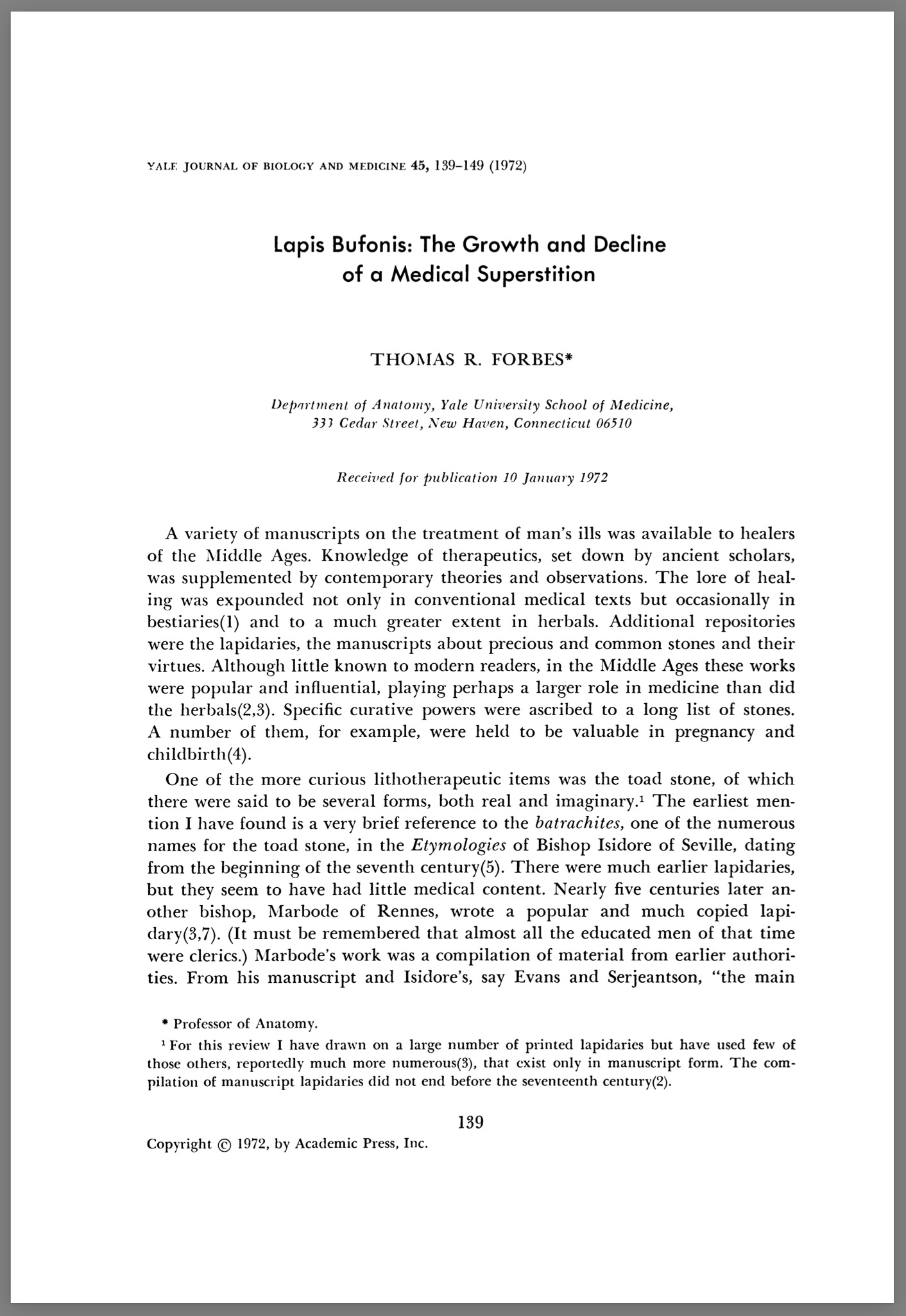
A variety of manuscripts on the treatment of man’s ills was available to healers of the Middle Ages. Knowledge of therapeutics, set down by ancient scholars, was supplemented by contemporary theories and observations. The lore of healing was expounded not only in conventional medical texts but occasionally in bestiaries and to a much greater extent in herbals. Additional repositories were the lapidaries, the manuscripts about precious and common stones and their virtues. Although little known to modern readers, in the Middle Ages these works were popular and influential, playing perhaps a larger role in medicine than did the herbals. Specific curative powers were ascribed to a long list of stones. A number of them, for example, were held to be valuable in pregnancy and childbirth. One of the more curious lithotherapeutic items was the toad stone, of which there were said to be several forms, both real and imaginary. The earliest mention I have found is a very brief reference to the batrachites, one of the numerous names for the toad stone, in the Etymologies of Bishop Isidore of Seville, dating from the beginning of the seventh century. There were much earlier lapidaries, but they seem to have had little medical content. Nearly five centuries later another bishop, Marbode of Rennes, wrote a popular and much copied lapidary. (It must be remembered that almost all the educated men of that time were clerics.) Marbode’s work was a compilation of material from earlier authorities. From his manuscript and Isidore’s, say Evans and Serjeantson, “the mainstream of the mediaeval tradition of the virtues of stones is derived.” But Marbode does not mention the toad stone.