
Four Treasures Reference Database
Record No. 27940
Lapidary formulas as topics of invention: From Thomas of Hales to Henryson
Journal Article
Bishop, I. (1986) Lapidary formulas as topics of invention: From Thomas of Hales to Henryson. Review of English Studies, Vol. 37, No. 148, pp. 469–477.
ISBN/ISSN: 346551 | Sinkankas/Born No.: NIS/NIB | RWHL
gems, early lapidaries, early gemology, early mineralogy, Albertus Magnus, Thomas of Hales, pearl
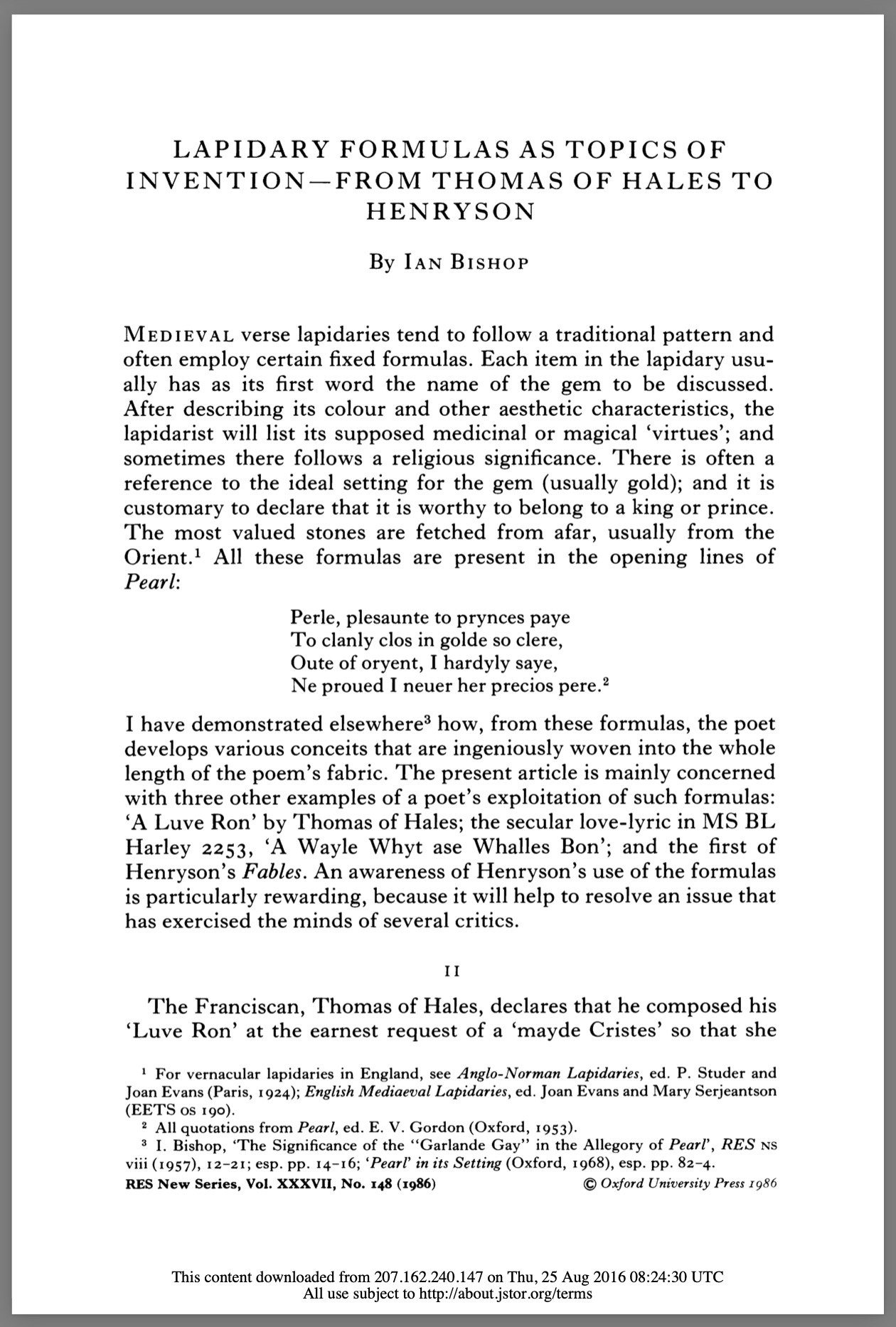
Medieval verse lapidaries tend to follow a traditional structure and often employ fixed formulas, beginning each entry with the name of the stone, followed by descriptions of its color and aesthetic qualities, then its supposed medicinal or magical virtues, and sometimes concluding with religious significance or a note on the ideal setting—typically gold—and a declaration of its princely worth, often emphasizing its exotic origin in the Orient. All these elements appear in Pearl: “Perle, plesaunte to prynces paye / To clanly clos in golde so clere, / Oute of oryent, I hardyly saye, / Ne proued I neuer her precios pere.” I have demonstrated elsewhere how poets take these formulas and develop complex conceits that are woven throughout their poems. This article focuses on three additional examples of poetic exploitation of lapidary formulas: A Luve Ron by Thomas of Hales, the secular love-lyric “A Wayle Whyt ase Whalles Bon” from MS BL Harley 2253, and the first of Henryson’s Fables, where recognizing the use of these conventions proves particularly fruitful in addressing a critical issue debated by several scholars.