
Four Treasures Reference Database
Record No. 27951
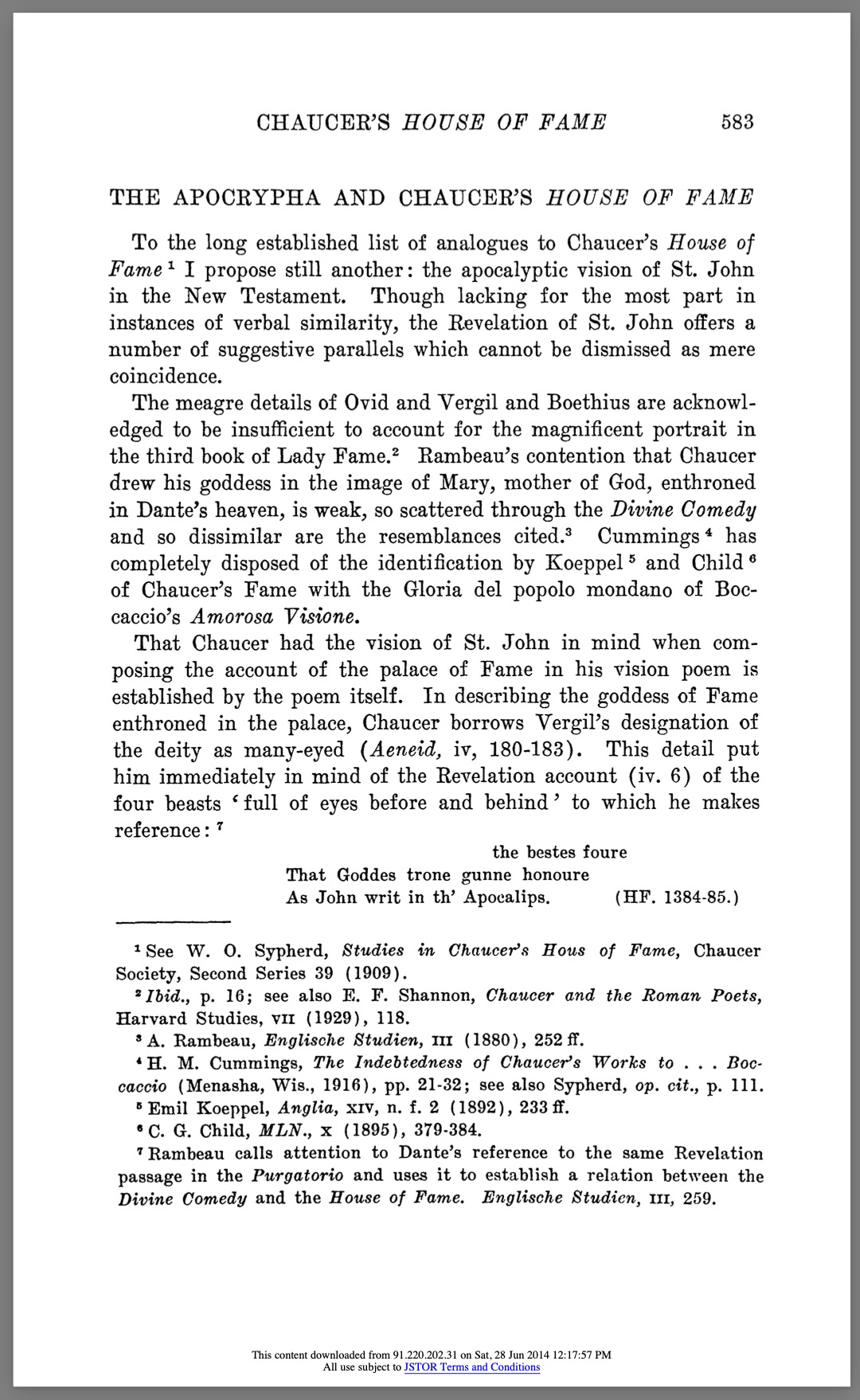
The apocrypha and Chaucer's House of Fame
Journal Article
Henkin, L.J. (1941) The apocrypha and Chaucer's House of Fame. Modern Language Notes, Vol. 56, No. 8, pp. 583–588.
gems, early lapidaries, early gemology, early mineralogy, Chaucer, history of gemology, nomenclature, lore, medicinal use
To the long-established list of analogues to Chaucer’s House of Fame, I propose still another: the apocalyptic vision of St. John in the New Testament. Though largely lacking in direct verbal similarities, the Revelation of St. John presents numerous compelling parallels that cannot be dismissed as mere coincidence. The sparse details from Ovid, Vergil, and Boethius are acknowledged to fall short of accounting for the grandeur of Chaucer’s portrayal of Lady Fame in Book III. Rambeau’s argument that Chaucer modeled his goddess on the Virgin Mary as depicted in Dante’s heaven is unconvincing, given how scattered and dissimilar the cited resemblances are. Cummings has thoroughly refuted the identifications by Koeppel and Child of Chaucer’s Fame with the Gloria del popolo mondano in Boccaccio’s Amorosa Visione. Evidence from the poem itself supports the view that Chaucer had the vision of St. John in mind when composing the palace of Fame. In describing the enthroned goddess, Chaucer draws on Vergil’s image of the many-eyed deity (Aeneid IV, 180–183), a detail that recalls the Revelation’s account (IV.6) of the four beasts “full of eyes before and behind,” which Chaucer explicitly references: “the bestes foure / That Goddes trone gunne honoure / As John writ in th’ Apocalips” (House of Fame, 1384–85).