
Four Treasures Reference Database
Record No. 27972
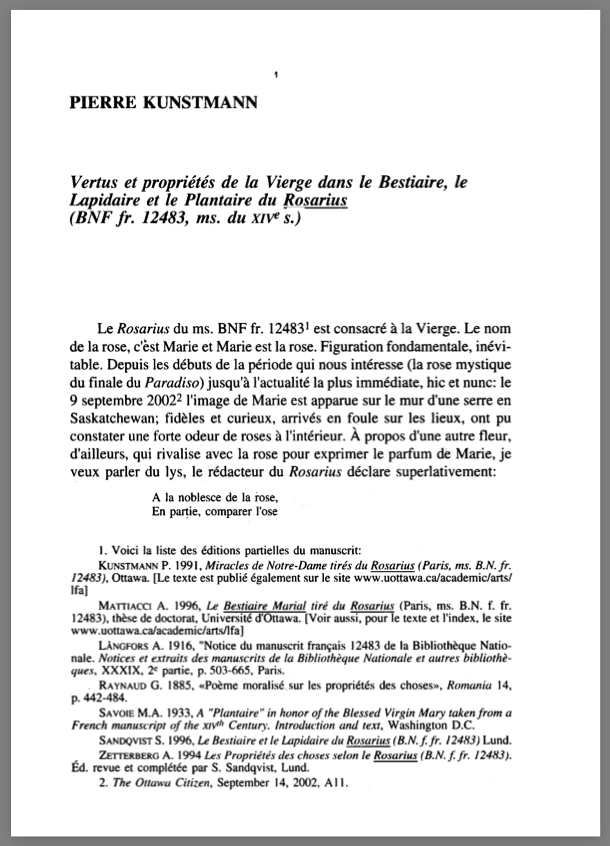
Vertus et propriétés de la Vierge dans le Bestiaire, le Lapidaire et le Plantaire du Rosarius (BNF fr. 12483, ms. du XIVe s.)
Virtues and properties of the Virgin in the Bestiary, Lapidary, and Plantaire of the Rosarius (BNF fr. 12483, 14ᵗʰ-century manuscript)
Journal Article
Kunstmann, P. (2005) Vertus et propriétés de la Vierge dans le Bestiaire, le Lapidaire et le Plantaire du Rosarius (BNF fr. 12483, ms. du XIVe s.). [Virtues and properties of the Virgin in the Bestiary, Lapidary, and Plantaire of the Rosarius (BNF fr. 12483, 14ᵗʰ-century manuscript)] Le Moyen Français, Vol. 55–56, pp. 205–217.
DOI: https://doi.org/10.1484/J.LMFR.2.303061 | Sinkankas/Born No.: NIS/NIB | Language: in French | RWHL
gems, early lapidaries, early gemology, early mineralogy, Rosarius
The Rosarius of manuscript BNF fr. 12483 is dedicated to the Virgin. The name of the rose is Mary, and Mary is the rose—a fundamental and inevitable figure. From the beginnings of the period that concerns us (the mystical rose at the end of the Paradiso) to the most immediate present, hic et nunc: on September 9, 2002, the image of Mary appeared on the wall of a greenhouse in Saskatchewan; the faithful and the curious, who arrived in crowds, reportedly perceived a strong scent of roses inside. Speaking of another flower, by the way, which rivals the rose in expressing Mary’s fragrance—I mean the lily—the author of the Rosarius declares with superlative praise: A ta noblesce de la rose, En parfie, comparer l’ose. (To your noble rosehood, none can be compared in fragrance.)