
Four Treasures Reference Database
Record No. 27977
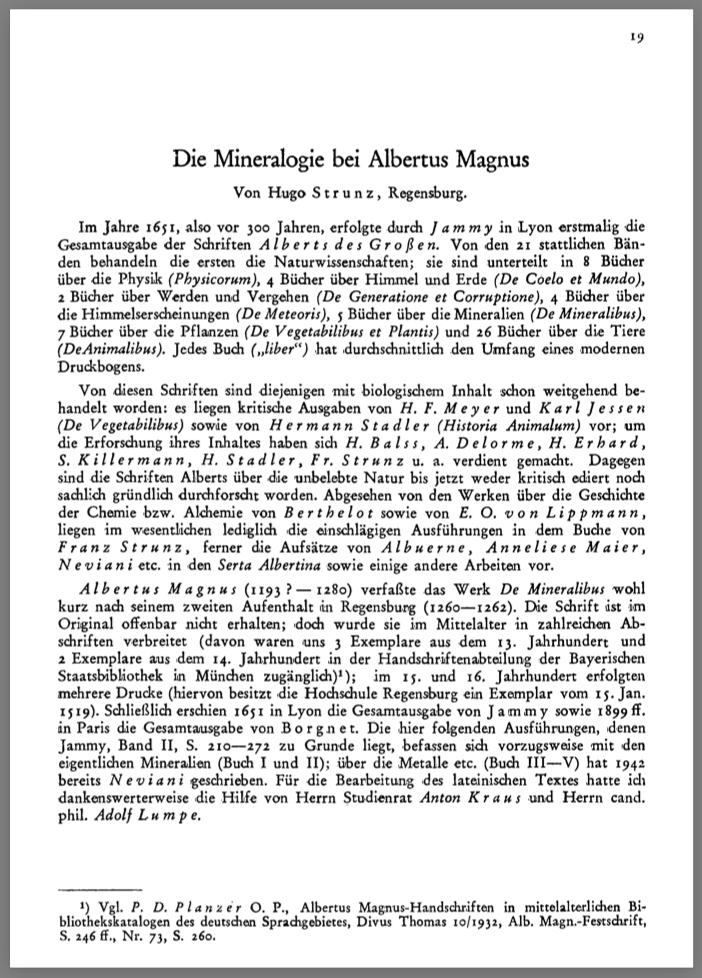
Die Mineralogie bei Albertus Magnus
Mineralogy in the work of Albertus Magnus
Journal Article
Stunz, H. (1951) Die Mineralogie bei Albertus Magnus. [Mineralogy in the work of Albertus Magnus] Acta Albertina Regensburg, pp. 13–39.
Sinkankas/Born No.: NIS/NIB | Language: in German | RWHL*
gems, early lapidaries, early gemology, early mineralogy, Albertus Magnus
Strunz examines the mineralogical writings of Albertus Magnus, concentrating chiefly on Books I and II of De Mineralibus, probably composed shortly after 1260–1262, and evaluates them in relation to the development of mineralogy. He emphasizes Albert’s unusually critical method, combining inherited authorities with personal observation, experiment, and rational inquiry, and his principle that natural science should not merely repeat reports but seek the causes of natural phenomena. Strunz summarizes Albert’s theories of the origin, composition, color, hardness, porosity, and other properties of stones and then surveys his alphabetical treatment of individual gemstones and minerals, including diamond, amethyst, beryl, carbuncle or ruby, garnet, rock crystal, hematite, amber, magnetite, and many more. Albert frequently records localities, physical characteristics, lapidary uses, and reputed medicinal or magical powers, although Strunz distinguishes these traditional beliefs from Albert’s own observations and critical judgments. Strunz finally places Albert’s classification of stones, metals, salts, sulfurous substances, and intermediate minerals within the historical sequence from Aristotle and Avicenna to Paracelsus and Agricola, presenting De Mineralibus as an important stage in the emergence of systematic mineralogy while stressing that his paper is only an introduction rather than a definitive assessment.