
Four Treasures Reference Database
Record No. 27980
Other texts on colours
Journal Article
Thorndike, L. (1960) Other texts on colours. Ambix, Vol. 8, No. 2, June, pp. 53–70.
ISBN/ISSN: 26980 | DOI: https://doi.org/10.1179/amb.1960.8.2.53 | Sinkankas/Born No.: NIS/NIB | RWHL
gems, color science, color theory, art, anthropology, history of color
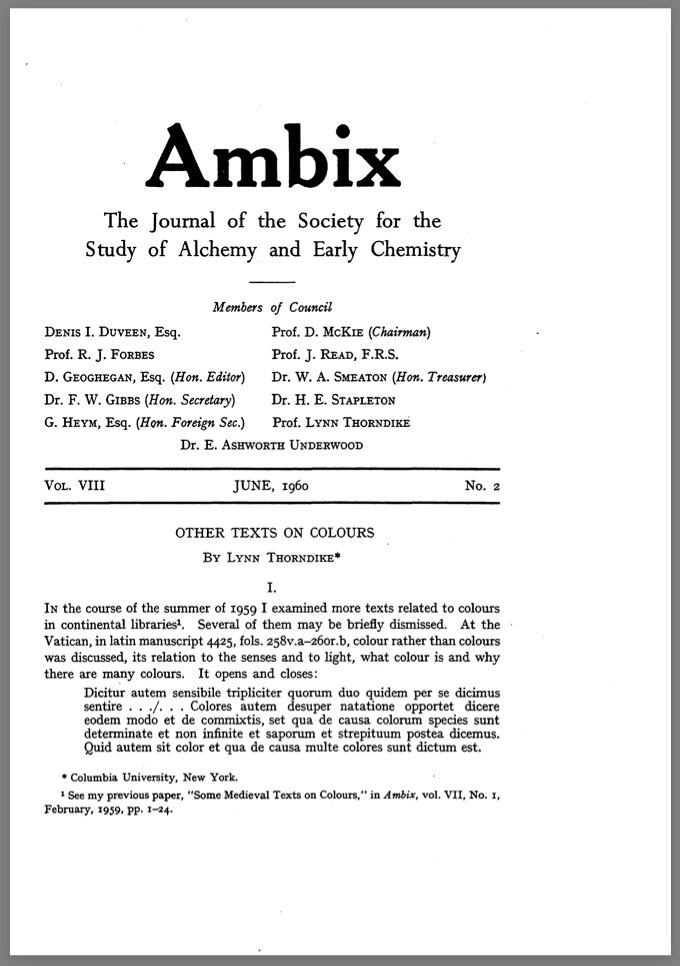
In the course of the summer of 1959 I examined more texts related to colours in continental libraries. Several of them may be briefly dismissed. At the Vatican, in Latin manuscript 4425, fols. 258v.a–260r.b, colour rather than colours was discussed—its relation to the senses and to light, what colour is and why there are many colours. It opens and closes: Dicitur autem sensibile tripliciter quorum duo quidem per se dicimus sentire … Colores autem desuper natatione opportet dicere eodem modo et de commixtis, set qua de causa colorum species sunt determinate et non infinite et saporum et strepituum postea dicemus. Quid autem sit color et qua de causa multe colores sunt dictum est. On closer examination the text was found to be a combination of passages from De anima and De sensu of Aristotle. Its incipit corresponds to the second sentence of De anima II.6 (418a) and its last sentence to the opening of cap. IV of De sensu (440b). The excerpt from De anima ends at the bottom of 258v.b, shortly before the close of II.7 (419a), and that from De sensu opens at the top of 259r.a, in the course of cap. I (436b). In the case of two Latin manuscripts at Graz, one text was only a paragraph in length, while the other soon lapsed into German. At Berne, De arte pingendi in MS. A.g. I.17, 11th–12th century, fols. 1v–5v, turned out to be incomplete and, so far as it went, to be concerned chiefly with the single colour clarea, of which there were two kinds: one made by beating, and one by shaking, or sometimes by pressing through wool or straw.