
Four Treasures Reference Database
Record No. 27983
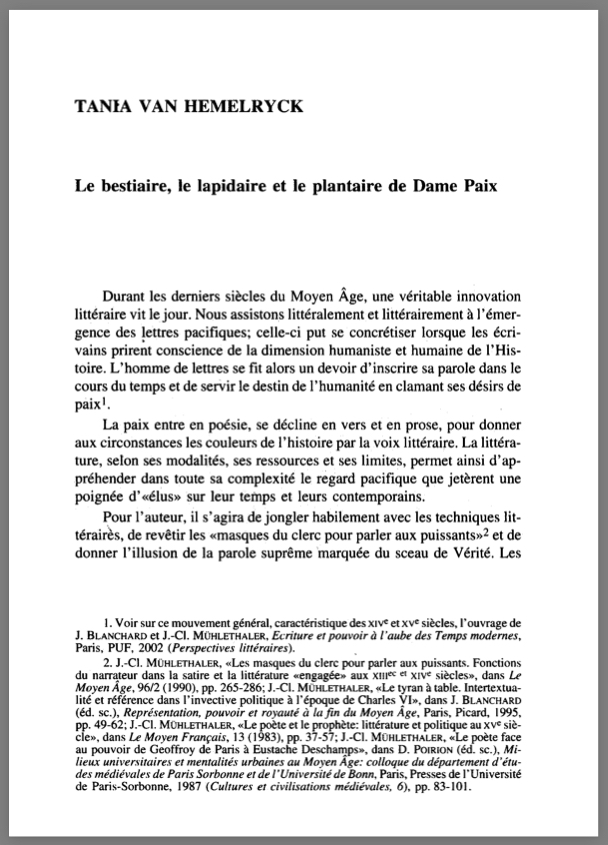
Le bestiaire, le lapidaire et le plantaire de Dame Paix
Journal Article
Van Hemelryck, T. (2005) Le bestiaire, le lapidaire et le plantaire de Dame Paix. Le Moyen Français, Vol. 55–56, pp. 167–185.
gems,
During the final centuries of the Middle Ages, a true literary innovation emerged. We witness, both literally and literarily, the rise of pacifist writings; this became possible when writers became aware of the humanistic and humane dimension of History. The man of letters then made it his duty to inscribe his voice into the course of time and to serve the destiny of humanity by proclaiming his desires for peace. Peace enters poetry, unfolds in verse and prose, lending historical circumstances the colors of literature. Literature, through its forms, resources, and limits, thus allows us to grasp in all its complexity the pacifist perspective cast by a handful of “chosen” individuals upon their time and contemporaries. For the author, it is a matter of skillfully juggling literary techniques, donning the “masks of the cleric to speak to the powerful,” and creating the illusion of a supreme speech marked with the seal of Truth. The resulting works are punctuated by small pacifist marks and rhetorical devices that allow peace to find a voice—either under the traditional banners of literature or through an author’s innovations.