
Four Treasures Reference Database
Record No. 27991
Influenza pandemic of 1918: Second update
Journal Article
Saul, J.M. and Haines, C.E. (2022) Influenza pandemic of 1918: Second update. Life: The Excitement of Biology, Vol. 10, No. 1, pp. 69–70.
Sinkankas/Born No.: NIS/NIB | RWHL
gems, medicine, pandemics, flu pandemic, 1918
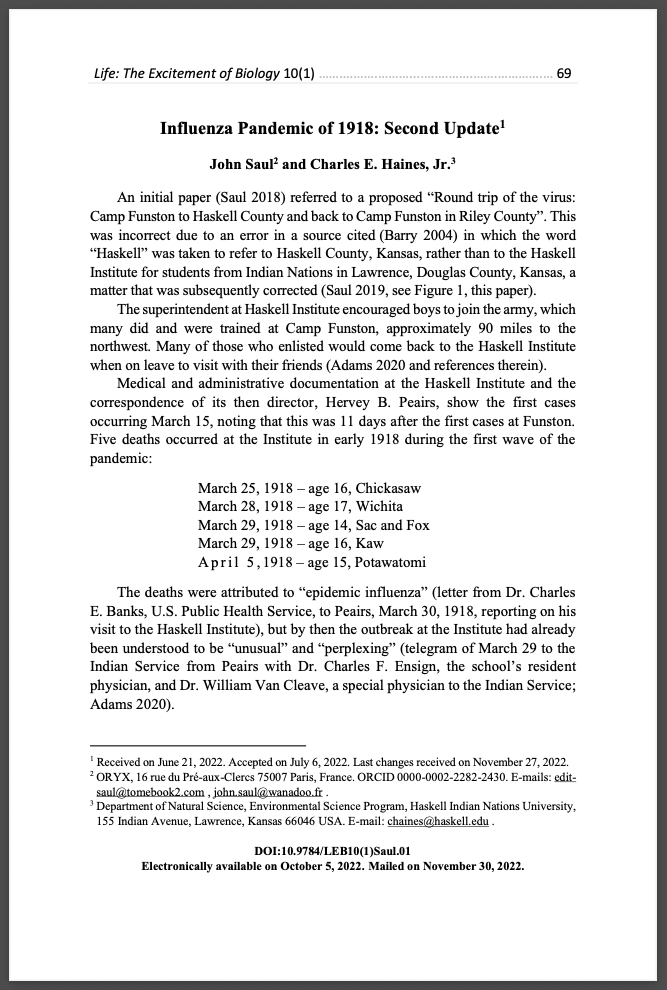
An initial paper (Saul 2018) referred to a proposed “Round trip of the virus: Camp Funston to Haskell County and back to Camp Funston in Riley County”; this was incorrect due to an error in a source cited (Barry 2004), in which the word “Haskell” was mistakenly interpreted as referring to Haskell County, Kansas, rather than to the Haskell Institute for students from Indian Nations in Lawrence, Douglas County, Kansas—a mistake subsequently corrected (Saul 2019, see Figure 1, this paper); the superintendent at Haskell Institute had encouraged boys to join the army, which many did, training at Camp Funston, approximately 90 miles to the northwest, and often returning to the Haskell Institute on leave to visit friends (Adams 2020 and references therein). Medical and administrative documentation at the Haskell Institute and correspondence from its director, Hervey B. Peairs, indicate that the first cases occurred on March 15, eleven days after the initial cases at Camp Funston; five student deaths followed during the first wave of the pandemic—March 25 (age 16, Chickasaw), March 28 (age 17, Wichita), March 29 (age 14, Sac and Fox), March 29 (age 16, Kaw), and April 5 (age 15, Potawatomi)—all attributed to “epidemic influenza” (letter from Dr. Charles E. Banks, U.S. Public Health Service, to Peairs, March 30, 1918), though by March 29 the outbreak was already considered “unusual” and “perplexing” (telegram from Peairs and doctors Charles F. Ensign and William Van Cleave to the Indian Service; Adams 2020); in the corrected reconstruction, the cohort at the Haskell Institute replaces the general population of Haskell County, who are no longer implicated, thus reinforcing Saul’s (2018) original conclusion that the 1918 influenza pandemic emerged through a multi-step natural evolutionary process favoring a fast-acting viral strain in a prime-of-life population where a slower strain would have died out, the virus—initially unremarkable—having arrived at Camp Funston, where it mutated within this homogenous cohort until a rapid form emerged, a scenario unlikely to recur.