
Four Treasures Reference Database
Record No. 27994
As it Is above, so shall it be below’: The blueprint of civilization
Journal Article
Saul, J.M. (1994) As it Is above, so shall it be below’: The blueprint of civilization. Archaeoastronomy, Vol. 11, 1989–1993, pp. 104–107.
Sinkankas/Born No.: NIS/NIB | not seen
gems, history of science, anthropology, history of religion, history of man, archaeology, origins of religion
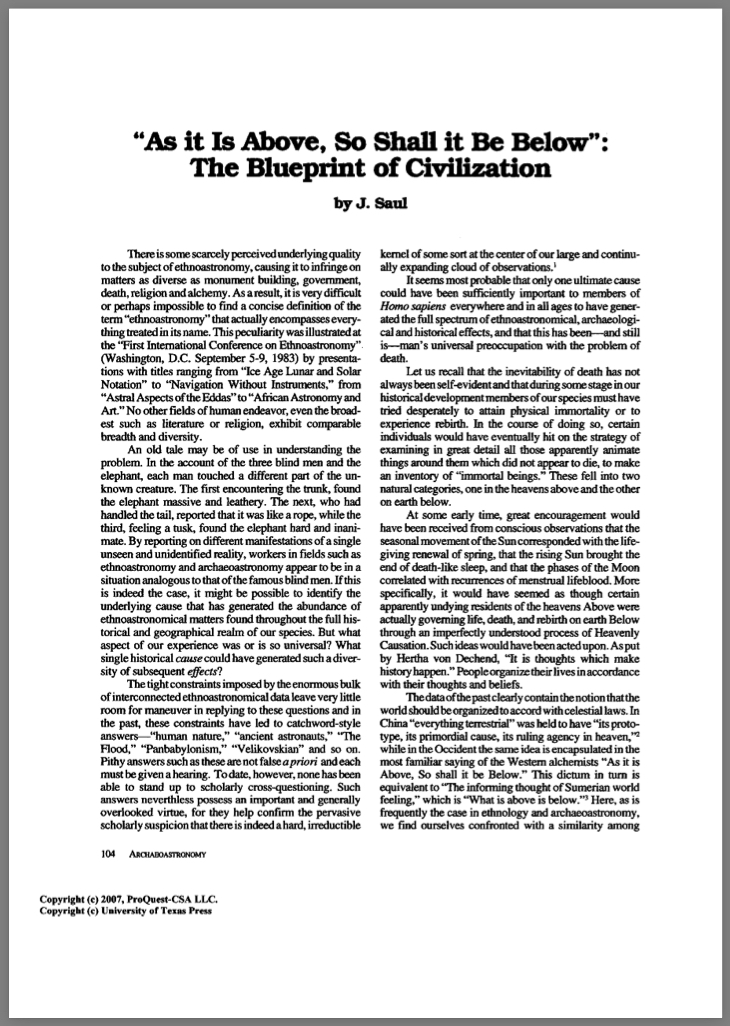
There is some scarcely perceived underlying quality to the subject of ethnoastronomy, causing it to infringe on matters as diverse as monument building, government, death, religion and alchemy. As a result, it is very difficult, or perhaps impossible, to find a concise definition of the term “ethnoastronomy” that actually encompasses everything treated in its name. This peculiarity was illustrated at the “First International Conference on Ethnoastronomy” (Washington, D.C. September 5–9, 1983) by presentations with titles ranging from “Ice Age Lunar and Solar Notation” to “Navigation Without Instruments,” from “Astral Aspects of the Eddas” to “African Astronomy and Art.” No other fields of human endeavor, even the broadest such as literature or religion, exhibit comparable breadth and diversity. An old tale may be of use in understanding the problem. In the account of the three blind men and the elephant, each man touched a different part of the unknown creature. The first, encountering the trunk, found the elephant massive and leathery. The next, who had seized the tail, reported that it was like a rope, while the third, feeling a tusk, found the elephant hard and inanimate. By reporting on different manifestations of a single unseen and unidentified reality, workers in the fields of ethnoastronomy and archaeoastronomy appear to be in a situation analogous to that of the famous blind men. If this is indeed the case, it might be possible to identify an underlying cause that has generated the abundance of ethnoastronomical matters found throughout the full historical and geographical realm of our species. But what aspect of our experience was or is so universal? What single historical cause could have generated such a diversity of subsequent effects?