
Four Treasures Reference Database
Record No. 27996
Petrographic and geochemical study of an anomalous melt rock from the Gilf Kebir plateau, close to the Libyan desert glass area, Egypt
Journal Article
Ferrière, L., Devouard, B., Goderis, S., Vincent, P., Bernon, D., Lorillard, R. and Saul, J.M. (2009) Petrographic and geochemical study of an anomalous melt rock from the Gilf Kebir plateau, close to the Libyan desert glass area, Egypt. Meteoritics and Planetary Science Supplement, p. 5384.
Sinkankas/Born No.: NIS/NIB | RWHL
gems, natural glass, Libyan Desert Glass, Libya
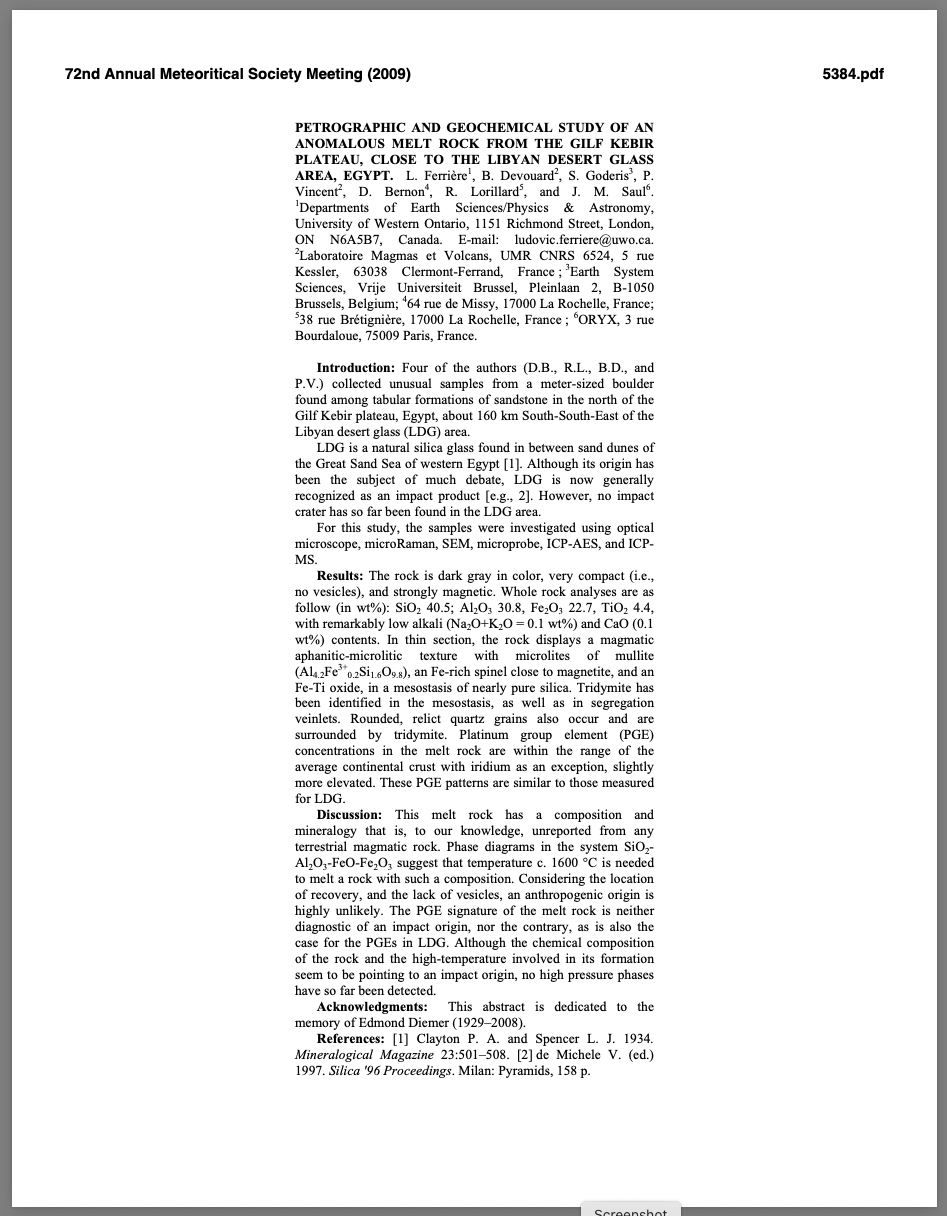
Four of the authors (D.B., R.L., B.D., and P.V.) collected unusual samples from a meter-sized boulder found among tabular formations of sandstone in the north of the Gilf Kebir plateau, Egypt, about 160 km South-South-East of the Libyan desert glass (LDG) area. LDG is a natural silica glass found in between sand dunes of the Great Sand Sea of western Egypt [1]. Although its origin has been the subject of much debate, LDG is now generally recognized as an impact product [e.g., 2]. However, no impact crater has so far been found in the LDG area. For this study, the samples were investigated using optical microscope, microRaman, SEM, microprobe, ICP-AES, and ICP-MS. Results: The rock is dark gray in color, very compact (i.e., no vesicles), and strongly magnetic. Whole rock analyses are as follow (in wt%): SiO₂ 40.5; Al₂O₃ 30.8, Fe₂O₃ 22.7, TiO₂ 4.4, with remarkably low alkali (Na₂O + K₂O = 0.1 wt%) and CaO (0.1 wt%) contents. In thin section, the rock displays a magmatic aphanitic-microlitic texture with microlites of mullite (Al₄.₂Fe³⁺₀.₂Si₁.₆O₉.₈), an Fe-rich spinel close to magnetite, and an Fe-Ti oxide, in a mesostasis of nearly pure silica. Tridymite has been identified in the mesostasis, as well as in segregation veinlets. Rounded, relict quartz grains also occur and are surrounded by tridymite. Platinum group element (PGE) concentrations in the melt rock are within the range of the average continental crust with iridium as an exception, slightly more elevated. These PGE patterns are similar to those measured for LDG. Discussion: This melt rock has a composition and mineralogy that is, to our knowledge, unreported from any terrestrial magmatic rock. Phase diagrams in the system SiO₂–Al₂O₃–FeO–Fe₂O₃ suggest that temperature c. 1600 °C is needed to melt a rock with such a composition. Considering the location of recovery, and the lack of vesicles, an anthropogenic origin is highly unlikely. The PGE signature of the melt rock is neither diagnostic of an impact origin, nor the contrary, as is also the case for the PGEs in LDG. Although the chemical composition of the rock and the high temperature involved in its formation seem to be pointing to an impact origin, no high-pressure phases have so far been detected.