
Four Treasures Reference Database
Record No. 28006
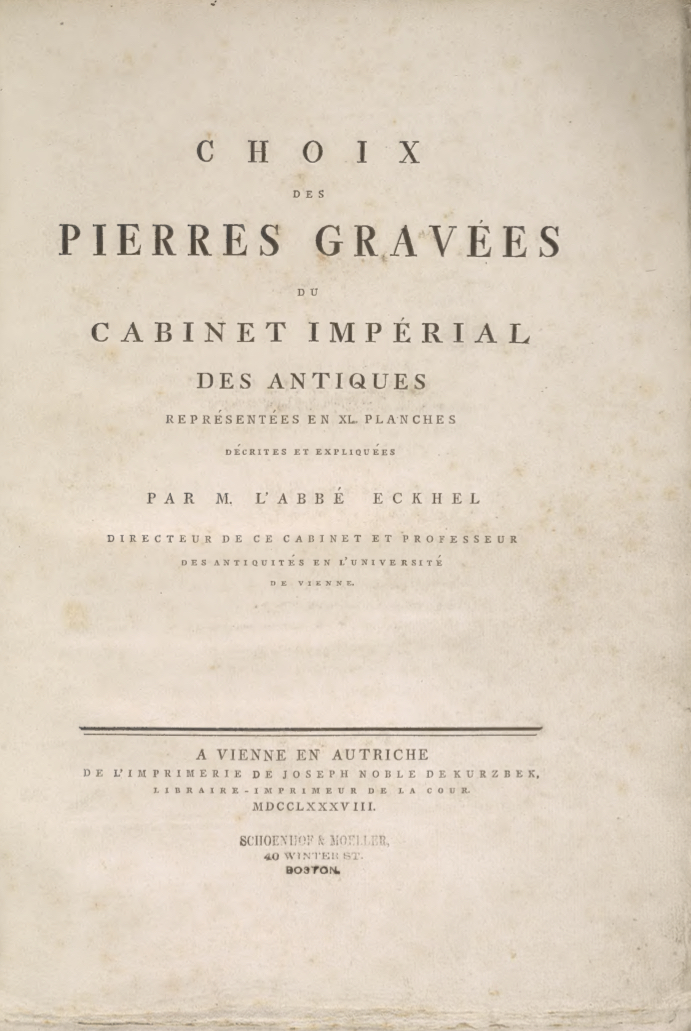
Choix des Pierres Gravées du Cabinet Impérial des Antiques | Représentées en XL. planches | Décrites et expliquées
Selection of Engraved Gems from the Imperial Cabinet of Antiquities | Shown in 40 Plates | Described and Explained
Book
Eckhel, J. (1788) Choix des Pierres Gravées du Cabinet Impérial des Antiques | Représentées en XL. planches | Décrites et expliquées. [Selection of Engraved Gems from the Imperial Cabinet of Antiquities | Shown in 40 Plates | Described and Explained] Vienna, Joseph Noble de Kurzbek, 77 pp., 40 plates
Sinkankas/Born No.: 1856; NIB | Language: in French | RWHL
gems, glyptic, engraved gems, agate, cameo, intaglio
Sinkankas: Illustrations and descriptions of 40 of the largest and most important engraved gems in the Imperial Cabinet of Antiquities in Vienna are presented in this work. The plates are superb and were designed by Kibler & Kohl, and engraved by Kohl, Mark, Schütz, Ponheimer, Mansfeld, Adam, and Durmer. Each plate features one gem, and in cases of smaller gems, the illustrations are considerably enlarged, while the largest engraved gems—such as the celebrated Apotheosis of Augustus (ca. 22.5 × 18.5 cm), Augustus with the Goddess of Rome (ca. 11 × 10 cm), and the Roman Eagle gem (ca. 19 cm diameter)—are drawn to actual size. For the first four enlarged gems, a scale is provided to show true size. The first four plates of Reinach’s Pierres gravées (1895), along with his tinted frontispiece plate, depict the same gems, while commentary and explanations of the subjects appear on pp. 1–9. The artistic quality of the work has been deemed “mediocre” by Vinet (1642), though Millin praised the descriptions as succinct, precise, clear, and satisfying. Furtwängler (Die antiken Gemmen, vol. 3, pp. 420–421) admired the care taken with the engravings and their fidelity to the originals, though he remarked that Eckhel was “not critical enough” in distinguishing modern Renaissance gems from antique ones. For full descriptions of the gems and the history of the collection, see Eichler & Kris, Die Kameen im Museum (1927); other references include Goodland, p. 181; Cicognara, no. 2829; and Zazoff, Gemmensammler, pp. 148–150. Eckhel’s preface offers a brief history of the collection and general remarks on previous illustrated works on engraved gems, as well as how the present work came into existence.