
Four Treasures Reference Database
Record No. 28008
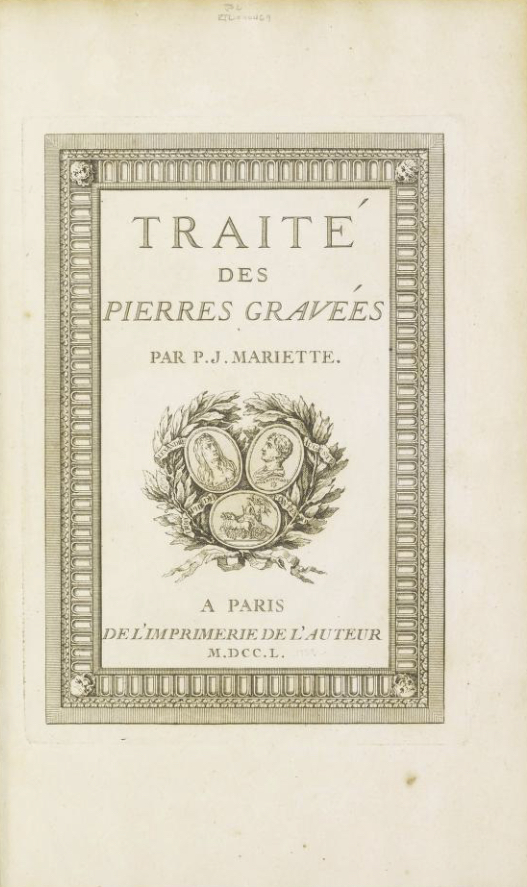
Traité des Pierres Gravées
Treatise on Engraved Gems
Book
Mariette, P.-J. (1750) Traité des Pierres Gravées. [Treatise on Engraved Gems] Paris, P.J. Mariette, 2 Vols., 468 pp., 132 plates
Sinkankas/Born No.: 4208; NIB | Language: in French | RWHL*
gems, glyptic, engraved gems, agate, cameo, intaglio
Sinkankas: This is the earliest analytical work on engraved gems and one that fully retains value even today. However, the two volumes are actually distinct works combined by the author and publisher—P.J. Mariette—for convenience. The first volume is by far the more important, offering an authoritative summary of knowledge on engraved gems, significantly enhanced by lengthy discourses on previous works and a nearly exhaustive bibliography of published sources. It begins with a general history of engraved gems, followed by an essay on modern gem engraving and engravers, and a large section describing the gems, divided into four chapters: I. Descriptions of gemstones and other materials used in engraving (pp. 153–194), including diamond, ruby, garnet, emerald, beryl, peridot, chrysolite, topaz, amethyst, quartz varieties, opal, lapis, coral, amber, ivory, and glass, drawing mainly on Pliny, De Berquen, and De Boodt; II. Lapidary processes, tools, and equipment required for gem engraving, with engraved plates showing an atelier, an engraver at work, and diagrams of engraving tools and accessories; III. Falsifications; IV. Making impressions. The final portion (pp. 239 to end) contains commentary on previous engravings used for illustration and the extensive bibliography noted earlier. In contrast, the second volume is entirely devoted to descriptions of the gem cabinet of Louis XV (1710–1774), King of France—this section drew strong interest from C.W. King (Antique Gems and Rings, vol. 1, pp. 465–466), who praised its content but criticized the engravings, drawn by Bouchardon (1698–1762), as being in too loose and flowing a style to convey an accurate idea of the originals. The cabinet featured gems of sapphire, zircon, malachite, jade, turquoise, and others in faceted forms, with the project supervised by the noted antiquarian Comte de Caylus (1692–1765). Vinet (1620) offered a long summary of the work, praising it as a classic still of use today, though he and others, including King, criticized the quality and accuracy of the engravings. The work was also attacked by Giulianelli (Memorie degli intagliatori, 1773) and Natter (Traité de la méthode… graver en pierres fines, 1754). Reinach (Pierres gravées, pp. 85–110) reproduces a number of its plates. Furtwängler (Die antiken Gemmen, vol. 3, p. 413) called the first volume broad in scope and written in an easy style with intelligent judgment, but joined critics of the second volume, calling its text “without learning and without citations,” and noting that antique and Renaissance gems were indiscriminately mixed—Mariette, he said, was as uncritical as Gravelle. See also Zazoff (Gemmensammler, 1983, pp. 127–133) for modern views.