
Four Treasures Reference Database
Record No. 28015
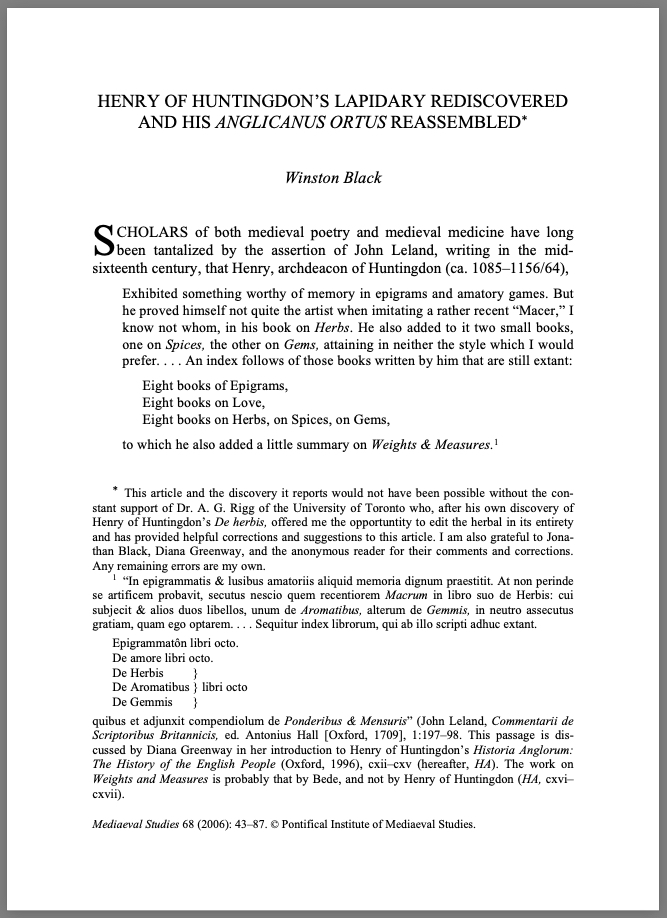
Henry of Huntington’s lapidary rediscovered and his Anglicanus ortus reassambled
Journal Article
Black, W. (2006) Henry of Huntington’s lapidary rediscovered and his Anglicanus ortus reassambled. Mediaeval Studies, Vol. 68, pp. 43–87.
gems, early lapidaries, Henry of Huntingdon, Medieval lapidaries
Scholars of both medieval poetry and medieval medicine have long been intrigued by John Leland’s mid-sixteenth-century claim that Henry, archdeacon of Huntingdon (ca. 1085–1156/64), “exhibited something worthy of memory in epigrams and amatory games,” though, when imitating a recent “Macer” (identity unknown) in his book on herbs, he “proved himself not quite the artist.” Leland adds that Henry also wrote two small books—one on spices and another on gems—but in neither did he achieve a style to Leland’s liking. He lists Henry’s extant works as including eight books of epigrams, eight books on love, and eight books on herbs, spices, and gems, along with a short treatise on weights and measures. The present report offers three important updates: first, a lost poem by Henry, De gemmis preciosis, has been rediscovered in a ca. 1300 medical manuscript (Oxford, Bodleian Digby 69, fols. 192v–195r) and is edited below; second, Henry’s De aromatibus is not lost but forms part of a six-book herbal preserved in Prague 1359 and edited by Rigg; and third, Henry’s eight-book poem De herbis, De aromatibus, De gemmis—as titled by Leland—can now be nearly fully reconstructed and is referred to here as Anglicanus Ortus (see pp. 50–51 below). These findings support several of Diana Greenway’s hypotheses regarding the order in which Henry composed his works.