
Four Treasures Reference Database
Record No. 28019
Zum earsten astrologischen Lapidar im Steinbuch des Damigeron und Fax
On the first astrological lapidary in the stone book of Damigeron and Fax
Journal Article
Quack, J.F. (2001) Zum earsten astrologischen Lapidar im Steinbuch des Damigeron und Fax. [On the first astrological lapidary in the stone book of Damigeron and Fax] Philologus, Vol. 145, No. 2, pp. 337–344.
DOI: https://doi.org/10.1524/phil.2001.145.2.337 | Sinkankas/Born No.: NIS/NIB | Language: in German | RWHL
gems, early lapidaries, Damigeron, magical properties, medicine, astrology, Evax
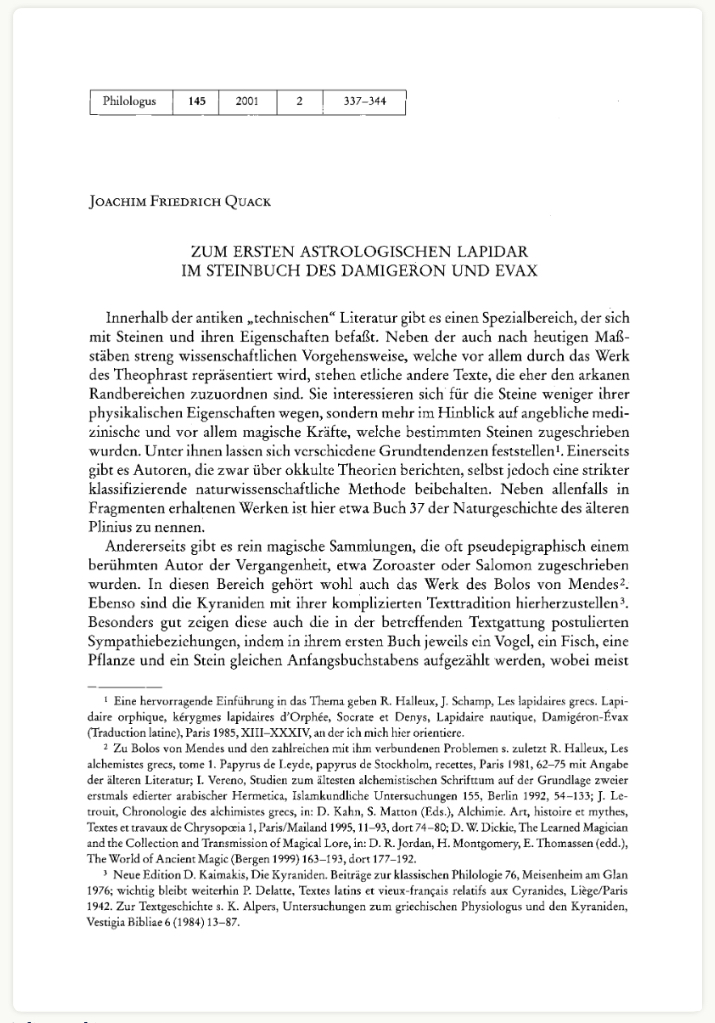
Within ancient “technical” literature, there is a specialized field that deals with stones and their properties. Alongside an approach that is rigorous and scientific even by modern standards—represented above all by the work of Theophrastus—there exist numerous other texts that belong more to the arcane fringes. These are less concerned with the physical properties of stones than with their supposed medicinal and especially magical powers. Among them, different basic tendencies can be identified: on the one hand, there are authors who, while reporting on occult theories, themselves maintain a strictly classificatory scientific method. Among the works preserved only in fragments, Book 37 of the Natural History by the elder Pliny may be mentioned here. On the other hand, there are purely magical collections, often pseudepigraphically attributed to a famous figure of the past, such as Zoroaster or Solomon. The work of Bolos of Mendes likely belongs to this category as well. Similarly, the Kyranides, with their complex textual tradition, should be placed here. These texts particularly illustrate the doctrine of sympathy relations postulated in this genre, as in their first book, for example, a bird, a fish, a plant, and a stone are each listed with the same initial letter, whereby the image of the fish and/or bird is usually to be engraved on the stone, and part of the plant is to be worn in the setting.