
Four Treasures Reference Database
Record No. 28026
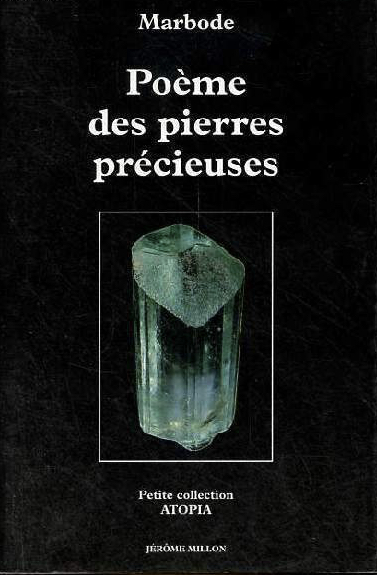
Poème des pierres précieuses : XIᵉ siècle / Marbode ; trad. du latin, présenté et annoté par Pierre Monat. Suivi de Une lecture symboliste des lapidaires médiévaux / par Claude Louis-Combet
Poem of Precious Stones: 11th Century / Marbode; translated from the Latin, presented and annotated by Pierre Monat. Followed by A Symbolist Reading of Medieval Lapidaries / by Claude Louis-Combet.
Edited Book
Marbode, Monat, P. and Louis-Combet, C., editor (1996) Poème des pierres précieuses : XIᵉ siècle / Marbode ; trad. du latin, présenté et annoté par Pierre Monat. Suivi de Une lecture symboliste des lapidaires médiévaux / par Claude Louis-Combet. [Poem of Precious Stones: 11th Century / Marbode; translated from the Latin, presented and annotated by Pierre Monat. Followed by A Symbolist Reading of Medieval Lapidaries / by Claude Louis-Combet.]. Grenoble, Jérôme Millon, 110 pp..
ISBN/ISSN: 9782840000000 | Sinkankas/Born No.: NIS/NIB | Language: in French | not seen
gems, early lapidaries, Marbode
Born in Angers around 1035, Marbode was bishop of Rennes from 1096 to 1123. Among his prolific works are a number of texts in praise of precious stones. Drawing on a Greek tradition transmitted to the West by the Latins and the Arabs, he celebrates, in dactylic verse, their beauty, their qualities, and above all their beneficial effects and mysterious power over bodies and minds. In the spirit of the Apocalypse and various Judeo-Christian speculations, he then offers a sort of hymn in their honor, in which each stone is praised as the embodiment of a Christian virtue. Marbode’s work—together with the pages Hildegard of Bingen devoted to the subtleties of stones and metals—represents the core of medieval knowledge, both magical and mystical, on the interconnections and correspondences between the mineral and the spiritual orders. Goldsmiths, as suppliers to the powerful and decorators of the most precious objects of worship, knew the virtues of the materials they worked with and their symbolic significance. They labored in a field that was at once material and spiritual—an integrated vision whose loss inspired dreams of recovery among the Symbolist generation of the late 19th century, with Huysmans as their most eloquent and tormented spokesman. It is in light of this literary legacy, at once distant and close to our own modernity, that the old Marbode deserves to be rediscovered.