
Four Treasures Reference Database
Record No. 28029
El contenido médico en el Lapidario alfonsí
The medical content in the Alfonsine Lapidary
Journal Article
Amasuno, M.V. (2007) El contenido médico en el Lapidario alfonsí. [The medical content in the Alfonsine Lapidary] Alcanate: Revista de estudios Alfonsíes, Vol. 5, pp. 139–162.
ISBN/ISSN: 15790576 | Sinkankas/Born No.: NIS/NIB | Language: in Spanish | RWHL
gems, early lapidaries, Alfonso X, Spain, Catalan, astrology, mythology, magical gems
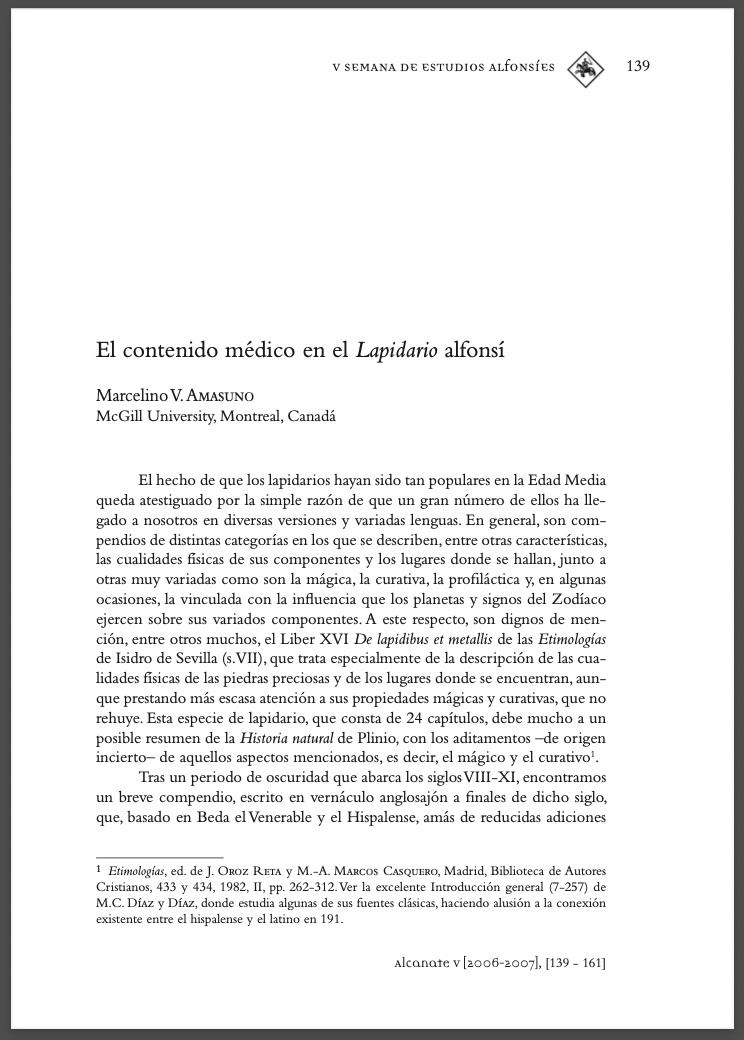
The fact that lapidaries were so popular in the Middle Ages is evidenced by the simple fact that a large number of them have come down to us in various versions and diverse languages. In general, they are compendia of different types, describing, among other features, the physical qualities of their components and the places where they are found, along with a wide range of other aspects—magical, healing, prophylactic, and, in some cases, the influence exerted by planets and zodiac signs on their various elements. In this regard, worthy of mention among many others is Book XVI De lapidibus et metallis from the Etymologies of Isidore of Seville (7th century), which focuses especially on describing the physical properties of precious stones and the places where they are found, though giving less attention—though not excluding—to their magical and healing properties. This kind of lapidary, consisting of 24 chapters, owes much to a possible summary of Pliny’s Natural History, with additions—of uncertain origin—relating to the aforementioned magical and healing aspects.