
Four Treasures Reference Database
Record No. 28030
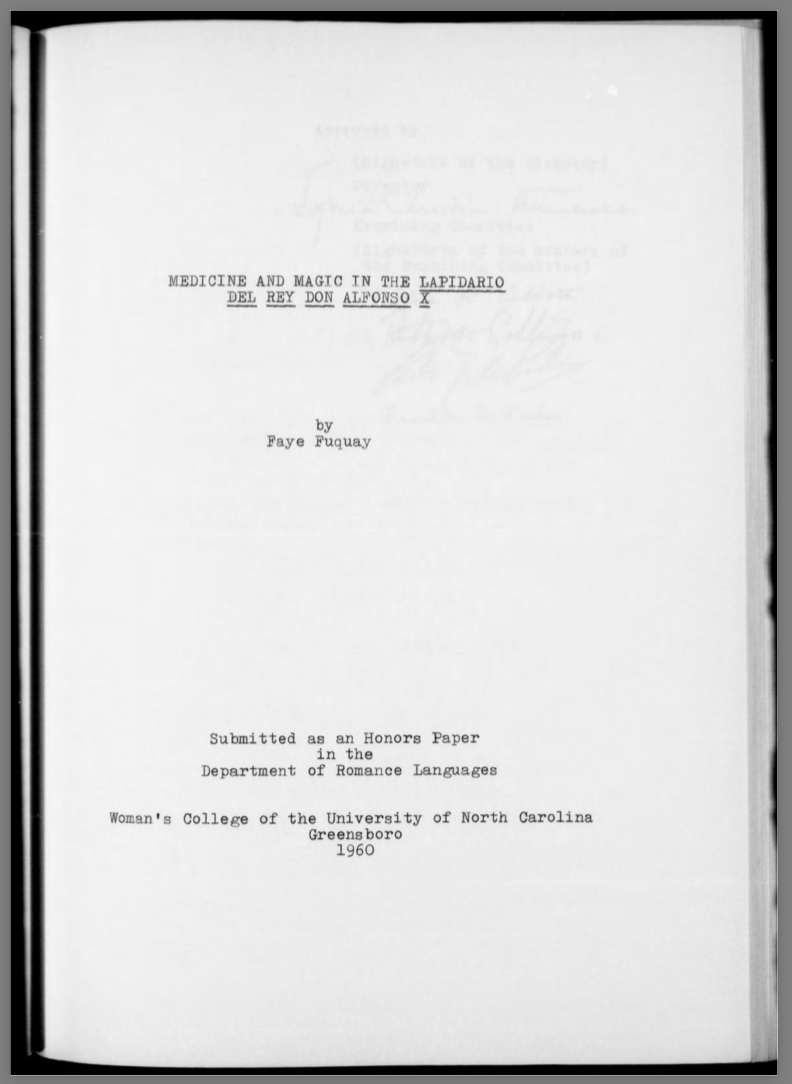
Medicine and Magic in the Lapidario del Rey don Alfonso X
Thesis
Fuquay, F. (1960) Medicine and Magic in the Lapidario del Rey don Alfonso X., Greensboro: Women’s College, University of North Carolina, 41 pp.
Sinkankas/Born No.: NIS/NIB | RWHL
gems, early lapidaries, Alfonso X, Spain, Catalan, astrology, mythology, magical gems, medicinal gems
The glittering sight of a precious stone has always attracted the human eye—an attraction deeper than the stone’s color or visible beauty, rooted in the stone’s very durability. Spring storms come and quickly go; summer suns rise and then fade into night; yet the brilliance of a precious stone has endured through the ages and will continue to endure. It is this awareness of permanence amidst change that gives the stone its enduring allure. The Enciclopedia universal ilustrada notes that in the Middle Ages, a lapidary was the name given to a book that described the virtues of precious stones. The purpose of this study is to investigate some of the particular virtues attributed to precious stones as found in the Lapidario del Rey Don Alfonso X. Códice Original. The edition used for this study is a facsimile of the original codex, translated from Arabic by order of Alfonso X in the thirteenth century. The original manuscript is now housed in the library of El Escorial near Madrid (prólogo, v.). Any attempt, in such a brief study, to extract from the Lapidario all references to the wide range of subjects it encompasses—astrological, metallurgical, mineralogical, geographical, magical, and medicinal, among others—would be extremely risky and beyond the scope of my investigation. Therefore, I have focused my attention on the general history and structure of the Lapidario, research on the number of stones in the manuscript, and the medicinal and magical aspects of the codex. This alone is a broad subject and has required further refinement through a process of elimination.