
Four Treasures Reference Database
Record No. 28037
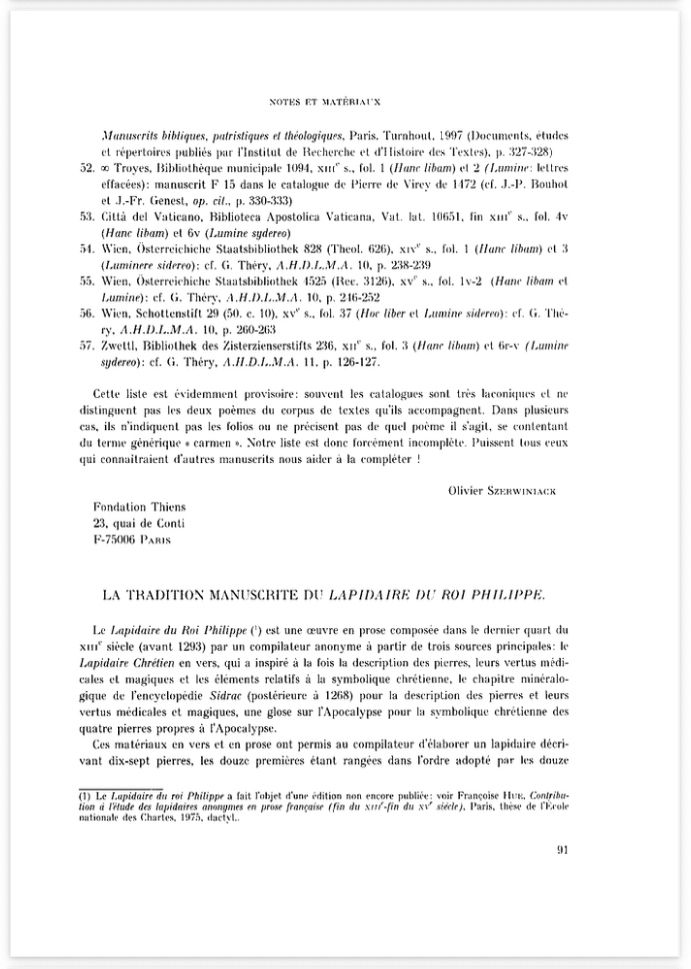
La tradition manuscrite du Lapidaire du roi Philippe
The manuscript tradition of the Lapidary of King Philip
Journal Article
Fery-Hue, F. (2000) La tradition manuscrite du Lapidaire du roi Philippe. [The manuscript tradition of the Lapidary of King Philip] Scriptorium, Vol. 54, No. 1, pp. 91–192.
Sinkankas/Born No.: NIS/NIB | Language: in French | RWHL
gems, early lapidaries, King Philip, Middle Ages, medieval
The Lapidary of King Philip is a prose work composed in the last quarter of the 13th century (before 1293) by an anonymous compiler, drawing on three main sources: the Christian Lapidary in verse, which inspired both the description of the stones, their magical virtues, and elements related to Christian symbolism; the mineralogical chapter of the Sidrac encyclopedia (dating after 1268) for the description of stones and their medical and magical properties; and a gloss on the Apocalypse for the Christian symbolism of the four stones specific to the Apocalypse. These materials, in both verse and prose, enabled the compiler to create a lapidary of seventeen stones. The first twelve are arranged in the order of the twelve stones of the High Priest’s breastplate (Rational) in Exodus 28:17–21; the next four are stones that appear only in the foundations of the Heavenly Jerusalem (Apocalypse 21:19–20) and not in Exodus; the final stone is the diamond (a stone that does not belong to the biblical tradition). These seventeen stones form the original core of the Lapidary of King Philip. Was this treatise commissioned by one of the two French kings named Philip in the second half of the century—Philip III the Bold (1270–1285) or Philip IV the Fair (1285–1314)? No textual detail or external historical evidence confirms the hypothesis of a royal commission. However, the treatise may have simply been “offered” by its author to one of these two kings.