
Four Treasures Reference Database
Record No. 28074
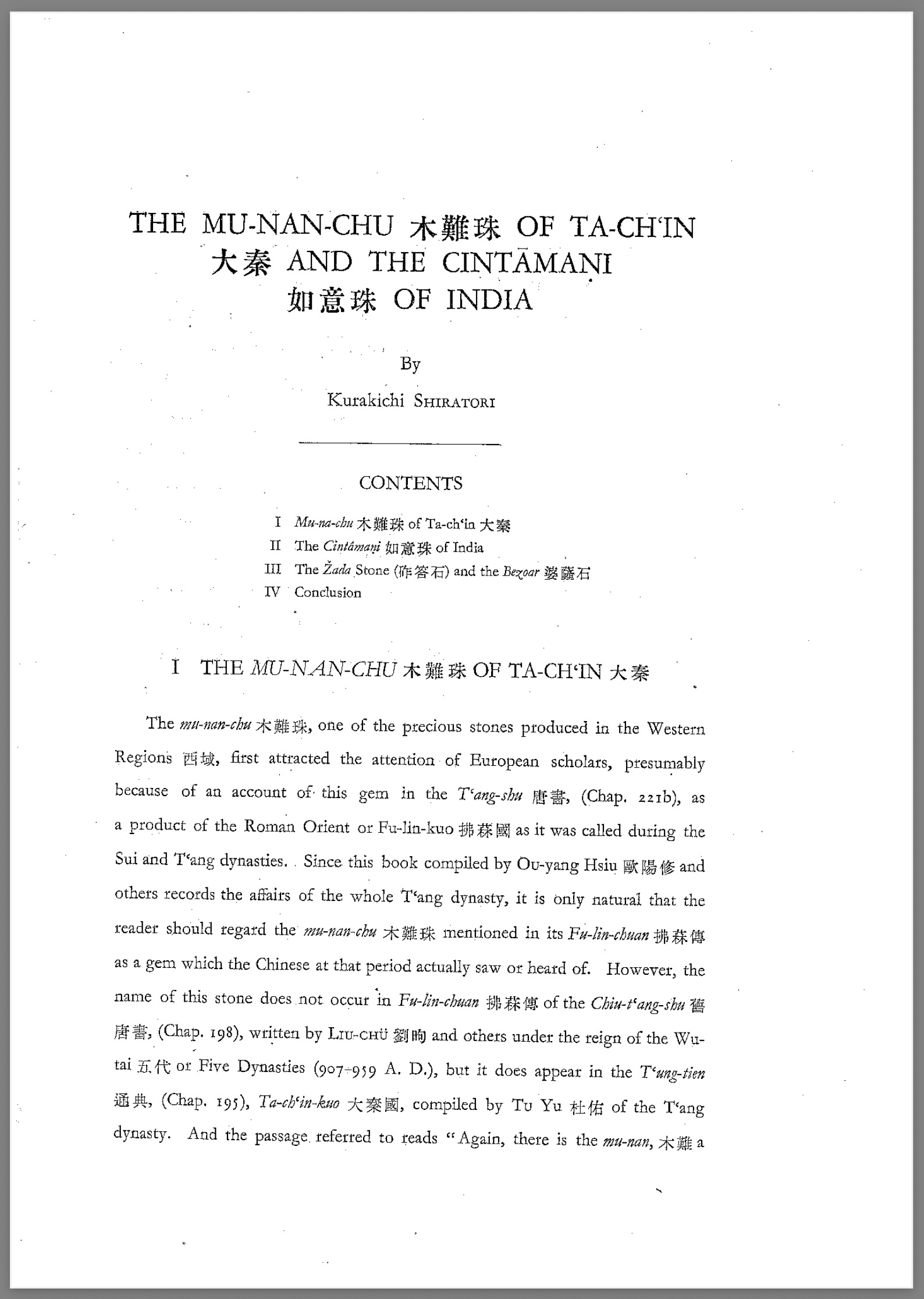
The Mu-nan-chu 木難珠 of Ta-chin 大秦 and the Cintāmaṇi 如意珠 of India
Journal Article
Shunatori, K. (1939) The Mu-nan-chu 木難珠 of Ta-chin 大秦 and the Cintāmaṇi 如意珠 of India. Memoirs of the Research Department of the Toyo Bunko, Vol. 11, pp. 1–54.
Sinkankas/Born No.: NIS/NIB | Language: in English | RWHL*
gems, ancient gemology, ancient jewelry, etymology of emerald, beryl, emerald, China, Chinese gemology, Persia, Persian, Iran, Arabic mineralogy,
The mu-nan-chu 木難珠, one of the precious stones produced in the Western Regions 西域, first attracted the attention of European scholars, presumably because of an account of this gem in the T’ang-shu 唐書, (Chap. 221b), as a product of the Roman Orient or Fu-lin-kuo 拂菻國 as it was called during the Sui and T’ang dynasties. Since this book compiled by Ou-yang Hsiu 歐陽修 and others records the affairs of the whole T’ang dynasty, it is only natural that the reader should regard the mu-nan-chu 木難珠 mentioned in its Fu-lin-chuan 拂菻傳 as a gem which the Chinese at that period actually saw or heard of. However, the name of this stone does not occur in Fu-lin-chuan 拂菻傳 of the Chiu-t’ang-shu 舊唐書, (Chap. 198), written by Liu-chü 劉恕 and others under the reign of the Wu-tai 五代 or Five Dynasties (907–959 A.D.), but it does appear in the T’ung-tien 通典, (Chap. 195), Ta-ch’in-kuo 大秦國, compiled by Tu Yu 杜佑 of the T’ang dynasty. And the passage referred to reads “Again, there is the mu-nan, 木難 a green stone which is a condensation of the saliva formed in the beak of the chin-chih bird 金翅鳥. The natives value it.” Now if Fu-lin and Ta-ch’in referred at the same time to one and the same province, no doubt whatever would arise. However, if there should be any difference in the times or regions the two terms referred to, it would seem more proper to consider the mu-nan-chu 木難珠 a product of Ta-ch’in rather than one of Fu-lin. According to my research, during the earlier years of the Hou-han 後漢 dynasty and down to the later period of the Tung-Chin 東晉, the Roman Orient whose centre was Alexandria in Egypt, extended to the extreme east of the Western Regions, and was known by the Chinese term Ta-ch’in 大秦. Towards the beginning of the Six Dynasties Ta-ch’in province had become a kind of fairy-land and even its locality had been lost sight of. Then a line of communication was again opened to that region and its proper name came to be accurately known as Fu-lin. In the documents of the Six Dynasties, the name was spelt Pu-lan 普蘭, Fu-lu-lin 伏盧尼, Fan-lin 泛淋, or Fu-lin 弗林, but in the Sui and T’ang dynasties the name came to be spelt Fu-lin 拂菻 invariably.