
Four Treasures Reference Database
Record No. 28087
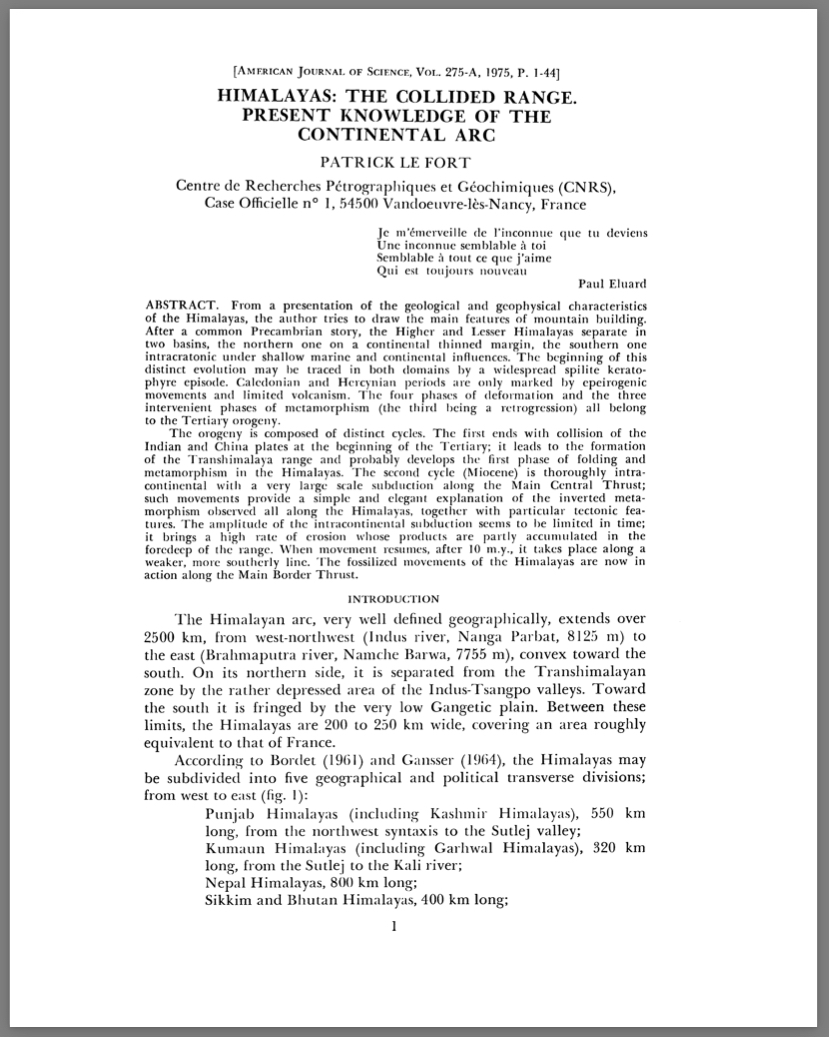
Himalayas: The collided range. Present knowledge of the continental arc
Journal Article
Le Fort, P. (1975) Himalayas: The collided range. Present knowledge of the continental arc. American Journal of Science, Vol. 275-A, pp. 1–44.
Sinkankas/Born No.: NIS/NIB | RWHL
gems, geology, East Africa, Kenya, Tanzania, Mozambique belt, Gondwanaland, plate tectonics, Himalayas, Himalayan orogeny, John Saul
From a presentation of the geological and geophysical characteristics of the Himalayas, the author attempts to outline the main features of mountain building. After a common Precambrian history, the Higher and Lesser Himalayas separate into two basins, the northern one on a thinned continental margin, the southern one intracratonic under shallow marine and continental influences. The beginning of this distinct evolution may be traced in both domains by a widespread spilite–keratophyre episode. Caledonian and Hercynian periods are only marked by epeirogenic movements and limited volcanism. The four phases of deformation and the three intervening phases of metamorphism (the third being a retrogression) all belong to the Tertiary orogeny. The orogeny is composed of distinct cycles: the first ends with collision of the Indian and China plates at the beginning of the Tertiary, leading to the formation of the Transhimalaya range and probably developing the first phase of folding and metamorphism in the Himalayas. The second cycle (Miocene) is thoroughly intracontinental with large-scale subduction along the Main Central Thrust; such movements provide a simple and elegant explanation of the inverted metamorphism observed throughout the Himalayas, together with particular tectonic features. The amplitude of the intracontinental subduction seems to be limited in time; it produces a high rate of erosion whose products are partly accumulated in the foredeep of the range. When movement resumes, after 10 million years, it takes place along a weaker, more southerly line. The fossilized movements of the Himalayas are now active along the Main Border Thrust.