
Four Treasures Reference Database
Record No. 28171
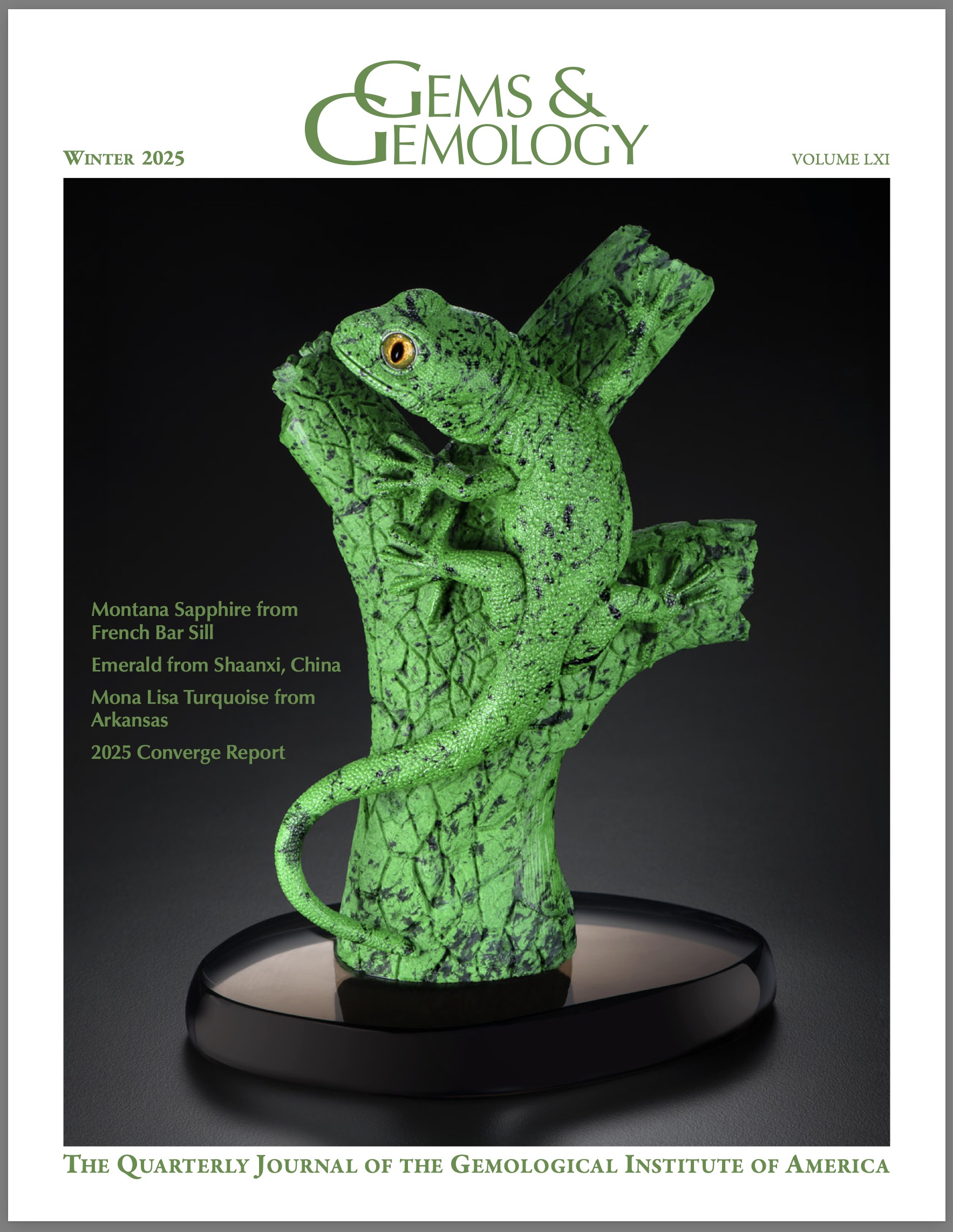
The primary sapphire occurrence at French Bar Sill along the Missouri River, near Helena, Montana
Journal Article
Kane, R.E., Pettman, K.L., Palke, A.C., Turnier, R.B., Berg, R.B., Renfro, N.D. and Smith, C.P. (2025) The primary sapphire occurrence at French Bar Sill along the Missouri River, near Helena, Montana. Gems & Gemology, Vol. 61, No. 4, Winter, pp. 332–353.
gems, corundum, USA.12, Montana.12, Missouri River, French Bar, Eldorado Bar, sapphire, geology.11
Sapphires have been mined in Montana since being discovered at Eldorado Bar, along the Missouri River, in 1865. The most valuable gold deposit in the area was mined near the top of the French Bar complex from 1867 to 1869. On portions of the Virginia terrace and the Center terrace, the French Bar sill, which sparsely contained sapphires in a host rock—identified here as a basaltic trachyandesite, but described elsewhere as a minette—was reported by Kunz in 1891. Other than Yogo Gulch, where the sapphires are in a lamprophyre dike, the French Bar sill is Montana’s only other source of gem-quality in situ sapphire. New ownership of the property in 2020 has resulted in the largest production to date, although it is still sparse. In this study, the authors examined 80 French Bar sill sapphires in matrix; 16 sapphires removed from the matrix, ranging from very small to 17.99 ct; 4 faceted stones; and 5 partly polished crystals. Trace element chemistry and inclusions were consistent with—and generally indistinguishable from—faceted Montana sapphires from the secondary deposits of the Missouri River, Rock Creek, and Dry Cottonwood Creek. This indicates that while the magmatic material (Eocene volcanism) that transported the sapphires from deep within the earth was different in certain cases, such as with French Bar sill, the genesis of the sapphires may be the same or similar. Many of the surface resorption features are similar, but one important distinction exists. Around 25% of Missouri River alluvial sapphires have encrustations of spinel, likely a result of reaction during transport by a mafic magma. Primary French Bar sill sapphires always have an encrustation of biotite (phlogopite) mica, but never spinel. The French Bar sill itself is certainly too small in extent to have supplied all the alluvial sapphires found at the Missouri River.