
Four Treasures Reference Database
Record No. 28179
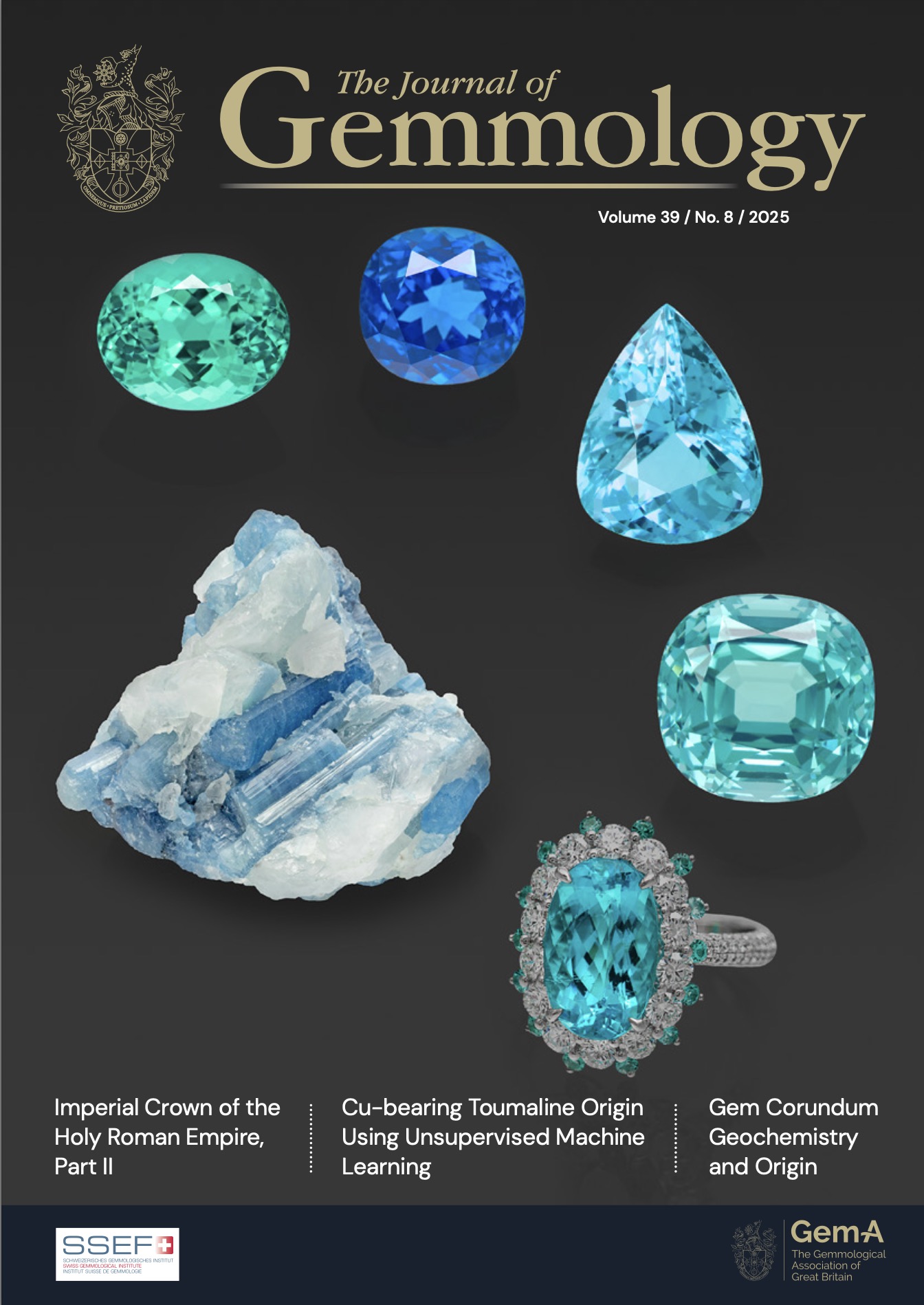
The Imperial Crown of the Holy Roman Empire, Part II: Origin determination of the gemstones and pearls
Journal Article
Gilg, H.A., Karampelas, S., Lamers, T., Uhlir, K., Griesser, M. and Kirchwegner, F. (2025) The Imperial Crown of the Holy Roman Empire, Part II: Origin determination of the gemstones and pearls. Journal of Gemmology, Vol. 39, No. 8, pp. 740–770.
Close Abstract
Hide Keywords
Copy Reference
gems, corundum, quality.10, crown jewels, auction, diamond, pearl, beryl, emerald, spinel, Tajikistan, Kuh-i-Lal, Swat, Pakistan, France.12
The medieval Imperial Crown of the Holy Roman Empire preserved in the Imperial Treasury in Vienna, Austria, has been the focus of an ongoing study (e.g. Nasdala et al. 2023). Here, we report on geographic origin determinations of its gems, which can offer new insights into the gem trade of the Early and High Middle Ages. We examined the 172 gemstones and 233 selected pearls in the crown using a combination of high-magnification digital microscopy, μ-EDXRF analysis, and UV-Vis-NIR spectroscopy with mobile instruments. The gemmological characteristics of most of the sapphires (including four stones over 100 ct) were consistent with a Sri Lankan origin. Most of the almandine and pyrope garnets were from South Asian deposits, while the emeralds were attributed to Egyptian sources, except for two from Swat, Pakistan. All these deposits have likely been exploited since Antiquity. Several stones, including three antique amethyst intaglios, were reused antique gems. The two spinels on the front plate of the circlet came from Kuh-i-Lal in Tajikistan, and six small (< 1 ct) basalt-related sapphires may have originated from deposits in France. Six faceted sapphires with steep, four-sided, and trigonal pyramids mark the onset of faceting of hard gemstones. The pearls were predominantly of saltwater origin from the Indian Ocean, but a significant number were most likely European freshwater pearls. The assemblage of gem materials in the crown’s removable arch and cross suggests that they are of later manufacture than the circlet.