
Four Treasures Reference Database
Record No. 28180
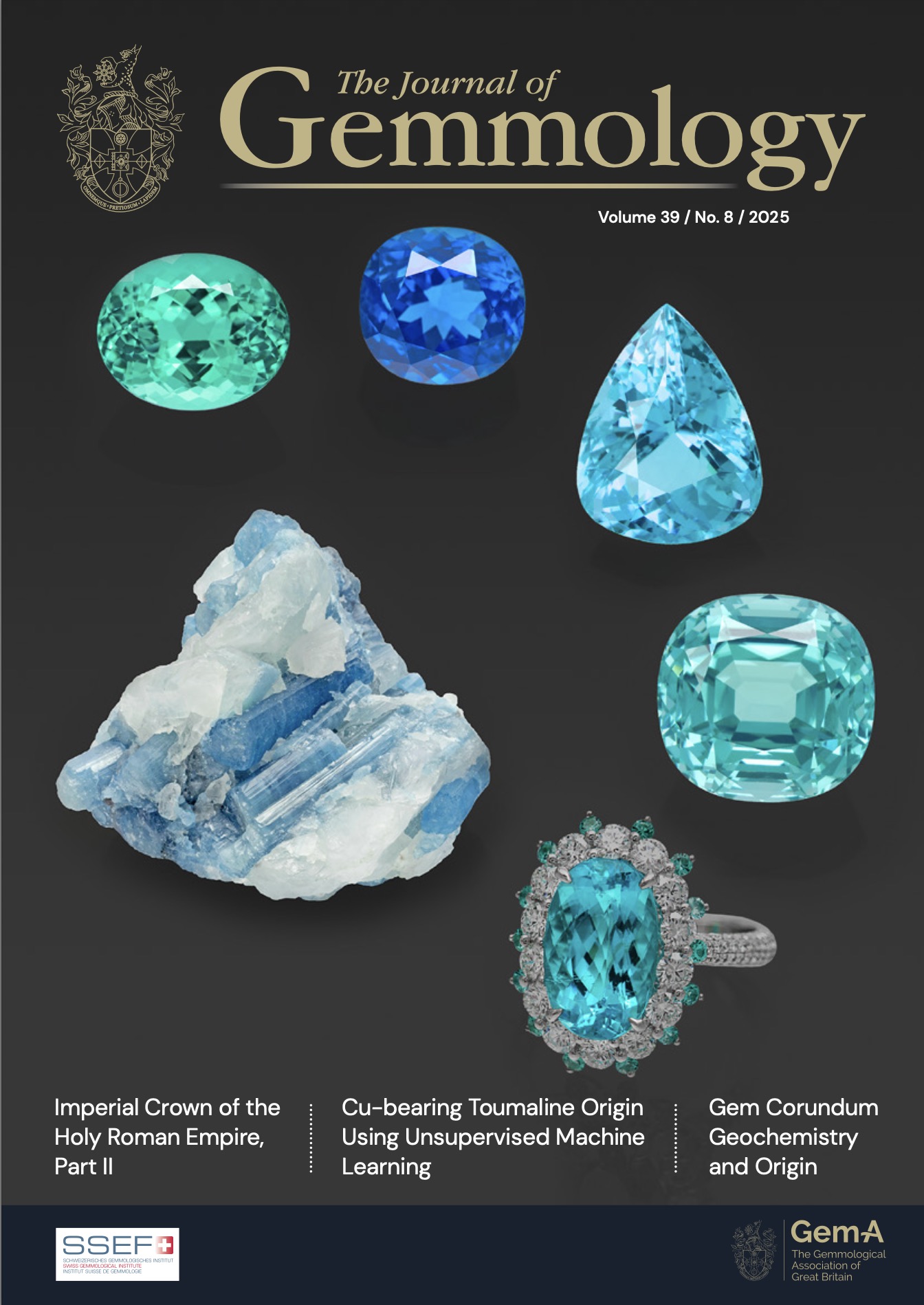
Unsupervised machine learning for the geographic origin determination of Cu-bearing tourmaline
Journal Article
Wang, H.A.O., Krzemnicki, M.S., Wälle, M. and Schultz-Guttler, R.A. (2025) Unsupervised machine learning for the geographic origin determination of Cu-bearing tourmaline. Journal of Gemmology, Vol. 39, No. 8, pp. 772–787.
Close Abstract
Hide Keywords
Copy Reference
gems, tourmaline, cuprian tourmaline, tourmaline heat treatment, Paraíba tourmaline, Brazil, Nigeria, Mozambique
Determining the geographic origin of Cu-bearing tourmaline poses a significant challenge in gemmology, particularly when traditional microscopic methods yield inconclusive results. This study applies a combined analytical and computational approach using 469 gem-quality samples from Brazil, Mozambique, and Nigeria. A total of 57 elements (from Li to U) were quantified using full-mass-spectrum LA-ICP-TOF-MS. The high-dimensional elemental dataset was reduced to interpretable 2D maps using non-linear unsupervised machine-learning algorithms, including t-distributed stochastic neighbour embedding (t-SNE) and uniform manifold approximation and projection (UMAP). These methods successfully identified complex patterns and distinct subgroups, revealing compositional similarities not captured by traditional linear approaches. The resulting clusters provided a clear framework for geographic origin determination of unknown samples. Elemental signatures of key elements (i.e. Na, Ca, Li, Ti, Fe, Mn, Cu, Ga, Sr, La, and Pb) highlighted their influence on clustering and related geochemical variations to colour and geographic origin. Unsupervised machine-learning algorithms do not rely on predefined origin labels. This reduces errors caused by uncertain origin information and helps reveal statistical outliers that may point to new or undocumented sources. By integrating colour information with compositional clustering, the method also provides a possible framework for identifying heat treatment in high-clarity stones.