
Four Treasures Reference Database
Record No. 28203
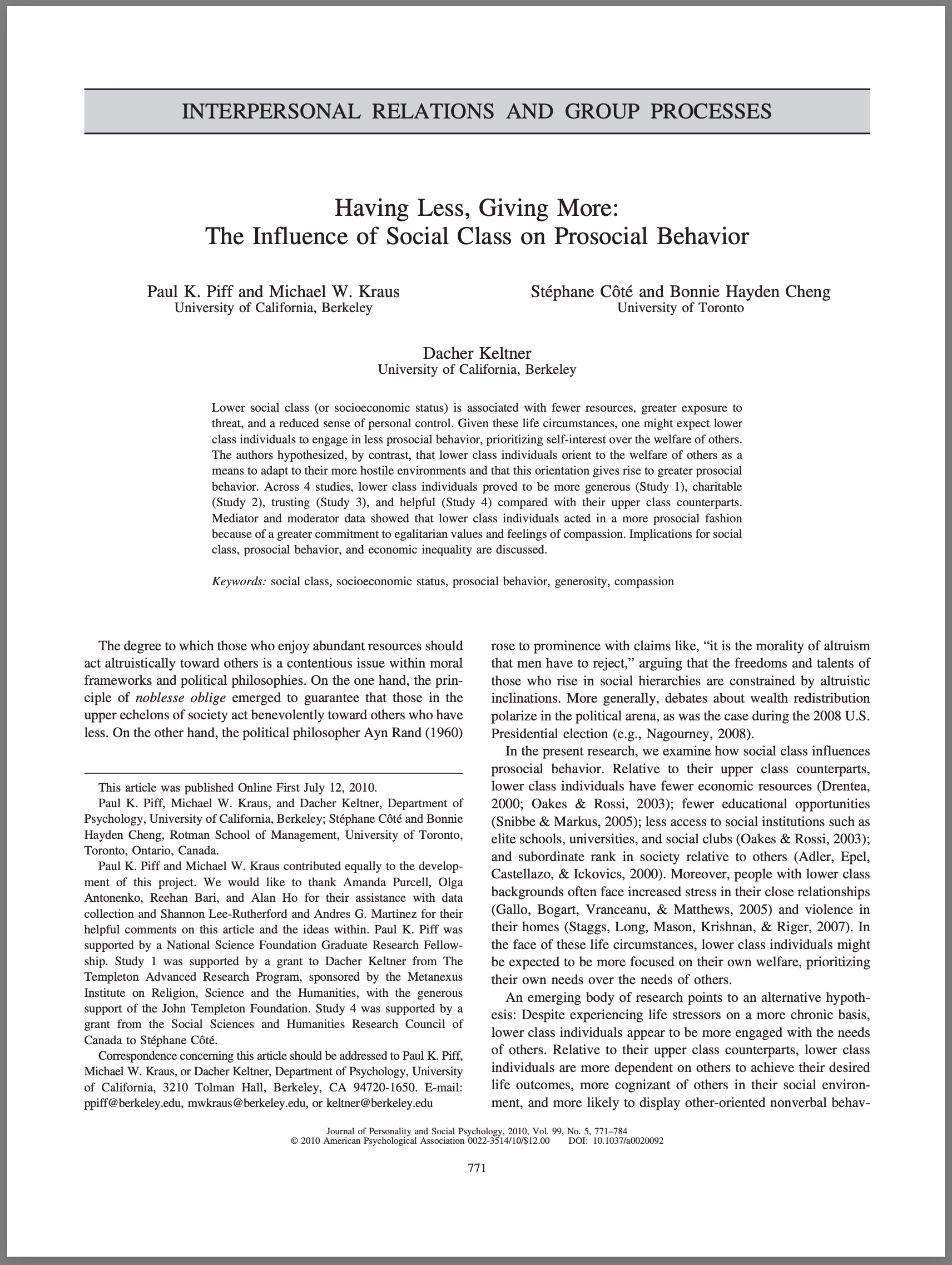
Having less, giving more: The influence of social class on prosocial behavior
Journal Article
Piff, P.K., Kraus, M.W., Côté, S., Cheng, B.H. and Keltner, D. (2010) Having less, giving more: The influence of social class on prosocial behavior. Journal of Personality and Social Psychology, Vol. 99, No. 5, pp. 771–784.
Sinkankas/Born No.: NIS/NIB | RWHL*
gems, AI, artificial intellegence, pyschology, income inequality
Lower social class (or socioeconomic status) is associated with fewer resources, greater exposure to threat, and a reduced sense of personal control. Given these life circumstances, one might expect lower-class individuals to engage in less prosocial behavior, prioritizing self-interest over the welfare of others. The authors hypothesized, by contrast, that lower-class individuals orient to the welfare of others as a means to adapt to their more hostile environments and that this orientation gives rise to greater prosocial behavior. Across four studies, lower-class individuals proved to be more generous ([1]), charitable ([2]), trusting ([3]), and helpful ([4]) compared with their upper-class counterparts. Mediator and moderator data showed that lower-class individuals acted in a more prosocial fashion because of a greater commitment to egalitarian values and feelings of compassion. Implications for social class, prosocial behavior, and economic inequality are discussed.