
Four Treasures Reference Database
Record No. 28240
Research on the identification of filled tourmaline and its filling grade
Journal Article
Dai, S., Qu, W., Xia, Y., Chen, H., Chen, D., Luo, Q. and Xu, S. (2017) Research on the identification of filled tourmaline and its filling grade. Mineralogy and Petrology, Vol. 37, No. 3, pp. 6–15.
DOI: https://dx.doi.org/10.19719/j.cnki.1001-6872.2017.03.002 | Sinkankas/Born No.: NIS/NIB | Language: in Chinese with English abstract | RWHL
gems, tourmaline, oiled, oiling, fissure filling, treatments, enhancements
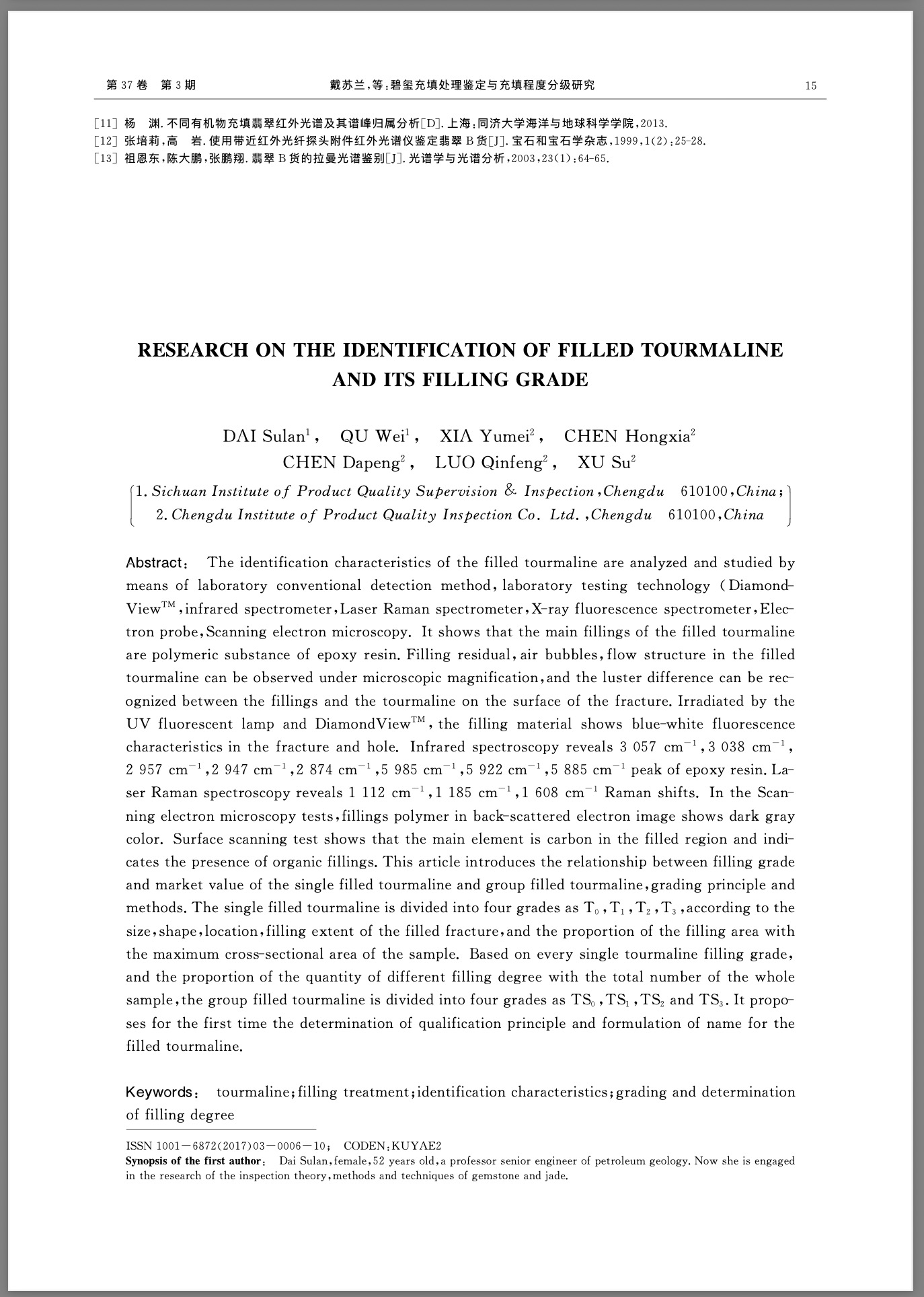
The identification characteristics of the filled tourmaline are analyzed and studied by means of laboratory conventional detection method, laboratory testing technology (Diamond-View™, infrared spectrometer, Laser Raman spectrometer, X-ray fluorescence spectrometer, electron probe, scanning electron microscopy). It shows that the main fillings of the filled tourmaline are polymeric substance of epoxy resin. Filling residual, air bubbles, flow structure in the filled tourmaline can be observed under microscopic magnification, and the luster difference can be recognized between the fillings and the tourmaline on the surface of the fracture. Irradiated by the UV fluorescent lamp and DiamondView™, the filling material shows blue-white fluorescence characteristics in the fracture and hole. Infrared spectroscopy reveals 3057 cm⁻¹, 3038 cm⁻¹, 2957 cm⁻¹, 2947 cm⁻¹, 2874 cm⁻¹, 5985 cm⁻¹, 5922 cm⁻¹, 5885 cm⁻¹ peak of epoxy resin. Laser Raman spectroscopy reveals 1112 cm⁻¹, 1185 cm⁻¹, 1608 cm⁻¹ Raman shifts. In the scanning electron microscopy tests, filling polymer in back-scattered electron image shows dark gray color. Surface scanning test shows that the main element is carbon in the filled region and indicates the presence of organic fillings. This article introduces the relationship between filling grade and market value of the single filled tourmaline and group filled tourmaline, grading principle and methods. The single filled tourmaline is divided into four grades as T0, T1, T2, T3, according to the size, shape, location, filling extent of the filled fracture, and the proportion of the filling area with the maximum cross-sectional area of the sample. Based on every single tourmaline filling grade, and the proportion of the quantity of different filling degree with the total number of the whole sample, the group filled tourmaline is divided into four grades as TS0, TS1, TS2 and TS3. It proposes for the first time the determination of qualification principle and formulation of name for the filled tourmaline.