
Four Treasures Reference Database
Record No. 28278
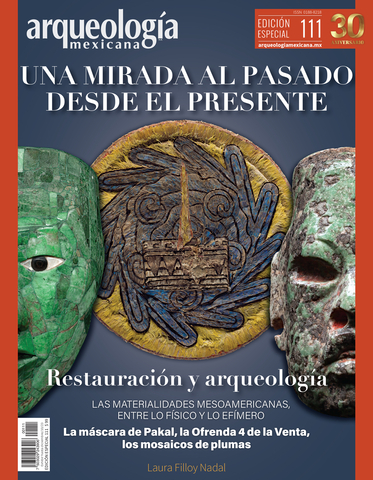
La máscara mortuoria de K’inich Jannab’ Pakal
The funerary mask of K’inich Janaab’ Pakal
Journal Article
Filloy Nadal, L. (2023) La máscara mortuoria de K’inich Jannab’ Pakal. [The funerary mask of K’inich Janaab’ Pakal] Arqueología Mexicana, edición especial, Dedicado a: Una mirada al pasado desde el presente. Restauración y arqueología, No. 111, October, pp. 20–33.
Sinkankas/Born No.: NIS/NIB | Language: in Spanish | not seen
gems, jade, jadeite, fei cui, Mesoamerica, Mexico, Guatemala, Costa Rica, Mayans, Olmecs, Aztecs, archaeology, history, archaeogemology
To create Pakal’s mask, the artisans selected six shades of green stones. Each tone was used in a different area of the face to define an anatomical feature or an ornament, and even to draw the viewer’s attention toward the central part of the face. For example, three pieces of a light, intense green colour were used to represent the central jewel of a diadem, while several thinner emerald-coloured plaques were used for the ends of the diadem. The central area of the face was made with the greenest and most brilliant jade, also called “imperial jade,” while the hair was represented with a darker, mottled tone. It is evident that there is a kind of bilateral symmetry between the tesserae and that their forms are similar on both sides of the face, both in position and in shape or colour. The pieces fit together exactly because the tesserae have bevelled edges that were cut at 45 degrees; in addition, a wooden backing, which did not survive the passage of the centuries, and a lime paste as cement were used. During the restoration, we realised that there was a logical sequence for assembling the tesserae of the mosaic.