
Four Treasures Reference Database
Record No. 28280
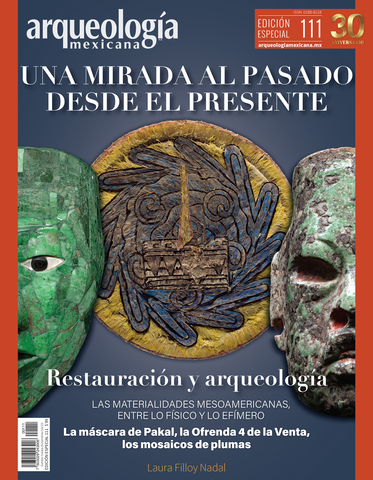
Conclusiones (Mosaicos de plumas)
Conclusions
Journal Article
Filloy Nadal, L. (2023) Conclusiones (Mosaicos de plumas). [Conclusions] Arqueología Mexicana, edición especial, Dedicado a: Una mirada al pasado desde el presente. Restauración y arqueología, No. 111, October, pp. 76–81.
Sinkankas/Born No.: NIS/NIB | Language: in Spanish | not seen
gems, jade, jadeite, fei cui, Mesoamerica, Mexico, Guatemala, Costa Rica, Mayans, Olmecs, Aztecs, archaeology, history, archaeogemology
The physical properties of materials contribute to the aesthetic and symbolic qualities of an object, but they are also powerful instruments for triggering emotional responses. It is precisely the aesthetic response that amplifies the material ability of objects to communicate and to determine their role in communal social life (Filloy Nadal, 2017). Reflecting on the intangible elements that gave rise to the different artefacts is not a simple task. Nor is it easy to imagine these objects in use, in situations where, for example, the attire and the wearer had to be seen as a unity, and the material components had to distinguish the bearer and project sumptuousness. During religious rituals, visual effects were surely of primary importance. However, one must also consider the elements that distinguished the individual himself, his personhood, such as the intentional modification of the skull, the manner in which he moved, the gestures he performed, or the sounds that accompanied him. The manufacture of the objects studied reflects complex production processes involving multiple participants and materials originating from different places. It is possible to reconstruct these processes, and this will lead us to appreciate their social significance. However, to understand the effect of their use, imagination is required.