
Four Treasures Reference Database
Record No. 2835
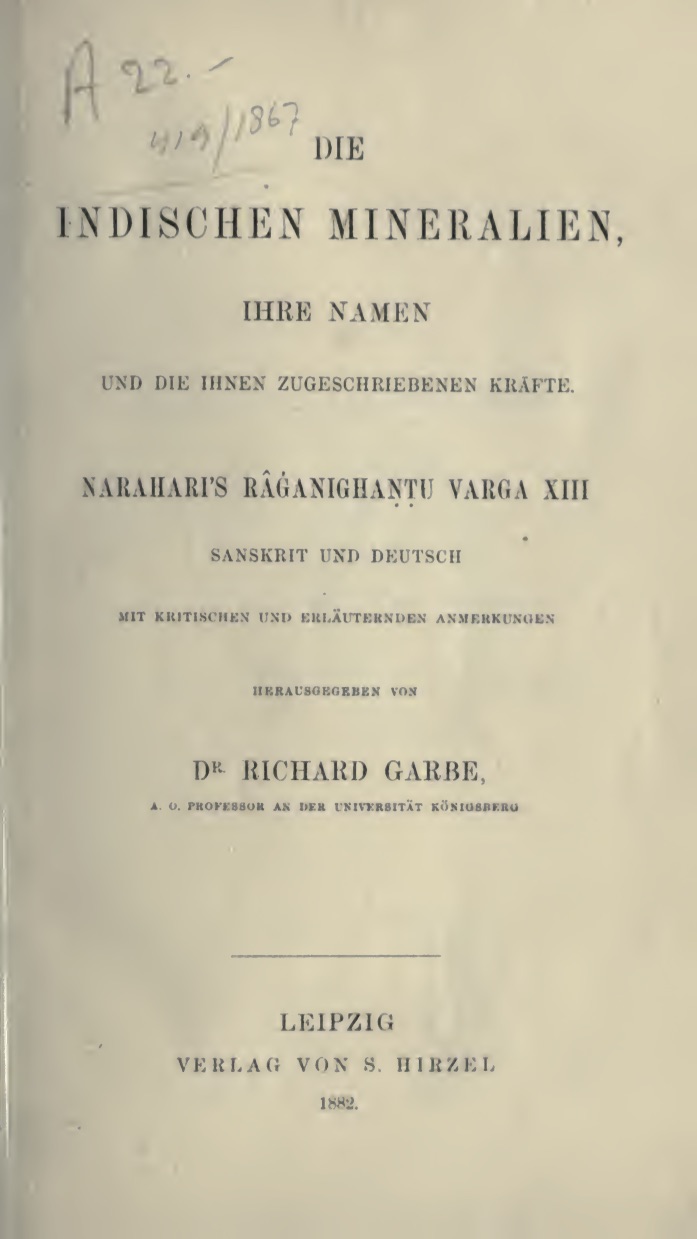
Die Indischen Mineralien, Ihre Namen und die Ihnen Zugeschriebenen Kräfte
The Indian Minerals, Their Names and the Powers Attributed to Them
Book
Narahari (or Naraharipandita) and Garbe, R. (1882) Die Indischen Mineralien, Ihre Namen und die Ihnen Zugeschriebenen Kräfte. [The Indian Minerals, Their Names and the Powers Attributed to Them] Leipzig, Verlag Von S. Hirzel, 104 pp.
Sinkankas/Born No.: 4691; NIB | Language: in German | RWHL
Close Abstract
Hide Keywords
Copy Reference
corundum, ruby, sapphire, history.1, India.12, gems, Indian lapidary
Sinkankas: Richard von Garbe’s complete work is reproduced in facsimile, including the original title page, and centers on his discovery and translation of a significant Sanskrit treatise on minerals by the Kashmiri physician Narahari. Despite the general absence of Sanskrit monographs on minerals, Garbe uncovered Narahari’s work, a section of the larger encyclopedic text King of Dictionaries, written between 1235 and 1250 AD. The translated extracts are organized into three categories: metals, non-metals, and precious stones, the last of which spans pages 70 to 91 in the German edition. This section includes discussions on the nine classical gemstones of Indian tradition—ruby, pearl, coral, emerald, topaz, diamond, sapphire, hyacinth, and cat’s-eye—as well as other stones like rock crystal, sunstone, moonstone, lapis lazuli, and turquoise. Each entry provides Indian synonyms, medicinal uses, and notes on color and quality, along with astrological associations. Garbe relied extensively on Tagore’s Mani Mala, though he acknowledged its shortcomings and urged cautious use. His translation remains a valuable contribution to early Indian gemological literature and a crucial supplement to Tagore’s work.