
Four Treasures Reference Database
Record No. 28352
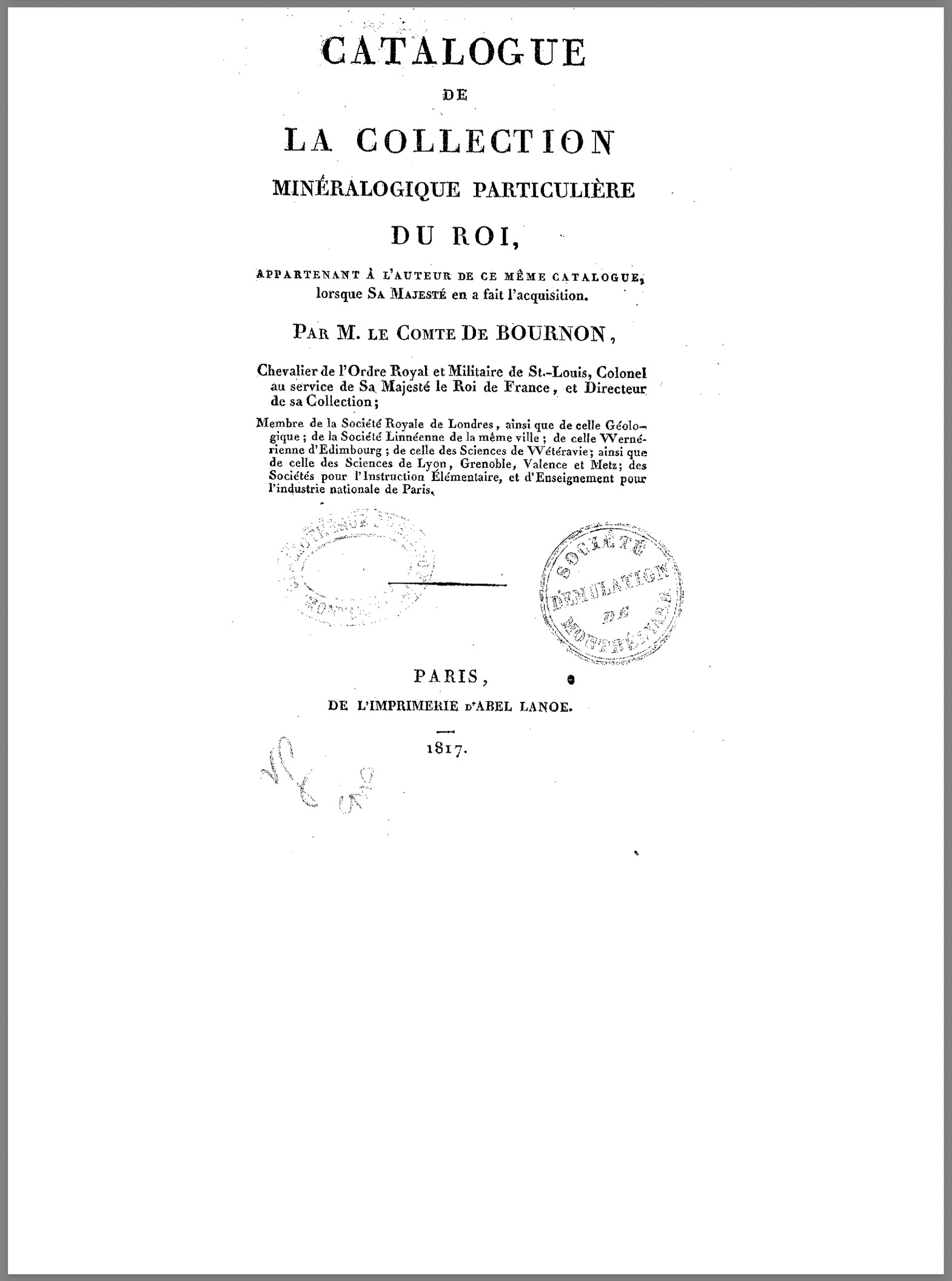
Catalogue de la Collection Minéralogique particulière du Roi
Catalog of the King's Private Mineralogical Collection
Book
Bournon, J.-L., de (1817) Catalogue de la Collection Minéralogique particulière du Roi. [Catalog of the King's Private Mineralogical Collection] Paris, Abel Lanoe, 557 pp.
Sinkankas/Born No.: 827: NIB | Language: in French | RWHL
gems, corundum, history.1, chemistry.2
This Catalogue first appeared, for the first time, at the end of the year 1813, when particular circumstances led me to feel the desire to part with my collection. At that time I had already been in England for nearly twenty years. The Battle of Battle of Leipzig, which soon afterwards took place, allowed me to glimpse the long-desired moment when my legitimate sovereign would be restored to the throne of his ancestors, and the worthy and respected princes of his august house reinstated in their rights. From that moment, I desired only to bring back to my homeland the fruit of the immense labour to which I had devoted myself ever since its deplorable and most unfortunate Revolution had voluntarily exiled me from it. I abandoned the project of selling my collection and became irrevocably attached to it. I had not been mistaken: the events that the outcome of this battle had led me to foresee soon came to pass. France, restored to herself, recalled to the inalienable right of ruling over her the illustrious family under whose ancestors she had risen to such a high degree of splendour, and whose exile and misfortunes had been the prelude to those of all Europe, which could not expect to remain forever the peaceful spectator of the crimes committed during that period. I had sacrificed absolutely everything in order to remain faithful to that family; its return to France restored to me a homeland toward which my desires and my hopes had ceaselessly turned, for more than twenty-five years, with regret and sorrow. I soon returned there, and upon my arrival I was rewarded for the many sacrifices that my constancy in fulfilling, without hesitation, all that my principles — the fruit of my fathers’ education — had always caused me to regard as duty, had led me to make. The King, to whom nothing concerning human knowledge is foreign, was gracious enough to acquire my mineralogical collection for himself, while entrusting me with its direction in his service. My wishes could not have been more completely satisfied: my love of tranquillity, my taste for work, and my desire to make that work useful — the only ambition to which my soul can today remain open — all these were contained in His Majesty’s act of kindness toward me. My gratitude can only be equalled by the wishes I form for the prosperity of his reign and for his happiness, so closely bound to that of the princes of his illustrious family. May those wishes be fulfilled! And may my beautiful homeland, through its return to justice, morality, and religion — inseparable foundations of the happiness of society — forget its errors and its misfortunes, just as a sick man forgets his most painful sufferings when health has been restored to him!