
Four Treasures Reference Database
Record No. 28353
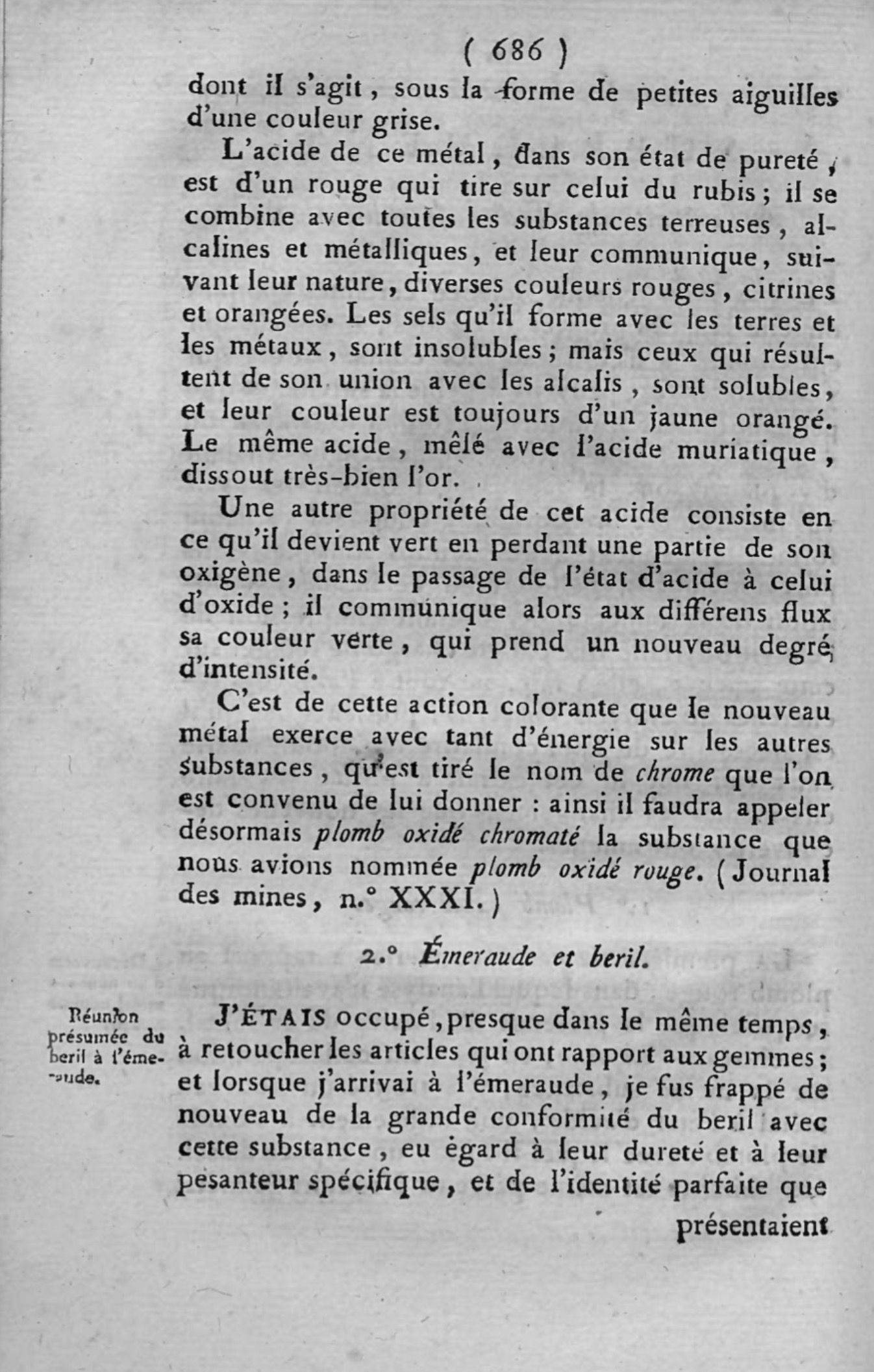
Émeraude at béril
Emerald and beryl
Journal Article
Haüy, R.J. (1797) Émeraude at béril. [Emerald and beryl] Journal des Mines, Vol. 6, No. 33, pp. 686–688.
Sinkankas/Born No.: NIS/NIB | Language: in French | RWHL*
gems, beryl, emerald, history of emerald, history of gemology, nomenclature
Emerald and beryl. I was occupied, at nearly the same time, in revising the articles relating to gemstones; and when I came to the emerald, I was struck anew by the great conformity of beryl with this substance, with regard to their hardness and specific gravity, and by the perfect identity presented by the figure and dimensions of their constituent molecules, and even by their secondary forms.¹ In truth, they had appeared to differ from one another only by refraction, which is double in the emerald, and which I had found to be simple in beryl. A very limpid prism of the latter substance had never given me more than a single image of objects, even when I viewed light placed at a distance of more than fifty toises. But recent investigations on double refraction in general led me to suspect that in every crystal possessing double refraction there exists one direction in which the image is sensibly simple, as Giovanni Battista Beccaria had already remarked concerning rock crystal. I first attempted to verify this suspicion by means of carbonate of lime, determining beforehand the manner in which one of the rhomboids known under the name Iceland spar should be cut so that, in a certain position of the eye, the two images would coincide into one. In this investigation I was guided by the knowledge acquired concerning the laws governing the double refraction of carbonate of lime, as I had explained elsewhere;² and experiment confirmed the result predicted by theory. Since analogous effects, obtained with other doubly refracting minerals, raised no doubts in my mind concerning those presented by the prism of beryl, I had a second prism cut in a different direction, and I observed that it doubled images, though only to a moderate degree; yet even in this it still approached the emerald. Thus, all the physical and geometrical characters concur in calling for the union of these two substances,³ and all that is now lacking is an analysis of beryl which, by its exactness, would deserve comparison with that which Martin Heinrich Klaproth gave for emerald, so that we may know what conclusion should be drawn from a rapprochement which mineralogy must not permit itself to make until it has obtained the consent of chemistry. The result that I have just announced will require precautions on the part of those who wish to determine whether the refraction of a mineral is simple or double. But since it seems to me that we now possess a rule for determining the direction in which only a single image is seen, it will be easy to avoid error. Theory will thereby have gained, and observation will be made more certain. ⸻ ¹ At that time beryl was known only in the form of the regular hexagonal prism, when observations made on several crystals of this gem which I had found in commerce, or had myself detached from a fragment of rock brought from Siberia, offered me a very marked rapprochement between the modifying facets on the summits of these crystals and those existing on varieties of emerald. See Journal des mines, no. XIX, p. 72. ² Mémoires de l’Académie des sciences, 1788, p. 34 ff.; Journal des Mines, Prairial, Year V. ³ Besides, the molecules here possess characters of regularity which might place them among the forms common to different substances. See Journal des mines, no. XIX, p. 72.