
Four Treasures Reference Database
Record No. 28366
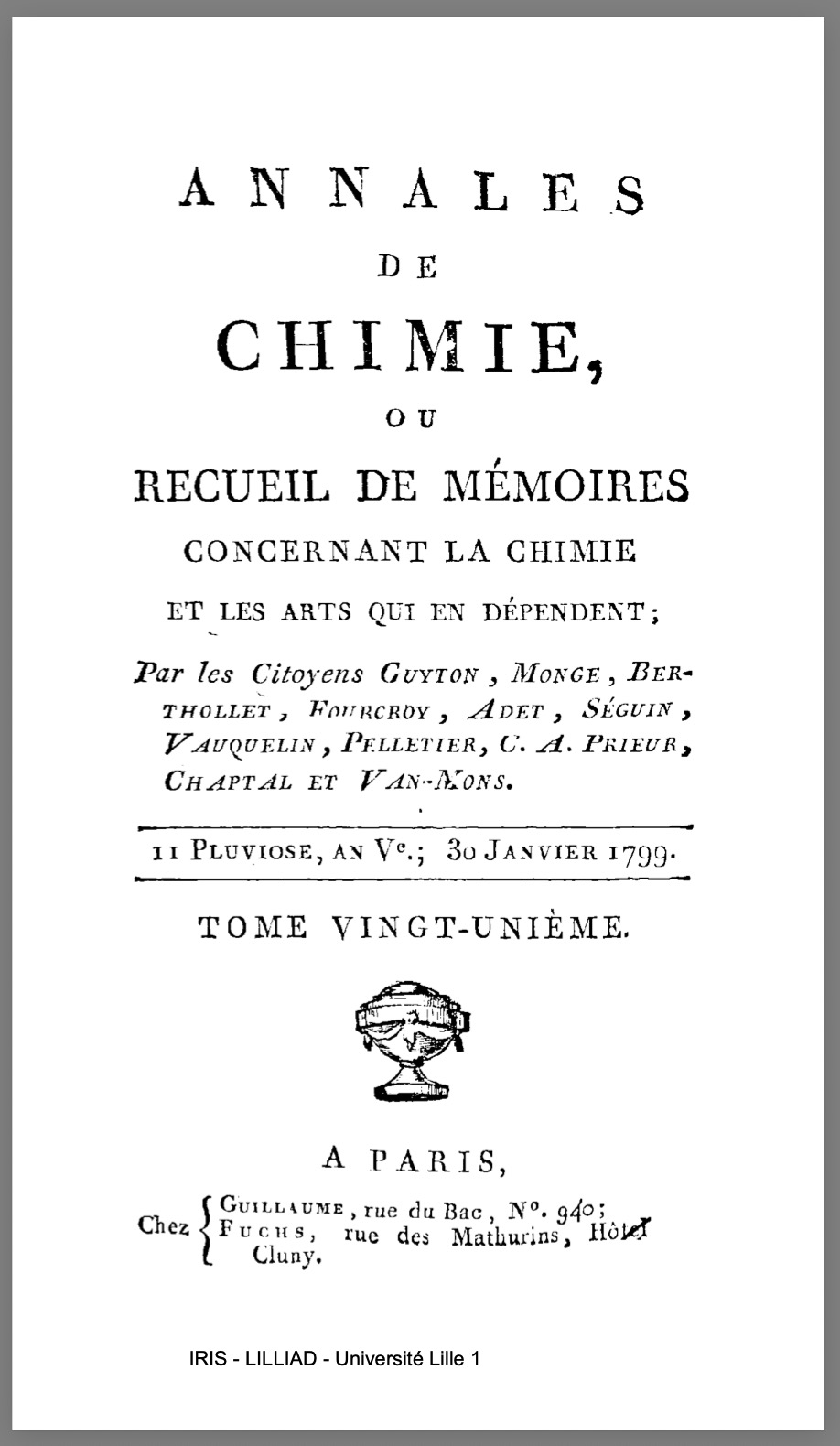
Mémoire sur l'Hyacinthe de France, congénère à celle de Ceylan, et sur la nouvelle terre simple qui entre dans sa composition
Memoir on the hyacinth of France, akin to that of Ceylon, and on the new simple earth that enters into its composition
Journal Article
Guyton de Morveau, L.-B. (1797) Mémoire sur l'Hyacinthe de France, congénère à celle de Ceylan, et sur la nouvelle terre simple qui entre dans sa composition. [Memoir on the hyacinth of France, akin to that of Ceylon, and on the new simple earth that enters into its composition] Annales de Chimie, Vol. 22, pp. 72–95.
Sinkankas/Born No.: NIS/NIB | Language: in French | RWHL
gems, hyacinth, zircon, history of gemology, Ceylon, Sri Lanka
One of the chemists who has devoted the most attention in recent times to the analysis of minerals, Martin Heinrich Klaproth of Berlin, announced in 1789 that he had extracted from stones known under the name jargon de Ceylan [Ceylon jargon], in the proportion of 0.60, an earth which could not be identified by its properties with any of the five previously discovered substances generally classified among the earths. This scholar rightly imagined that, in the present state of science, which has made those who cultivate it more rigorous in the examination of facts, this new principle would be admitted only after a series of confirmatory experiments. He therefore invited naturalists to direct their researches toward this object; and, in the collection of analyses which he has just published, he complains that they have not responded to his invitation. He attributes this to the rarity of the mineral, and hopes to remove this obstacle to the confirmation of his experiments by indicating the same earth as a constituent part, in at least equal quantity, of a somewhat more common material, the hyacinth of Ceylon.