
Four Treasures Reference Database
Record No. 28383
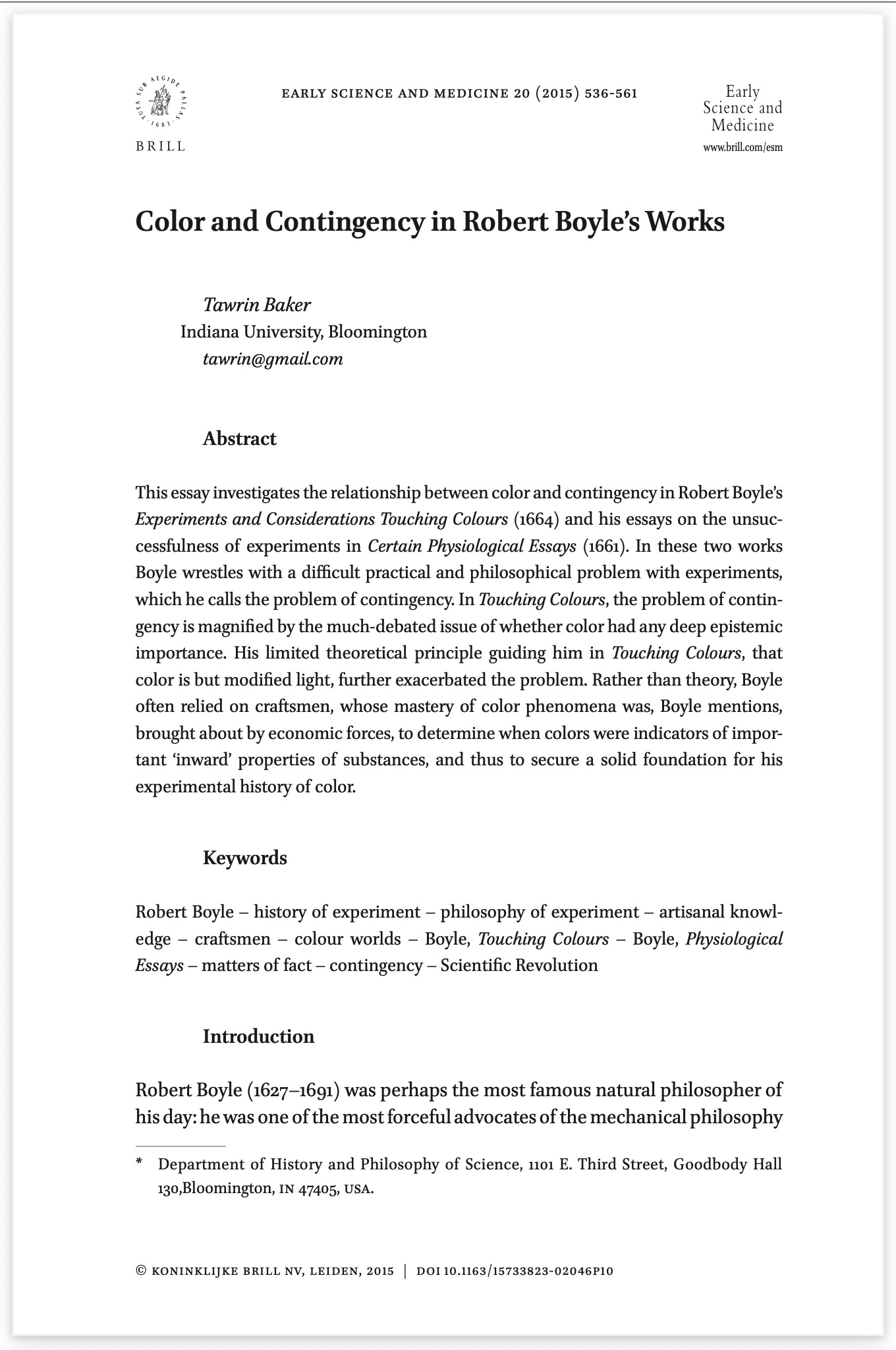
Color and contingency in Robert Boyle’s Works
Journal Article
Baker, T. (2015) Color and contingency in Robert Boyle’s Works. Early Science and Medicine, Vol. 20, pp. 536–561.
gems, color science, color theory, art, anthropology
This essay investigates the relationship between color and contingency in Robert Boyle’s Experiments and Considerations Touching Colours (1664) and his essays on the unsuccessfulness of experiments in Certain Physiological Essays (1661). In these two works Boyle wrestles with a difficult practical and philosophical problem with experiments, which he calls the problem of contingency. In Touching Colours, the problem of contingency is magnified by the much-debated issue of whether color had any deep epistemic importance. His limited theoretical principle guiding him in Touching Colours, that color is but modified light, further exacerbated the problem. Rather than theory, Boyle often relied on craftsmen, whose mastery of color phenomena was, Boyle mentions, brought about by economic forces, to determine when colors were indicators of important ‘inward’ properties of substances, and thus to secure a solid foundation for his experimental history of color.