
Four Treasures Reference Database
Record No. 28390
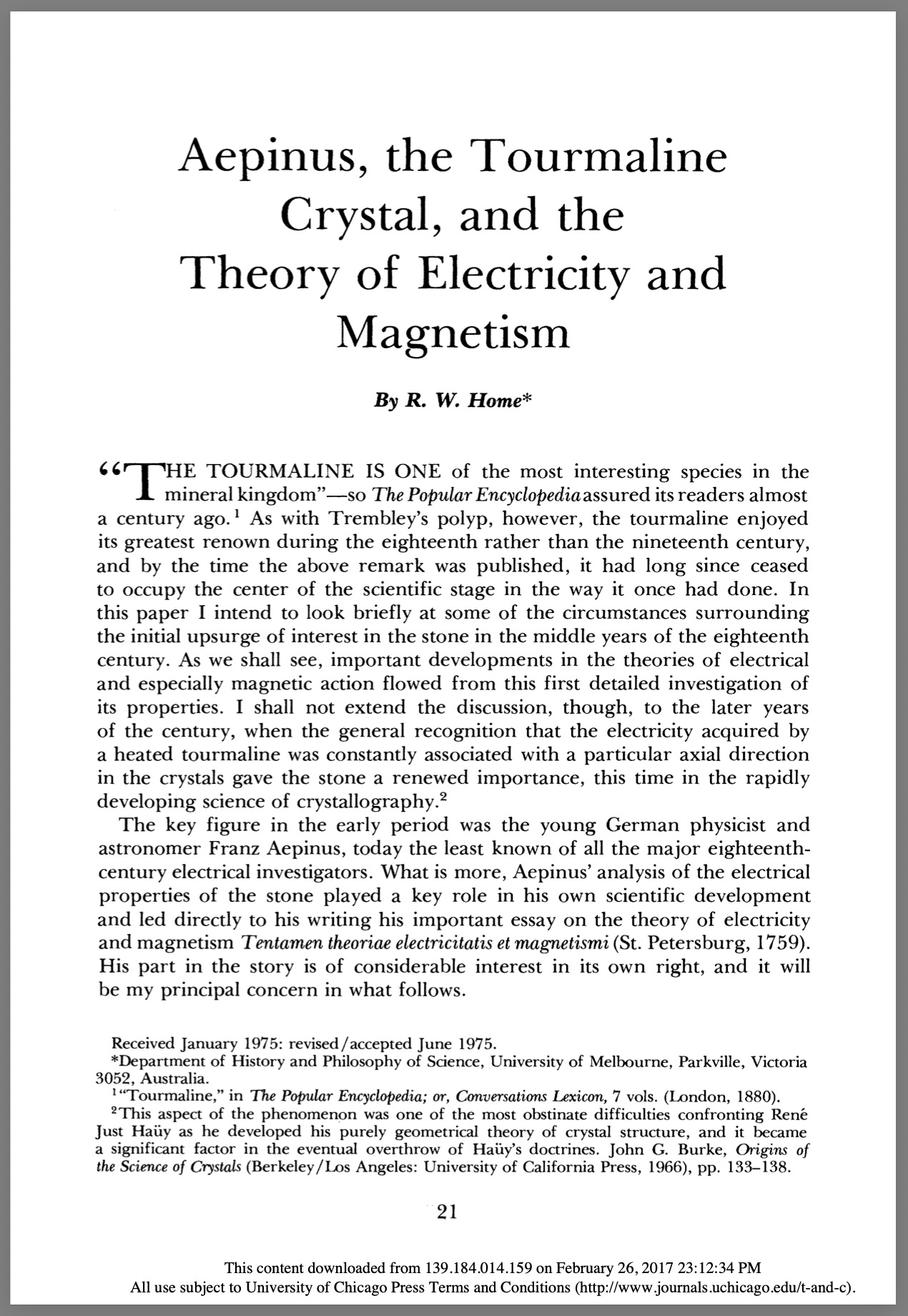
Aepinus, the tourmaline crystal, and the theory of electricity and magnetism
Journal Article
Home, R.W. (1976) Aepinus, the tourmaline crystal, and the theory of electricity and magnetism. Isis, Vol. 67, No. 1, pp. 21–30.
ISBN/ISSN: 00211753, 15456994 | Sinkankas/Born No.: NIS/NIB | RWHL
gems, history of gemology, tourmaline
The tourmaline is one of the most interesting species in the mineral kingdom”—so The Popular Encyclopedia assured its readers almost a century ago. As with Abraham Trembley’s polyp, however, the tourmaline enjoyed its greatest renown during the eighteenth rather than the nineteenth century, and by the time the above remark was published, it had long since ceased to occupy the centre of the scientific stage in the way it once had done. In this paper I intend to look briefly at some of the circumstances surrounding the initial upsurge of interest in the stone in the middle years of the eighteenth century. As we shall see, important developments in the theories of electrical and especially magnetic action flowed from this first detailed investigation of its properties. I shall not extend the discussion, though, to the later years of the century, when the general recognition that the electricity acquired by a heated tourmaline was constantly associated with a particular axial direction in the crystals gave the stone a renewed importance, this time in the rapidly developing science of crystallography.