
Four Treasures Reference Database
Record No. 28398
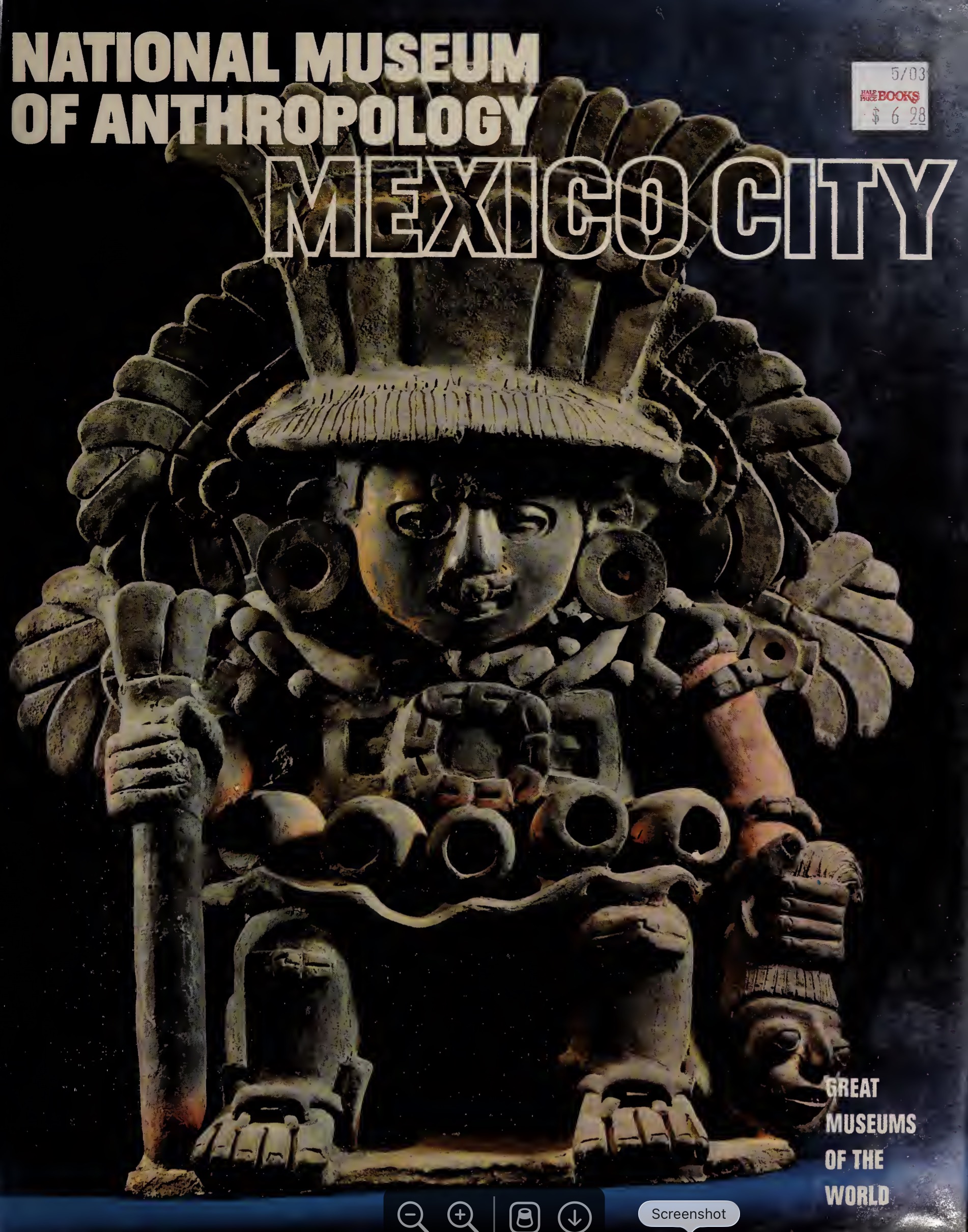
National Museum of Anthropology, Mexico City
Book
Ragghianti, C.L. and Collobi, L.R. (1971) National Museum of Anthropology, Mexico City. New York, Newsweek, 172 pp.
ISBN/ISSN: 088225233X | Sinkankas/Born No.: NIS/NIB | RWHL
gems, jade, jadeite, fei cui, Mesoamerica, Mexico, Guatemala, Costa Rica, Mayans, Olmecs, Aztecs, archaeology, history, archaeogemology
The ancient roots of Mexican civilization, as seen in its art and artifacts, are on view in the pages of this book, just as they are in the National Museum of Anthropology itself. Here the reader encounters the treasures of pre-Hispanic Mexico, as on a guided tour through the Museum’s splendours led by its Director. These range from the earliest traces of primitive civilizations to the most refined examples of sixteenth-century Aztec culture — from the small figures and pottery of the twelfth century B.C. Pre-Classic period, and the urns, frescoes and colossal statues of the Classic period, to the ceremonial dishes, ornaments and giant votive tablets of the Postclassic era, when the Spanish conquistadors first set foot in the new world of Mexico. From Tlatilco comes one of the earliest and most original creations of representational art in the Valley of Mexico, the Kneeling Woman Kissing a Dog, a small masterpiece that is highly personal and remarkably sophisticated in composition. From the Olmec culture comes the Group of Figures, composed of sixteen standing male statuettes arranged in an exceptionally impressive tableau, reproduced here in a magnificent double spread. Also represented are such masterpieces of the Classic period as the Seated Woman, a fifth-century image of sovereign authority embodying the goddess of fertility, sensual in its vibrant play of light and shade, and the figure of the god Tlaloc, innocent and refined, pouring upon the earth the life-giving waters that nourish the crops. The genius of later Mexican art is seen in the fourteenth-century Flower Prince, a sacred portrait of Xochipilli, the Aztec god of spring, love, poetry and dance, which combines floral elements with geometric simplicity; the Crouching Rabbit, an exquisite rock-crystal sculpture of exceptional balance and compact stylization; and, crowning the collection, the giant Sun Stone, representing the history of the world — abstract, occult and filled with the fire and movement of the Aztec universe.