
Four Treasures Reference Database
Record No. 28404
A cache of early jades from Chacsinkin, Yucatan
Journal Article
Andrews, E.W. (1987) A cache of early jades from Chacsinkin, Yucatan. Mexicon, Vol. 9, No. 4, pp. 78–85.
ISBN/ISSN: 7205988 | Sinkankas/Born No.: NIS/NIB | RWHL
gems, jade, jadeite, fei cui, Mesoamerica, Mexico, Guatemala, Costa Rica, Mayans, Olmecs, Aztecs, archaeology, history, archaeogemology
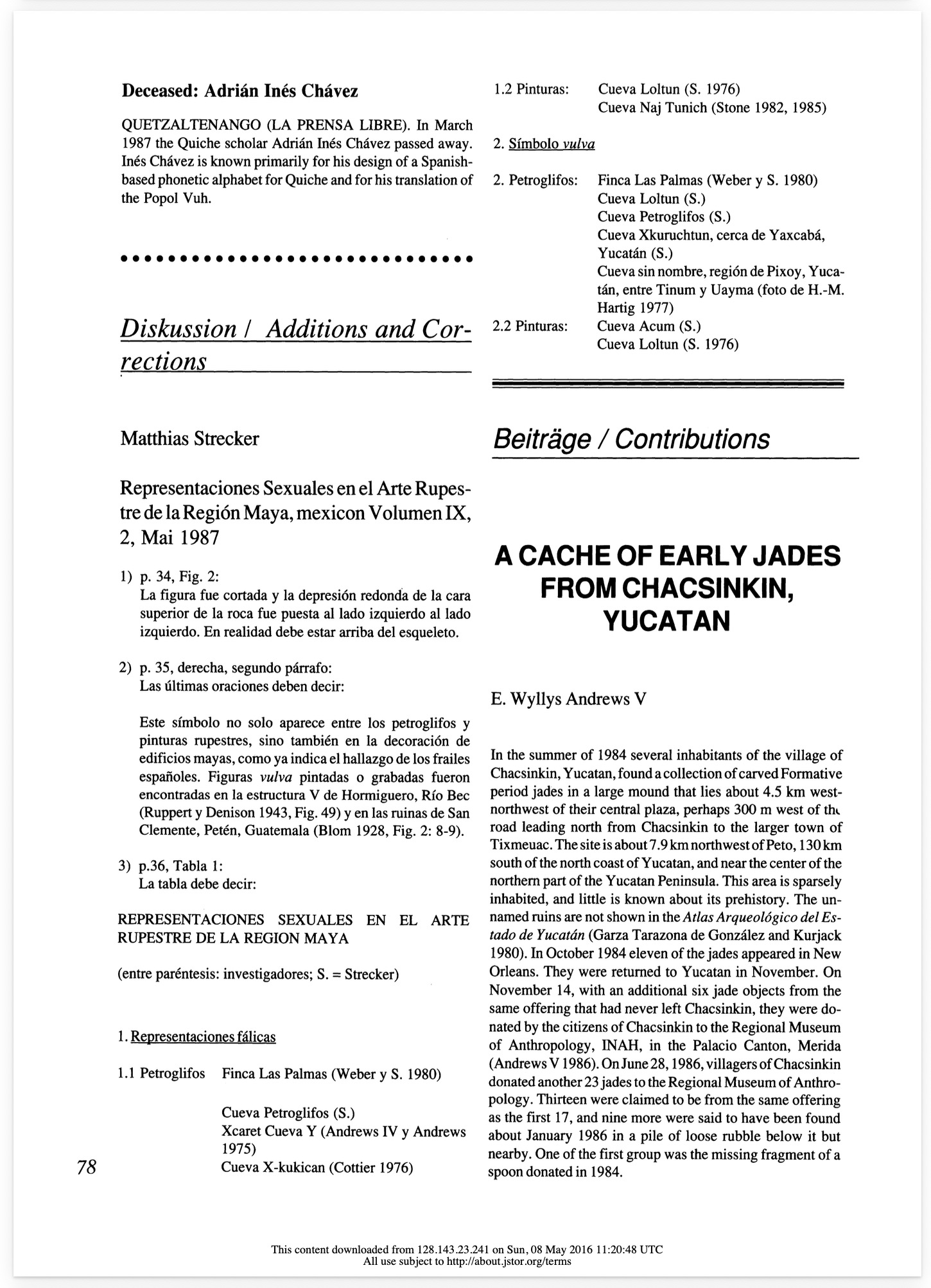
In the summer of 1984, several inhabitants of the village of Chacsinkín, Yucatán, discovered a collection of carved Formative-period jades within a large mound situated about 4.5 km west-northwest of the village plaza and approximately 300 m west of the road leading north from Chacsinkín to the larger town of Tixmeuac. The site lies about 7.9 km northwest of Peto, 130 km south of the northern coast of Yucatán and near the centre of the northern Yucatán Peninsula. This region is sparsely inhabited and little is known of its prehistory. The unnamed ruins are not recorded in the Atlas Arqueológico del Estado de Yucatán (Garza Tarazona de González and Kurjack, 1980). In October 1984, eleven of the jade objects appeared in New Orleans, but they were returned to Yucatán the following month. On 14 November, together with an additional six jade objects from the same offering that had never left Chacsinkín, they were donated by the citizens of Chacsinkín to the Regional Museum of Anthropology of INAH in the Palacio Cantón, Mérida (Andrews V, 1986). On 28 June 1986, villagers of Chacsinkín donated another twenty-three jades to the Regional Museum of Anthropology. Thirteen were said to belong to the same offering as the original seventeen objects, while nine others were reportedly found around January 1986 in a pile of loose rubble below and near the original deposit. One object from the first group proved to be the missing fragment of a spoon donated in 1984.