
Four Treasures Reference Database
Record No. 28434
The Crown Jewel of Belize: The Jade Head
Web Page
Anonymous (n.d.) The Crown Jewel of Belize: The Jade Head. travelbelize.org, <https://www.travelbelize.org/blog/the-crown-jewel-of-belize-the-jade-head/>, accessed: 23 May.
Sinkankas/Born No.: NIS/NIB | RWHL
gems, jade, jadeite, fei cui, Guatemala, Mesoamerica, Belize
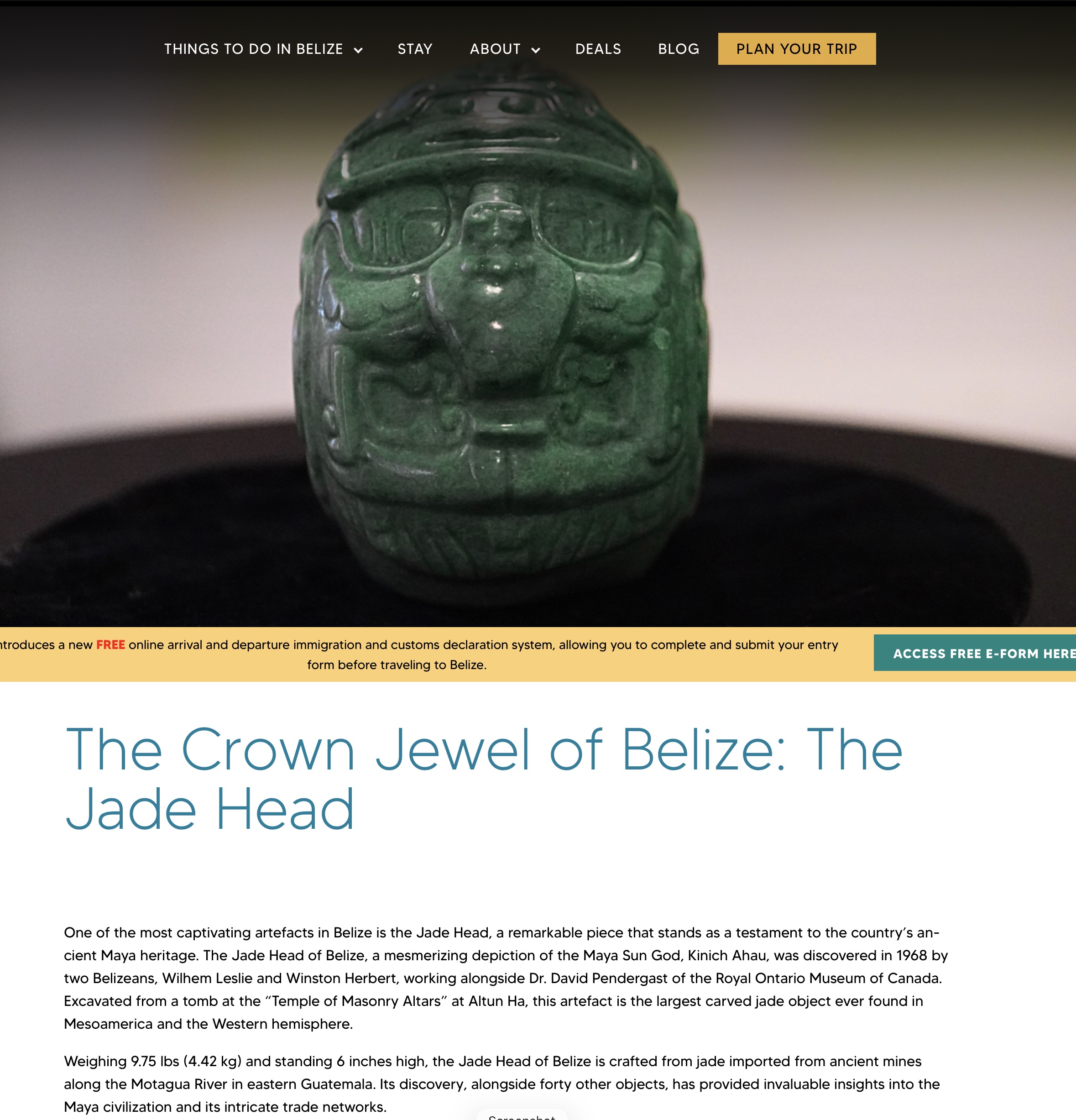
One of the most captivating artifacts in Belize is the Jade Head of Belize, a remarkable object that stands as a testament to the country’s ancient Maya heritage. This striking depiction of the Maya Sun God, Kinich Ahau, was discovered in 1968 by Wilhem Leslie and Winston Herbert, working alongside David Pendergast of the Royal Ontario Museum. Excavated from a tomb within the “Temple of Masonry Altars” at Altun Ha, the artifact is the largest carved jade object ever discovered in Mesoamerica and the Western Hemisphere. Weighing 9.75 pounds (4.42 kg) and standing six inches high, the Jade Head was carved from jade imported from the ancient jade sources along the Motagua River in eastern Guatemala. Its discovery, together with forty other objects, has provided valuable insight into Maya civilization and its extensive trade networks. Altun Ha, meaning “Rockstone Water” in Yucatec Maya, was an important ceremonial center that flourished during the Classic Period. Located near Rockstone Pond along the old northern highway, the site functioned as a major trading link between the Caribbean coast and settlements in the interior. At its peak, around A.D. 500–600, Altun Ha is estimated to have supported a population of between 8,000 and 10,000 inhabitants. The tomb in which the Jade Head was found also contained the remains of an elderly male believed to have held high social status, underscoring the wealth and influence of the city’s elite. Today, the Jade Head of Belize is celebrated as the national treasure of Belize. Beyond its immense archaeological importance, it has become a symbol of national identity and appears on all Belizean paper currency. More recently, the artifact was featured at the launch of Access501, a learning platform created by the Ministry of Education, Culture, Science, and Technology, through which visitors can explore digital 3D models of the Jade Head and other Maya artifacts created in collaboration with the Institute of Archaeology.