
Four Treasures Reference Database
Record No. 28457
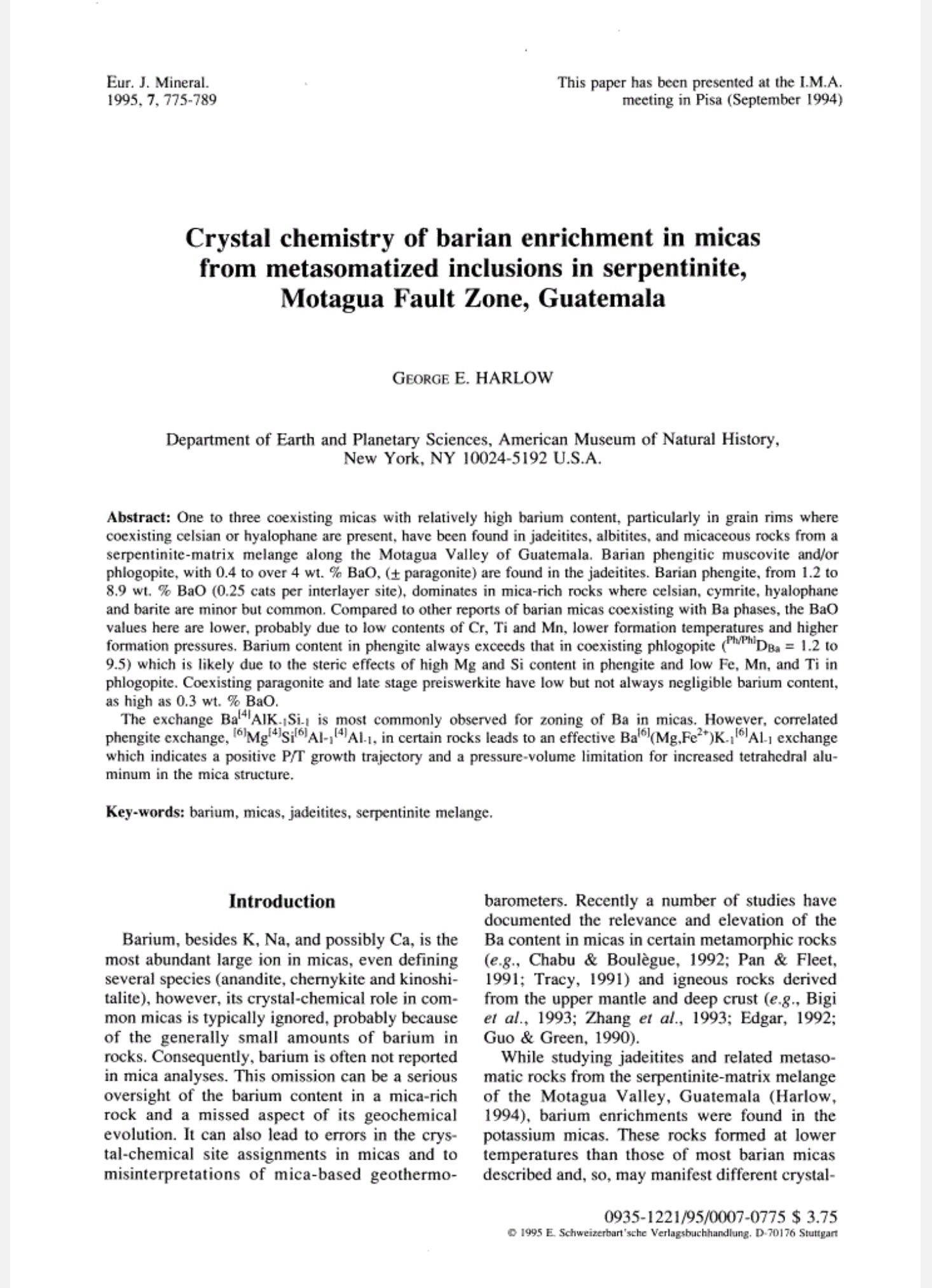
Crystal chemistry of barian enrichment in micas from metasomatized inclusions in serpentine, Motagua fault zone, Guatemala
Journal Article
Harlow, G.E. (1995) Crystal chemistry of barian enrichment in micas from metasomatized inclusions in serpentine, Motagua fault zone, Guatemala. European Journal of Mineralogy, Vol. 7, No. 4, pp. 775–789.
Sinkankas/Born No.: NIS/NIB | not seen
gems, jade, jadeite, fei cui, Guatemala, Mesoamerica, Costa Rica, Mexico, geology
Abstract One to three coexisting micas with relatively high barium content, particularly in grain rims where coexisting celsian or hyalophane are present, have been found in jadeitites, albitites, and micaceous rocks from a serpentinite-matrix mélange along the Motagua Valley of Guatemala. Barian phengitic muscovite and/or phlogopite, with 0.4 to over 4 wt.% BaO (± paragonite), are found in the jadeitites. Barian phengite, from 1.2 to 8.9 wt.% BaO (0.25 cations per interlayer site), dominates in mica-rich rocks where celsian, cymrite, hyalophane and barite are minor but common. Compared to other reports of barian micas coexisting with Ba phases, the BaO values here are lower, probably due to low contents of Cr, Ti and Mn, lower formation temperatures and higher formation pressures. Barium content in phengite always exceeds that in coexisting phlogopite (Ph/Phl Dᴮᵃ = 1.2 to 9.5), which is likely due to the steric effects of high Mg and Si content in phengite and low Fe, Mn and Ti in phlogopite. Coexisting paragonite and late-stage preiswerkite have low but not always negligible barium content, as high as 0.3 wt.% BaO. The exchange Ba[4]AlK⁻¹Si⁻¹ is most commonly observed for zoning of Ba in micas. However, correlated phengite exchange, [6]Mg[4]Si[6]Al⁻¹[4]Al⁻¹, in certain rocks leads to an effective Ba⁶K⁻¹[6]Al⁻¹ exchange, which indicates a positive P/T growth trajectory and a pressure-volume limitation for increased tetrahedral aluminum in the mica structure.