
Four Treasures Reference Database
Record No. 28554
Traffic in stone axe and adze blades
Journal Article
Clark, G. (1965) Traffic in stone axe and adze blades. The Economic History Review, Vol. 18, No. 1, pp. 1–28.
ISBN/ISSN: 00130117, 14680289 | DOI: https://doi.org/10.2307/2591871 | Sinkankas/Born No.: NIS/NIB | RWHL
gems, jade, jadeite, nephrite, axes, archaeology, archaeogemology
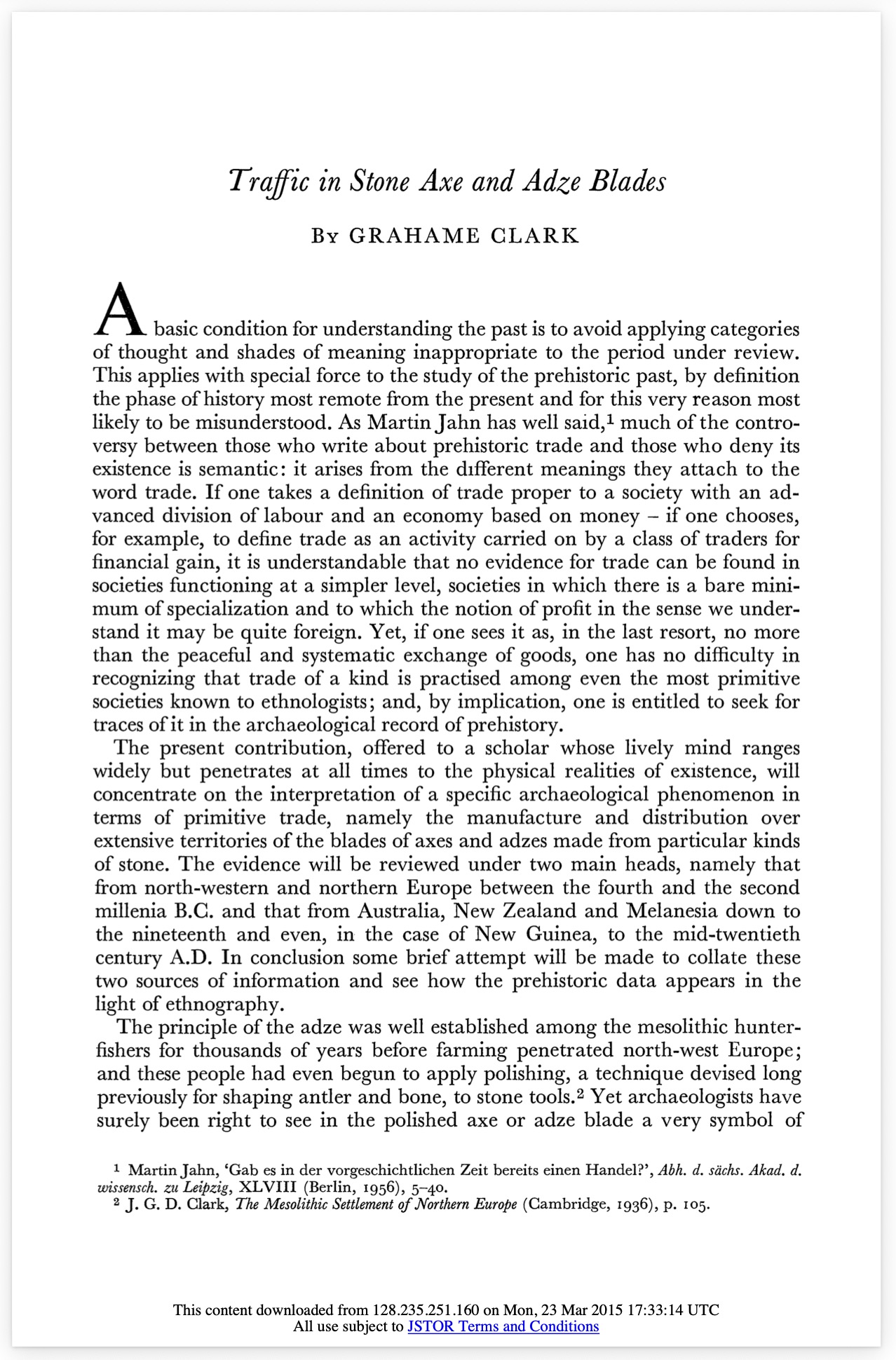
A basic condition for understanding the past is to avoid applying categories of thought and shades of meaning inappropriate to the period under review. This applies with special force to the study of the prehistoric past, by definition the phase of history most remote from the present and, for this very reason, most likely to be misunderstood. As Martin Jahn has well said, much of the controversy between those who write about prehistoric trade and those who deny its existence is semantic: it arises from the different meanings they attach to the word trade. If one takes a definition of trade proper to a society with an advanced division of labour and an economy based on money—if one chooses, for example, to define trade as an activity carried on by a class of traders for financial gain—it is understandable that no evidence for trade can be found in societies functioning at a simpler level, societies in which there is a bare minimum of specialization and to which the notion of profit, in the sense we understand it, may be quite foreign. Yet, if one sees it as, in the last resort, no more than the peaceful and systematic exchange of goods, one has no difficulty in recognizing that trade of a kind is practised among even the most primitive societies known to ethnologists; and, by implication, one is entitled to seek traces of it in the archaeological record of prehistory. The present contribution, offered to a scholar whose lively mind ranges widely but penetrates at all times to the physical realities of existence, will concentrate on the interpretation of a specific archaeological phenomenon in terms of primitive trade, namely the manufacture and distribution over extensive territories of the blades of axes and adzes made from particular kinds of stone. The evidence will be reviewed under two main headings: that from north-western and northern Europe between the fourth and second millennia B.C., and that from Australia, New Zealand, and Melanesia down to the nineteenth century, and even, in the case of New Guinea, to the mid-twentieth century A.D. In conclusion, some brief attempt will be made to collate these two sources of information and examine how the prehistoric data appear in the light of ethnography.