
Four Treasures Reference Database
Record No. 28556
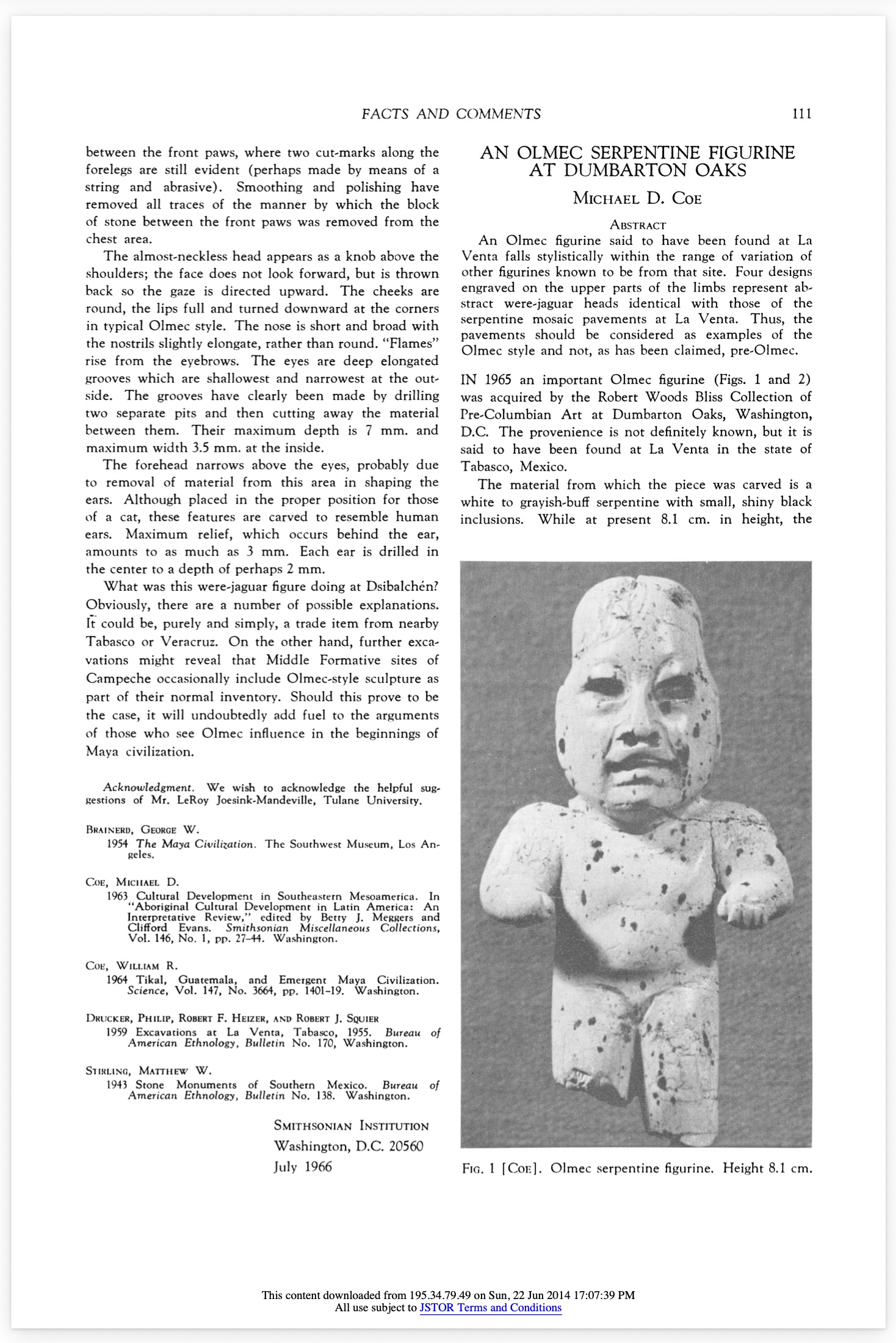
An Olmec serpentine figure at Dumbarton Oaks
Journal Article
Coe, M.D. (1967) An Olmec serpentine figure at Dumbarton Oaks. American Antiquity, Vol. 32, No. 1, pp. 11–113.
Close Abstract
Hide Keywords
Copy Reference
gems, jade, jadeite, fei cui, Mesoamerica, Mexico, Guatemala, Costa Rica, Mayans, Olmecs, Aztecs, archaeology, history, archaeogemology, Sahagun, codices, codex, serpentine
An Olmec figurine said to have been found at La Venta falls stylistically within the range of variation of other figurines known to be from that site. Four designs engraved on the upper parts of the limbs represent abstract were-jaguar heads identical with those of the serpentine mosaic pavements at La Venta. Thus, the pavements should be considered examples of the Olmec style and not, as has been claimed, pre-Olmec. In 1965 an important Olmec figurine (Figs. 1 and 2) was acquired by the Robert Woods Bliss Collection of Pre-Columbian Art at Dumbarton Oaks, Washington, D.C. The provenience is not definitely known, but it is said to have been found at La Venta in the state of Tabasco, Mexico. The material from which the piece was carved is a white to greyish-buff serpentine with small, shiny black inclusions. While presently 8.1 cm in height, the figurine had been broken in ancient times, so that one foot is missing, as well as the lower part of the other leg. There has been no restoration, although a recent break across the left shoulder and the chin has been repaired. The material, workmanship, and patination all testify to its authenticity.