
Four Treasures Reference Database
Record No. 28568
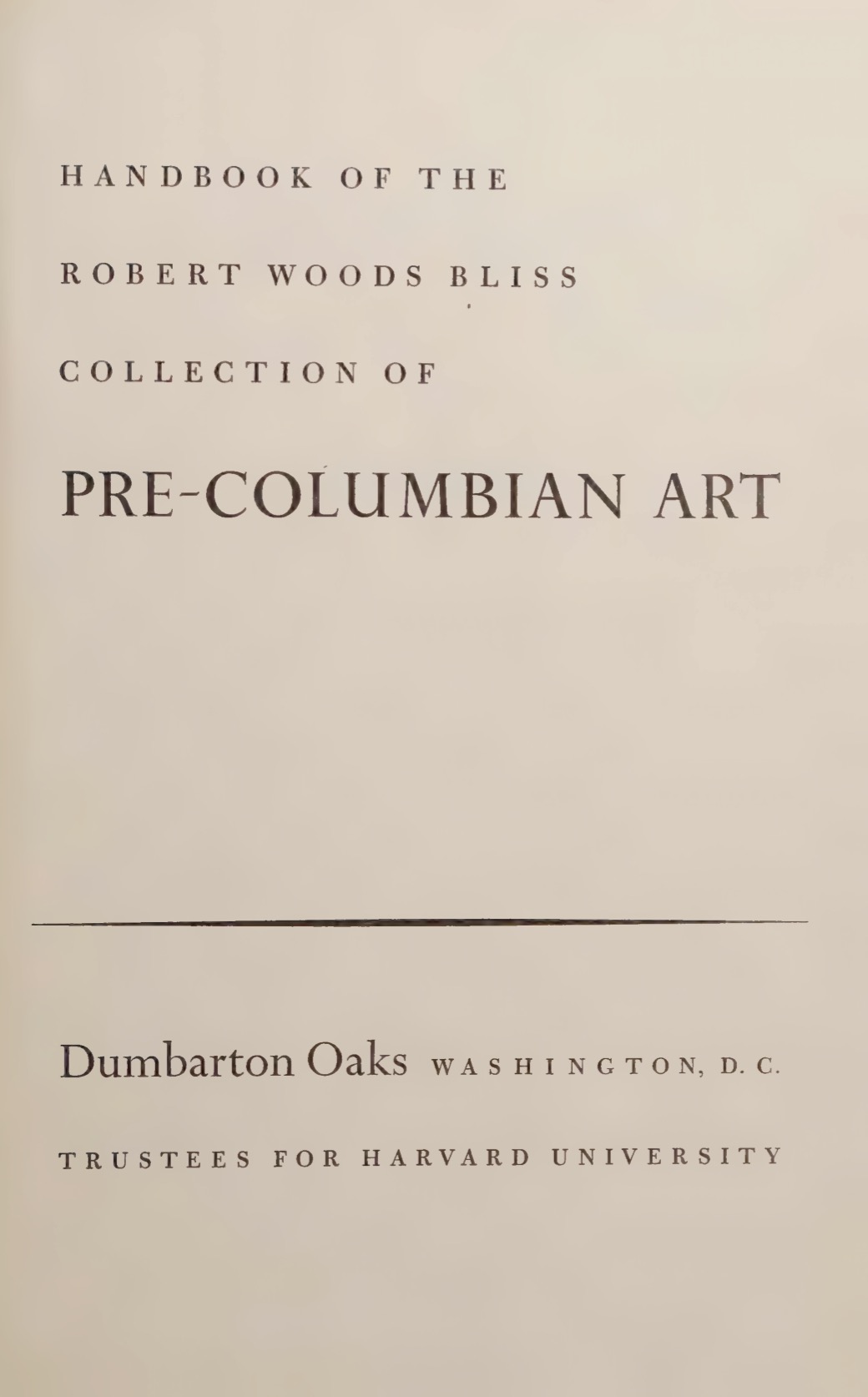
Handbook of the Robert Woods Bliss Collection of Pre-Columbian Art
Book
Thacher, J.S. and Coe, M.D. (1963) Handbook of the Robert Woods Bliss Collection of Pre-Columbian Art. Washington, DC, Dumbarton Oaks, 78 pp., many plates
Sinkankas/Born No.: NIS/NIB | RWHL
gems, jade, jadeite, fei cui, Mesoamerica, Mexico, Guatemala, Costa Rica, Mayans, Olmecs, Aztecs, archaeology, history, archaeogemology
Robert Woods Bliss’s Collection of Pre-Columbian Art was formed by the strong personal interest of a man deeply engaged in his subject. The Collection is most unusual in that its objects are not merely of archaeological interest but were chosen by Mr. Bliss for the intrinsic beauty of their craftsmanship and materials. Mr. Bliss’s first purchase was an Olmec sculpture in Paris in 1912 (Handbook no. 25). During the succeeding years, while he and Mrs. Bliss were forming their Byzantine Collection and establishing Dumbarton Oaks, Mr. Bliss also acquired pre-Columbian objects. He collected more intensively in the 1940s and 1950s, after Dumbarton Oaks had been conveyed to Harvard University, and continued to do so avidly until the time of his death in 1962. Mrs. Bliss always shared his interest in the Collection, and has recently added to it several objects which he no doubt would have selected himself. By the mid-forties, the Collection had assumed such importance as to be of public interest, and, in April 1947, it was placed on exhibition at the National Gallery of Art. There it remained, its size and area of installation expanding, until July 1962. Thus, during these sixteen years, many people were given the privilege of studying and enjoying the Collection. Mr. Bliss was eager to have the indigenous arts of the Americas represented permanently in the capital of this country. He made the happy decision to give his Collection to Dumbarton Oaks, and Philip Johnson was chosen to design a building for it. Mr. Johnson has created an original and beautiful setting where the objects are seen as works of art, arranged according to cultures. Except for the more recent accessions, largely generous gifts whose sources are noted in this handbook, the entire Collection was acquired by Mr. Bliss himself.