
Four Treasures Reference Database
Record No. 28578
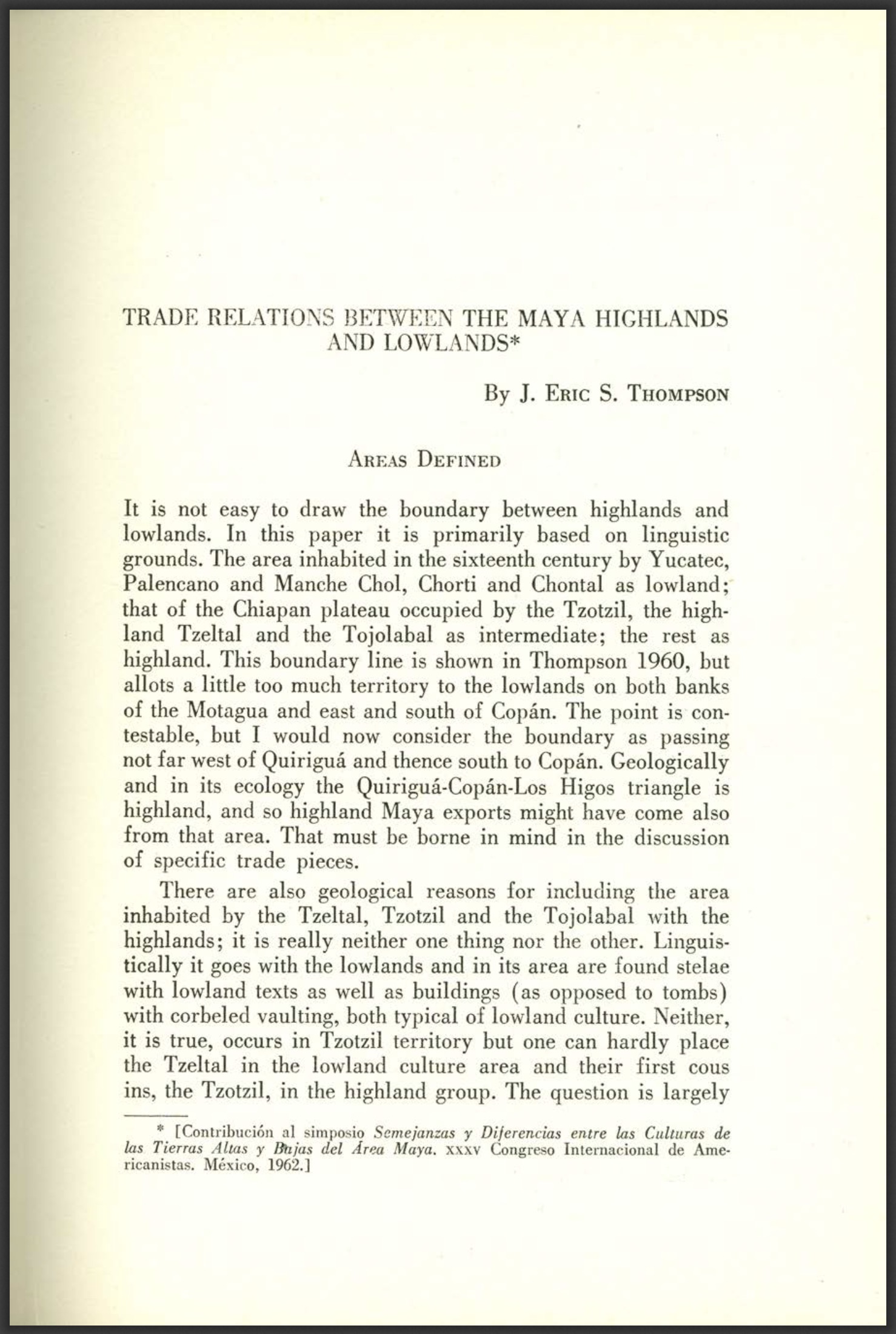
Trade relations between the Maya Highlands and Lowlands
Journal Article
Thompson, J.E.S. (1964) Trade relations between the Maya Highlands and Lowlands. Estudios de Cultura Maya, Vol. 4,, 23-Aug pp. 13–19.
gems, jade, jadeite, fei cui, Mesoamerica, Mexico, Guatemala, Costa Rica, Mayans, Olmecs, Aztecs, archaeology, history, archaeogemology
Jade, the most valued of all Maya products, is very scarce or does not occur in the Yucatán Peninsula. Foshag (1955, p. 11), in listing seven varieties of jade found in archaeological collections from Middle America, notes the intimate association of jade in situ with serpentine deposits and points out that they normally have an enveloping skin of albite in the process of conversion into jade. He observes that where there are deposits of serpentine there is a good possibility of finding jade, and lists the following known deposits: the Sierra de las Minas north of the middle Motagua, with an outlying spur south of San Agustín Acasaguastlán; the Sierra de Santa Cruz northwest of Lake Izabal; the Sierra de Chuacús in northern El Quiché north of the Río Negro and extending into adjacent Baja Verapaz; and a small area north of Huehuetenango. More recently, jade was actually found in situ near Manzanal in the Sierra de las Minas (Foshag and Leslie, 1955). Small deposits of serpentine are situated, according to Sapper, near Chimalapa in southern Chiapas, close to the Guatemala border. Of these areas—and it must be remembered that, except for Manzanal, jade had not been found anywhere; the rest were only potential sources—only the Sierra de Santa Cruz and perhaps the northeastern end of the Sierra de las Minas are in lowland territory. Whether there is jade in these two areas, and whether the Manche Chol who inhabited the region (they were called Toqueguas there but were of Chol speech) worked it if it existed there, are uncertainties. Pusilhá and Lubaantun, which were in Chol territory at the time of the Spanish conquest, have not shown much evidence of jade wealth, and the same is true of Quiriguá, which lies in territory probably occupied by the Chol in the sixteenth century. On the other hand, the relatively insignificant sites of Pomoná, Kendall, Camp 6, and the not very important Mountain Cow, to the east and west of the Maya Mountains in British Honduras, have yielded some very fine worked jades in the course of quite minor excavations. One is led to speculate whether there could be jade in that range.