
Four Treasures Reference Database
Record No. 28630
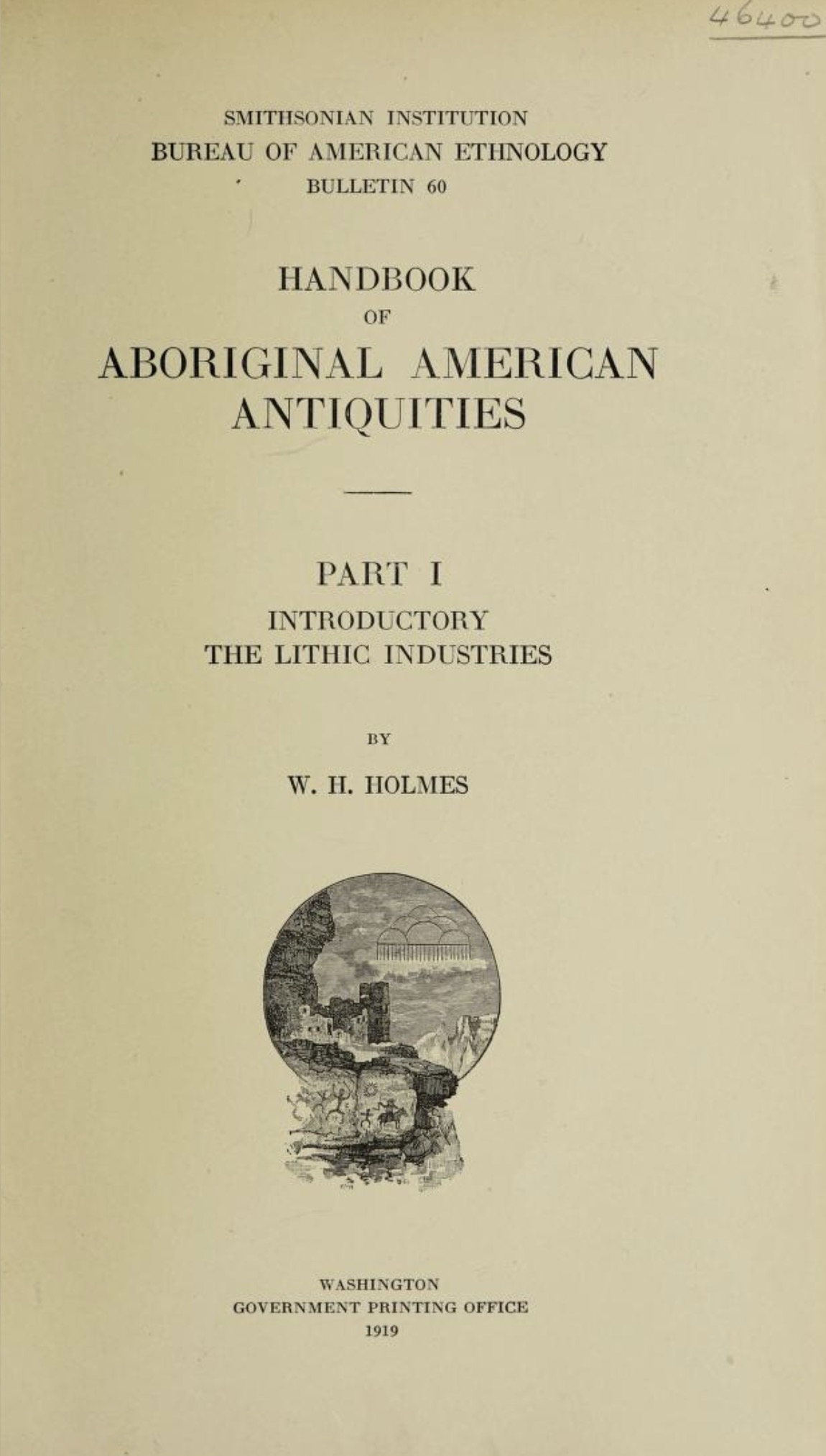
Handbook of Aboriginal American Antiquities, Part 1: Introductory, The Lithic Industries
Report
H., H.W. (1919) Handbook of Aboriginal American Antiquities, Part 1: Introductory, The Lithic Industries. Washington, DC: Bureau of American Ethnology, 380 pp.
Sinkankas/Born No.: NIS/NIB | RWHL*
gems, jade, fei cui, pyroxene jade, amphibole jade, nephrite, Alaska, Canada, Washington State, California, lapidary, jasper, quartz, chalcedony, greenstone, turquoise, Mexico, Guatemala, Costa Rica, Honduras
THE present work forms one of the series of handbooks of the Bureau of American Ethnology, which was conceived as the natural and necessary outgrowth of the Handbook of American Indians (Bulletin 30), a comprehensive treatise completed and sent to press while the writer was Chief of the Bureau. It was planned to have a series of at least 12 separate handbooks which should cover as many grand divisions of the subject matter embodied in brief form in Bulletin 30. The first of this series to be submitted for publication was the Handbook of American Indian Languages (Bulletin 40), Part 1, and the second, the present memoir, the Handbook of American Antiquities. This work is not designed as a formal presentation of American archaeology in which the antiquities are described and discussed country by country, or region by region, in geographical sequence, but rather as a reference work or manual, the principal purpose of which is to assemble and present the antiquities of the continent in such a manner and order as to make them readily available to the student who shall undertake to present a comprehensive view of the evolution of culture among men. The present volume is, in large measure, introductory to the systematic presentation of the antiquities; it deals with the scope of archaeological science, the character, extent, and classification of its subject matter, the progress of research; with the several important problems which present themselves for solution, including those of race origin, migrations, culture evolution, and chronology; with the ethnic characterization areas; with the acquirement of the substances employed in the arts; and finally with the manipulation of stone. [Note: Part 2 was never published]