
Four Treasures Reference Database
Record No. 28688
The Cleveland Plaque: Cloudy places of the Maya realm
Book Section
Stone, A. (1996) The Cleveland Plaque: Cloudy places of the Maya realm. In: Eighth Palenque Round Table, San Francisco: Pre-Columbian Art Research Institute, pp. 1–10.
Sinkankas/Born No.: NIS/NIB | RWHL
gems, jade, jadeite, fei cui, Mesoamerica, Mexico, Guatemala, Costa Rica, Mayans, Olmecs, Aztecs, archaeology, history, archaeogemology, Pre-Columbian jade; Costa Rica; Maya; exchange; iconography, lapidary
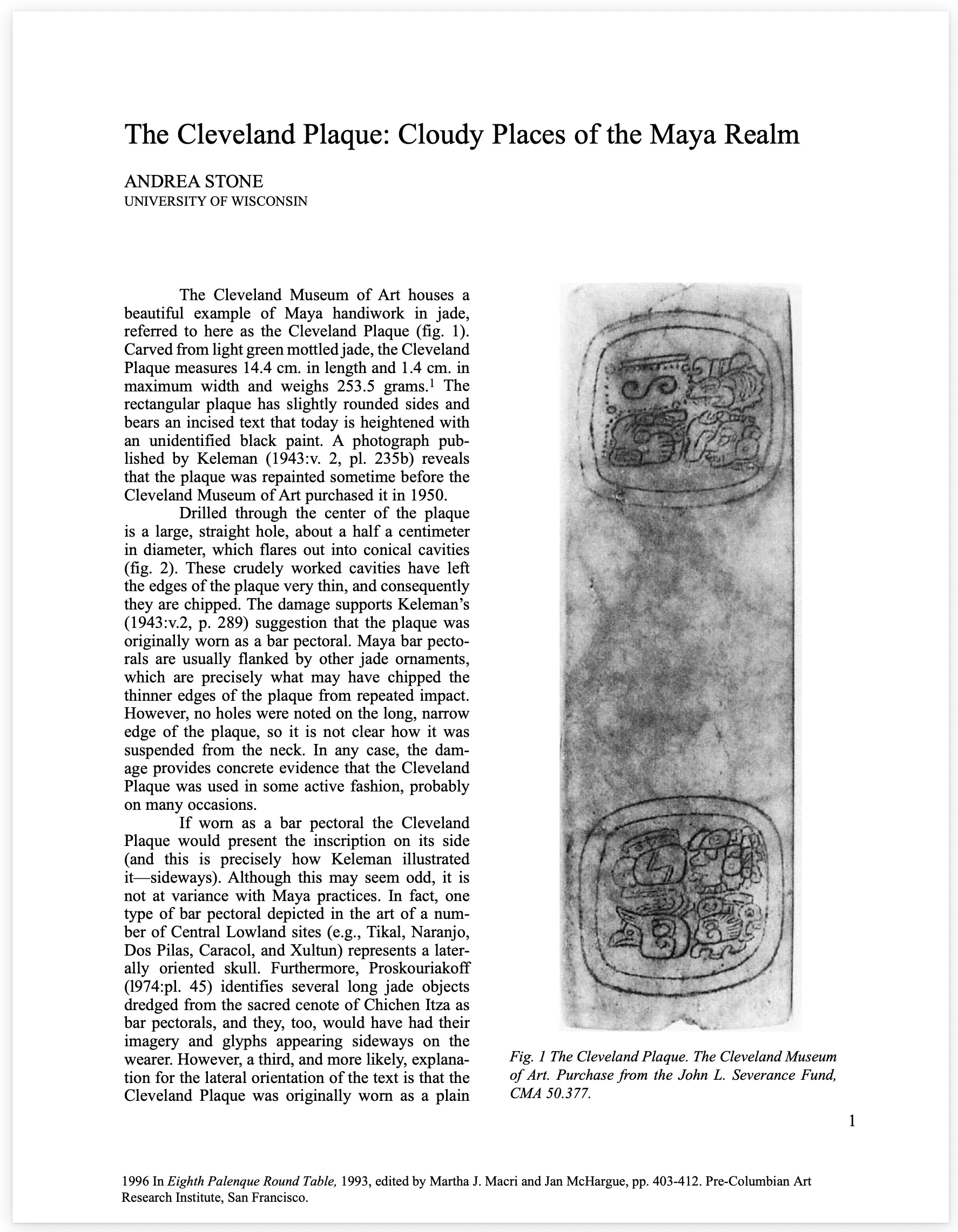
The Cleveland Museum of Art houses a beautiful example of Maya handiwork in jade, referred to here as the Cleveland Plaque (fig. 1). Carved from light green mottled jade, the Cleveland Plaque measures 14.4 cm in length and 1.4 cm in maximum width and weighs 253.5 grams. The rectangular plaque has slightly rounded sides and bears an incised text that today is highlighted with an unidentified black paint. A photograph published by Kelemen (1943: vol. 2, pl. 235b) reveals that the plaque was repainted sometime before the Cleveland Museum of Art purchased it in 1950. Drilled through the centre of the plaque is a large, straight hole, about half a centimetre in diameter, which flares out into conical cavities (fig. 2). These crudely worked cavities have left the edges of the plaque very thin, and consequently they are chipped. The damage supports Kelemen’s (1943: vol. 2, p. 289) suggestion that the plaque was originally worn as a bar pectoral. Maya bar pectorals are usually flanked by other jade ornaments, which are precisely what may have chipped the thinner edges of the plaque through repeated impact. However, no holes were noted on the long, narrow edge of the plaque, so it is not clear how it was suspended from the neck. In any case, the damage provides concrete evidence that the Cleveland Plaque was used in some active fashion, probably on many occasions.