
Four Treasures Reference Database
Record No. 28715
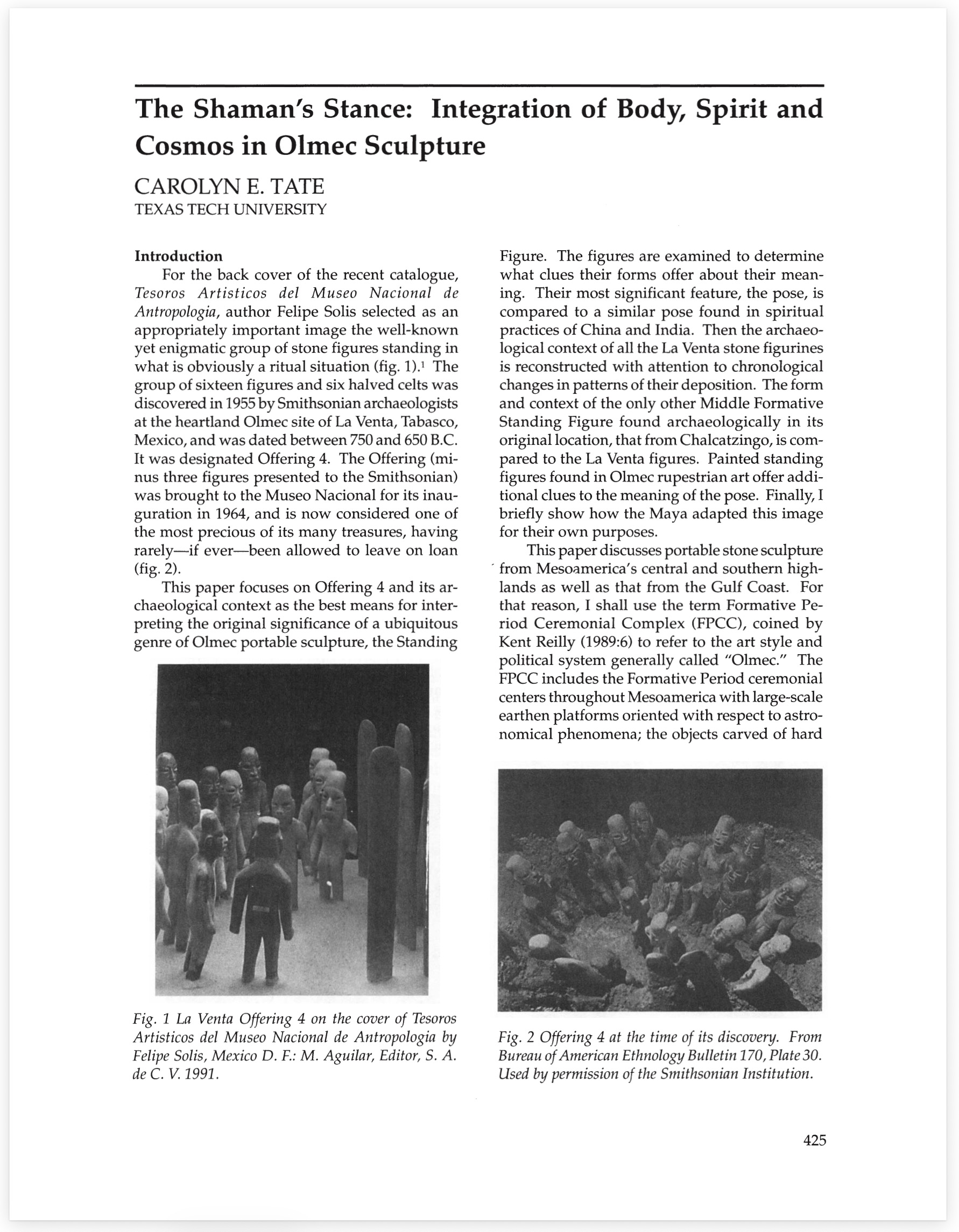
The shaman's stance: Integration of body, spirit and cosmos in Olmec sculpture
Book Section
Tate, C.E. (1996) The shaman's stance: Integration of body, spirit and cosmos in Olmec sculpture. In: Eighth Palenque Round Table, 1993, San Francisco: Pre-Columbian Art Research Institute, pp. 425–439.
ISBN/ISSN: 093405102X | Sinkankas/Born No.: NIS / NIB | RWHL
gems, jade, jadeite, fei cui, Mesoamerica, Mexico, Guatemala, Costa Rica, Mayans, Olmecs, Aztecs, archaeology, history, archaeogemology, Pre-Columbian jade; Costa Rica; Maya; exchange; iconography, lapidary
For the back cover of the recent catalogue, Tesoros Artisticos del Museo Nacional de Antropologia, author Felipe Solis selected as an appropriately important image the well-known yet enigmatic group of stone figures standing in what is obviously a ritual situation (fig. 1).1 The group of sixteen figures and six halved celts was discovered in 1955 by Smithsonian archaeologists at the heartland Olmec site of La Venta, Tabasco, Mexico, and was dated between 750 and 650 B.C. It was designated Offering 4. The Offering (minus three figures presented to the Smithsonian) was brought to the Museo Nacional for its inauguration in 1964, and is now considered one of the most precious of its many treasures, having rarely-if ever-been allowed to leave on loan (fig. 2). This paper focuses on Offering 4 and its archaeological context as the best means for interpreting the original significance of a ubiquitous genre of Olmec portable sculpture, the Standing Figure.