
Four Treasures Reference Database
Record No. 28763
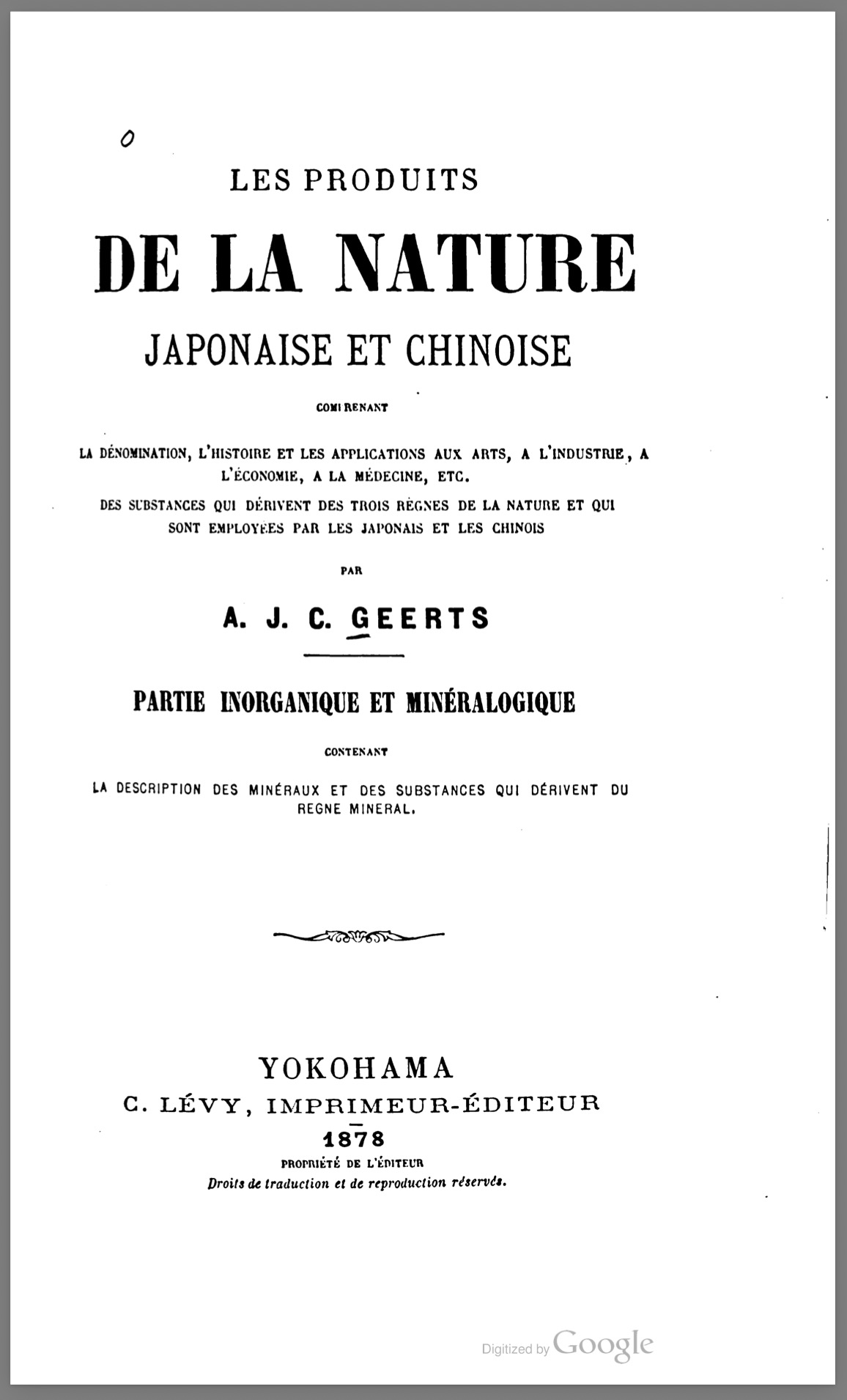
Les Produits de la Nature Japonaise et Chinese Comprenant la Dénomination, l'Histoire et les Applications aux Arts, a l'Industrie, a l'Economie, a la Médecine, etc.
Book
Geerts, A.J.C. (1878, 1883) Les Produits de la Nature Japonaise et Chinese Comprenant la Dénomination, l'Histoire et les Applications aux Arts, a l'Industrie, a l'Economie, a la Médecine, etc. Yokohama, C. Lévy, 2 Vols.
Sinkankas/Born No.: 2327; NIB | RWHL*
gems, jade, China, Chinese jade carving, Chinese lapidary arts, quartz, amethyst, smoky quartz, aventurine
The first of two separately published parts dealing with the mineral products employed by the Japanese and Chinese in older, traditional arts and industries; they are considered highly important sources of authentic information and were much referenced in later publications. In the large section on carbon, diamond finds a place on pages 201–203, and here Geerts gives its names in phonetic equivalents as well as in the native ideographs, then cites authorities for the same and gives a discussion of its uses by the Japanese and the Chinese. In similar manner, under the heading of “Silicium,” he gives crystalline and cryptocrystalline varieties of quartz, pp. 241–247, including rock crystal, sagenite, smoky quartz, amethyst, rose quartz, citrine, cat’s-eye quartz, aventurine, and others, as well as numerous varieties of chalcedony, and at the end includes opal. An appendix to this section, pp. 272–294, describes prehistoric stone implements and weapon points, including objects meant for personal adornment or as talismans. The plates depict recovery of arsenic, charcoal-burning, making soot, weapon points, implements, tools, and other stone objects. The last plate is a part-colored folding map of Japan showing the major mining districts, with colored spots indicating the minerals obtained. This part contains alabaster-gypsum, p. 329; marbles, pp. 332–335; ruby, pp. 358–362; obsidian, pp. 413–414; garnets, pp. 421–424; tourmaline, pp. 424–425; serpentines and steatites, pp. 434–440, including agalmatolite; meerschaum, p. 441; and ophitic serpentines, pp. 441–445. In the section entitled “Pierres précieuses,” pp. 452–482, appear discussions of jade varieties, including properties, use in medicines, etc., also red coral, several uncertainly identified stones, topaz, emerald, aquamarine, zircon, and sapphire. This work is cited and commented upon by Laufer in his Sino-Iranica (1919) and his treatises on turquoise and diamond; see also F. de Mély and M. H. Courcel, Les Lapidaires de l’Antiquité et du Moyen Âge, I, Lapidaires Chinois, especially in connection with a Chinese-Japanese encyclopedia containing a lapidary, reproduced in its original form in that volume along with translation and commentaries. Gemstones are discussed on pp. 178–188.