
Four Treasures Reference Database
Record No. 28779
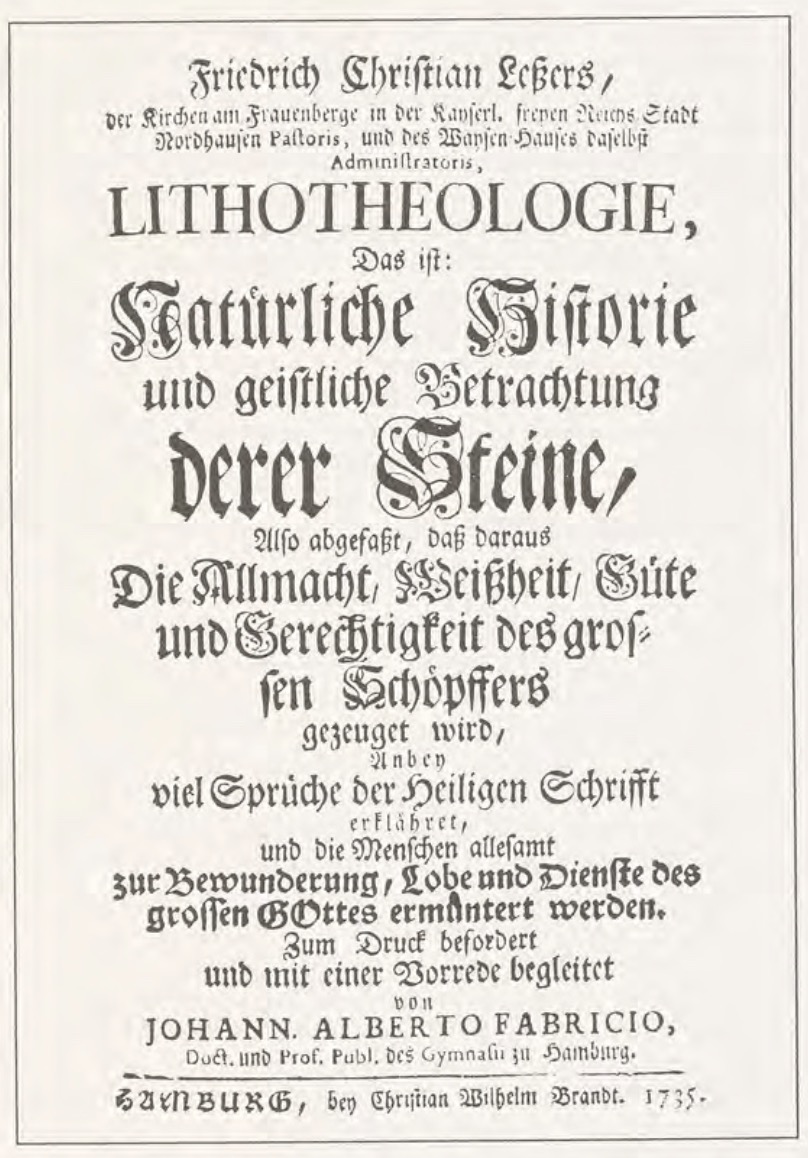
Lithotheologie, Das ist: Natürliche Historie und geistliche Betrachtung derer Steine, also abgefasst, dass daraus die Allmacht, Weisheit, Güte und Gerechtigkeit des grossen Schöpffers gezeuget wird, anbey viel Sprüche der Heiligen Schrifft erklähret und die Menschen allesamt zur Bewunderung, Lobe und Dienste des grossen Gottes ermuntert werden.
Lithotheologic, that is: Natural history and spiritual contemplation of stones, composed in such a way that from them the omnipotence, wisdom, goodness, and justice of the great Creator are demonstrated; together with explanations of many passages of Holy Scripture, and an exhortation to all mankind to admiration, praise, and service of the great God
Book
Lesser, F.C. (1735) Lithotheologie, Das ist: Natürliche Historie und geistliche Betrachtung derer Steine, also abgefasst, dass daraus die Allmacht, Weisheit, Güte und Gerechtigkeit des grossen Schöpffers gezeuget wird, anbey viel Sprüche der Heiligen Schrifft erklähret und die Menschen allesamt zur Bewunderung, Lobe und Dienste des grossen Gottes ermuntert werden. [Lithotheologic, that is: Natural history and spiritual contemplation of stones, composed in such a way that from them the omnipotence, wisdom, goodness, and justice of the great Creator are demonstrated; together with explanations of many passages of Holy Scripture, and an exhortation to all mankind to admiration, praise, and service of the great God] Hamburg, Christian Wilhelm, 1300 pp.
Sinkankas/Born No.: 3904 | Language: in German | RWHL
Close Abstract
Hide Keywords
Copy Reference
gems, history of gemology, diamond, garnet, ruby, sapphire, emerald, pearl, high priest's breastplate, jade, lapis lazuli, jasper, malachite
Sinkankas: Utterly fascinating work in great detail and complexity, attempting to demonstrate the hand of God in every manifestation of the mineral kingdom. Lesser assembled an astounding fund of information culled from hundreds of ancient and modern sources and covering nearly every aspect of geology, mineralogy, paleontology, and gemology. So successful was he, and apparently so careful in his choices and interpretations, that the present work was very commonly quoted by later writers in earth sciences and mineralogy. It is divided into nine books, each with several parts and chapters. Book one explains fundamental interrelationships existing among the lithosphere, atmosphere, hydrosphere, and biosphere. Book two concerns the origin and formation of rocks and minerals. Book three treats occurrences or deposits of mineral materials, including gemstones. Book four discusses the properties of minerals and stones. Book five addresses “precious” and “non-precious” stones, with pp. 343–66 treating precious stones, though restricted to a limited number of the better-known species and varieties, the stones themselves being apportioned among transparent, translucent, and opaque kinds, i.e., diamond, ruby, garnet, hyacinth, sapphire, amethyst, emerald, topaz, opal, and chrysolite as transparent stones, and translucent stones such as carnelian, sard, and other varieties of chalcedony; opaque stones include turquoise, malachite, jasper, lapis lazuli, and jade. This book also contains descriptions of some famous diamonds and other large and valuable gems, as well as data on the precious stones mentioned in the Bible. Also among the stones in this book are those that display remarkable inclusions, fanciful portraits or scenes, fossils, and crystals, and other curious, if not marvelous, mineral materials. Book six treats architectural and monumental stones, and also includes brief discussions of engraved gems, seals, and ringstones, with pp. 832–46 describing and speculating on the true identities of the gemstones in the vestments and breastplate of the High Priest, suitably illustrated with diagrams showing their positions and identities. Book seven concerns the misuse of stones, ostentatious display of gemstones, superstitious belief in their powers, the use of birthstones and planetary stones, and other topics of this nature. Book eight treats artificial stones of all kinds, including gemstones. Book nine concerns “works of wonder” in stone, e.g., Lot’s wife turned into a pillar of salt!