
Four Treasures Reference Database
Record No. 28816
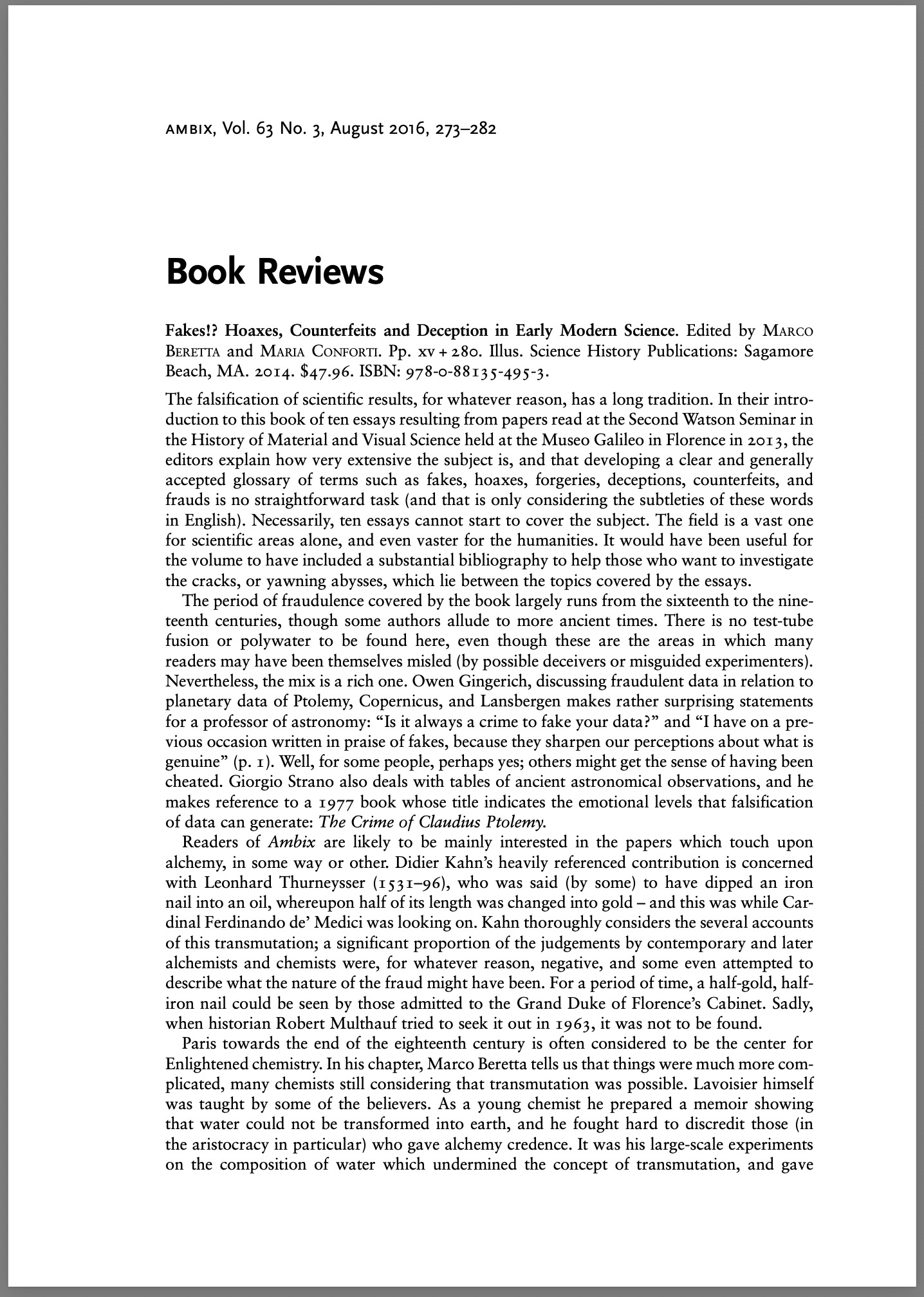
Review: Fakes!? Hoaxes, counterfeits and deception in Early Modern science
Journal Article
Anderson, R.G.W. (2016) Review: Fakes!? Hoaxes, counterfeits and deception in Early Modern science. Ambix, Vol. 63, No. 3, pp. 273–274.
ISBN/ISSN: 0002-6980 | DOI: https://doi.org/10.1080/00026980.2016.1246806 | Sinkankas/Born No.: NIS/NIB | RWHL
gems, fake gems, forgery, counterfeit, deception
The falsification of scientific results, for whatever reason, has a long tradition. In their introduction to this book of ten essays, derived from papers presented at the Second Watson Seminar in the History of Material and Visual Science held at Museo Galileo in 2013, the editors explain how extensive the subject is and how difficult it is to develop a clear and generally accepted glossary for terms such as fakes, hoaxes, forgeries, deceptions, counterfeits, and frauds—and that challenge exists even when considering only the subtleties of these words in English. Necessarily, ten essays can only begin to address such a vast field. Scientific fraud alone encompasses an enormous range of topics, and the humanities broaden it still further. It would have been useful if the volume had included a substantial bibliography to guide readers wishing to explore the cracks—or yawning abysses—between the subjects covered by the essays. The period examined in the book runs largely from the sixteenth through the nineteenth centuries, though some authors refer to more ancient precedents. Readers will not find modern scientific scandals such as test-tube fusion or polywater here, despite the fact that many may themselves have been misled by such episodes, whether through deliberate deception or misguided experimentation. Nevertheless, the collection is rich and varied. Owen Gingerich, discussing fraudulent data in relation to the planetary observations of Claudius Ptolemy, Nicolaus Copernicus, and Philipp van Lansberge, makes the rather surprising statements, “Is it always a crime to fake your data?” and “I have on a previous occasion written in praise of fakes, because they sharpen our perceptions about what is genuine” (p. 1). For some readers this may seem defensible; for others, it may simply reinforce the feeling of having been cheated. Giorgio Strano likewise examines ancient astronomical tables and refers to a 1977 work whose title itself reveals the emotional intensity provoked by scientific falsification: The Crime of Claudius Ptolemy.