
Four Treasures Reference Database
Record No. 28842
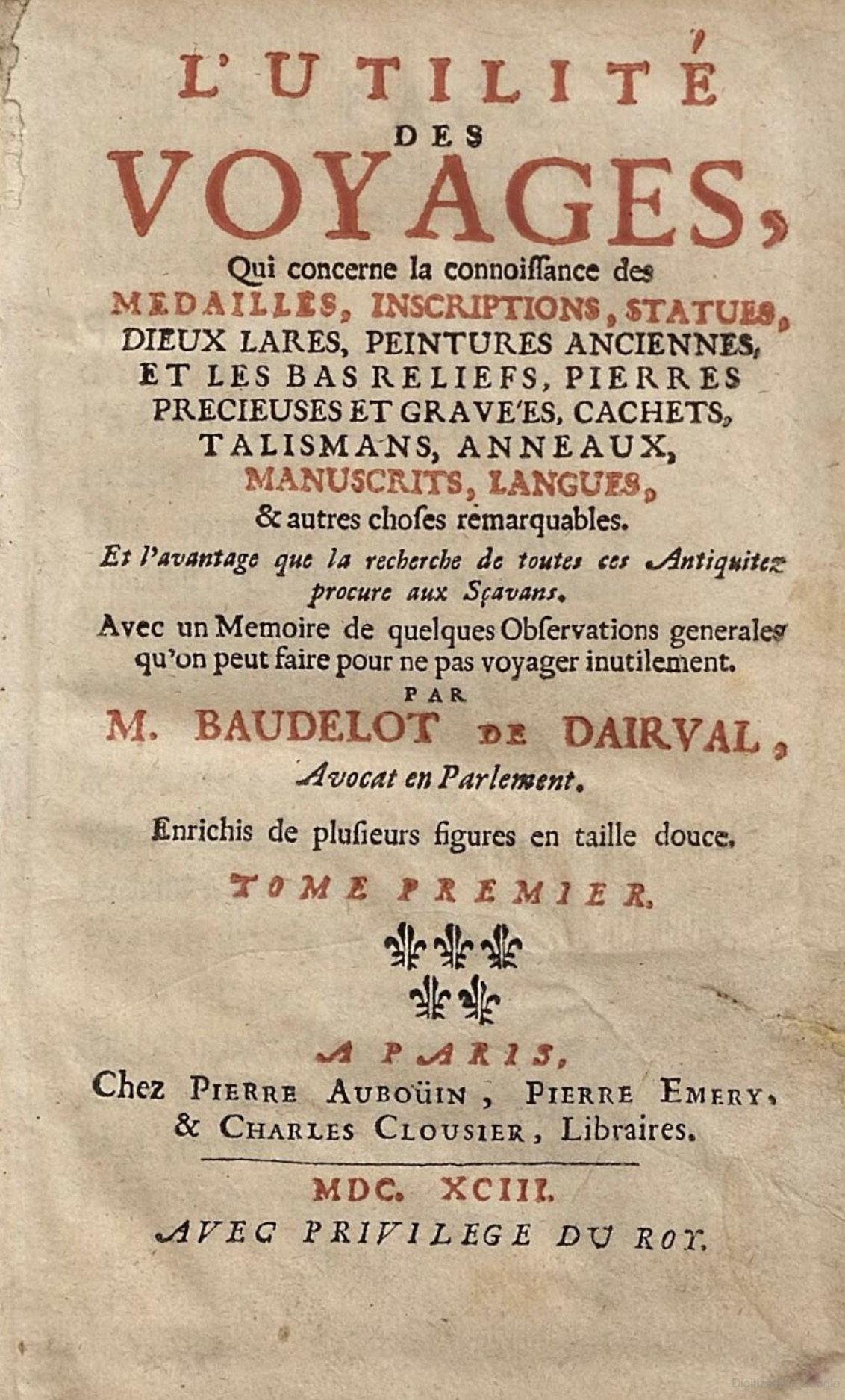
L' utilité des voyages qui concerne la connoissance des medailles, inscriptions, statues, dieux lares, peintures anciennes et les bas reliefs, pierres precieuses et gravées, cachets, talismans, anneaux, manuscrits, langues ... et l'avantage que la recherche de toutes ces antiquitez procure aux sçavans
The usefulness of travel as it concerns the knowledge of medals, inscriptions, statues, household gods, ancient paintings and bas-reliefs, precious and engraved stones, seals, talismans, rings, manuscripts, languages … and the advantage that the study of all these antiquities affords to scholars.
Book
Baudelot De Dairval, C.C. (1686) L' utilité des voyages qui concerne la connoissance des medailles, inscriptions, statues, dieux lares, peintures anciennes et les bas reliefs, pierres precieuses et gravées, cachets, talismans, anneaux, manuscrits, langues ... et l'avantage que la recherche de toutes ces antiquitez procure aux sçavans. [The usefulness of travel as it concerns the knowledge of medals, inscriptions, statues, household gods, ancient paintings and bas-reliefs, precious and engraved stones, seals, talismans, rings, manuscripts, languages … and the advantage that the study of all these antiquities affords to scholars.] Paris, Pierre Aubouin, Pierre Emery, & Charles Clousier, 374 pp.
Sinkankas/Born No.: 451–452; NIB | Language: in French | RWHL
gems, glyptic, engraved gems, agate, cameo, intaglio, antique gems, jewelry, rings, history of gems, travel, ancient history, coins, numismatics,
Sinkankas: Vol. I is especially replete with every typographical error imaginable: mispaginations, mis-signings, page and signature number duplications, inversions, misspellings, etc.; the errata leaves only begin to sample the rich resources of error. Essays on the theme that antiquities obtained through travel in historical lands increase and preserve our knowledge of ancient cultures. Volume one opens with a long discourse on the travels of ancient writers who recorded their experiences and thus preserved what they saw for succeeding generations. This essay occupies 15 chapters and is liberally studded with quotations from such accounts. Next are short essays on researches in medals, inscriptions, statuary, a passage in Seneca, Lares figures, paintings and bas-reliefs, a commentary on archaeology in general, architecture, engraved gems (pp. 293–349), various types of antiquities and the collections in which they are preserved, the cabinet of the King of France, and an appendix of remarks on the foregoing sections. The second volume begins with an essay on talismans (pp. 361–401), followed by short essays on medals, coins, coinage metals, and a long section of advice to would-be travelers. To gemologists, the extended remarks on engraved gems in the first volume, and to a lesser degree the remarks on talismans in the second volume, will prove useful and informative. Engraved gems are treated according to their uses as seals, in jewelry, as wards or talismans, as religious symbols, e.g. Gnosticism, as fertility and health aids, etc., with closing remarks on the selection and purchase of engraved gems. Mariette, Traité des Pierres Gravées, I, 1750, pp. 258–60, provides a detailed analysis; see also Zazoff, Gemmensammler, p. 33. Several engraved gems attracted the attention of Goodland, Biblio Sex Rites, p. 39; see also Furtwängler, Antiken Gemmen, III, p. 407. 1693 Edition: Entirely reset; engraved titles added; previous errors largely eliminated; the “additions” of the previous edition now incorporated into the text; on the whole, a much more workmanlike edition.