
Four Treasures Reference Database
Record No. 28880
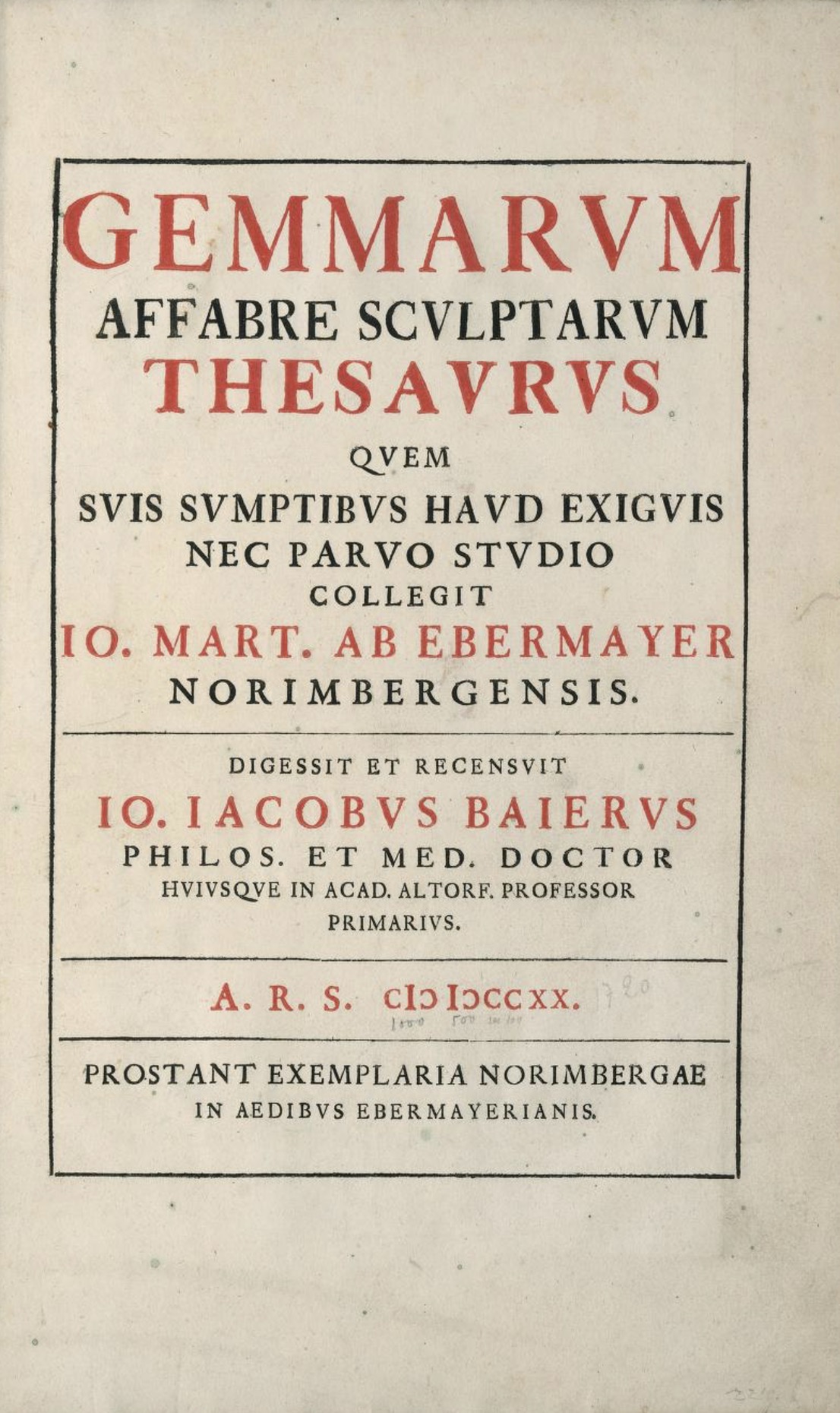
Gemmarum Affabre Sculptarum Thesaurus
Treasury of Skillfully Engraved Gems
Book
Ebermayer, J.M. (1720) Gemmarum Affabre Sculptarum Thesaurus. [Treasury of Skillfully Engraved Gems] Nuremberg, In aedibus Ebermayerianis, 46 pp.
Sinkankas/Born No.: 1846 | Language: in Latin | RWHL
gems, glyptic, engraved gems, agate, cameo, intaglio, shell, ancient gems, Rome, Greece, ancient jewelry, rings
Sinkankas: The valuable descriptive catalogue of the engraved gem collection formed by Ebermayer, about whom little important information appears to be known. The large and impressive portrait plate, by C. D. Heumann of Nuremberg, depicts Ebermayer together with two medallions and a laudatory plaque in addition to the central oval frame containing his name and birth date; Ebermayer is shown as a bust upon a pedestal. The dedication is to Ludwig Rudolph, Duke of Brunswick and Lüneburg. Following the preface is a large folding plate of an elaborately carved cabinet, then plates of engraved gems inserted at appropriate points in the text. Of particular interest are the engraved plates appearing singly or in pairs on the versos of 22 leaves and paged only on the printed sides. These are exquisitely engraved, but the richness of detail suggests that much was supplied by the artist and engraver in order to make more impressive what may originally have been rather plain gems. Above each enlarged depiction appears a plain, or sometimes elaborately jeweled, mount in which the gem was set; these seem to be shown at actual size and give, in the center, the name of the gem material. The work was strongly condemned by Mariette, Traité des pierres gravées, 1, pp. 310–312, who claimed the collection was formed from gems newly engraved in Germany after known prints, specially designed compositions for the cabinet, designs copied from medals, and numerous gems imitating authentic antique stones. He ridiculed Baier’s statement that these gems compared favorably with the antiques. Vinet followed Mariette in scathingly denouncing the work (no. 1614) as “without value” and a “veritable imposture.” C. W. King, Antique Gems and Rings, 1, 1872, pp. 463–464, while noting that the text was “unmercifully censured by Mariette, who attributes the originals, one and all, to Dorsch himself,” nevertheless observed that “many of the plates are not without merit, and now have a special interest from exhibiting the elegant Renaissance settings in which most of the larger pieces were then mounted.” Furtwängler, Die antiken Gemmen, 3, p. 409, states that the gems were literally mass-produced to order by the Nuremberg gem-cutter Christoph Dorsch (1676–1732), and that the collection was later sold to the King of Portugal. Cicognara, 2741; Zazoff, Gemmensammler, pp. 106–110 passim.