
Four Treasures Reference Database
Record No. 28882
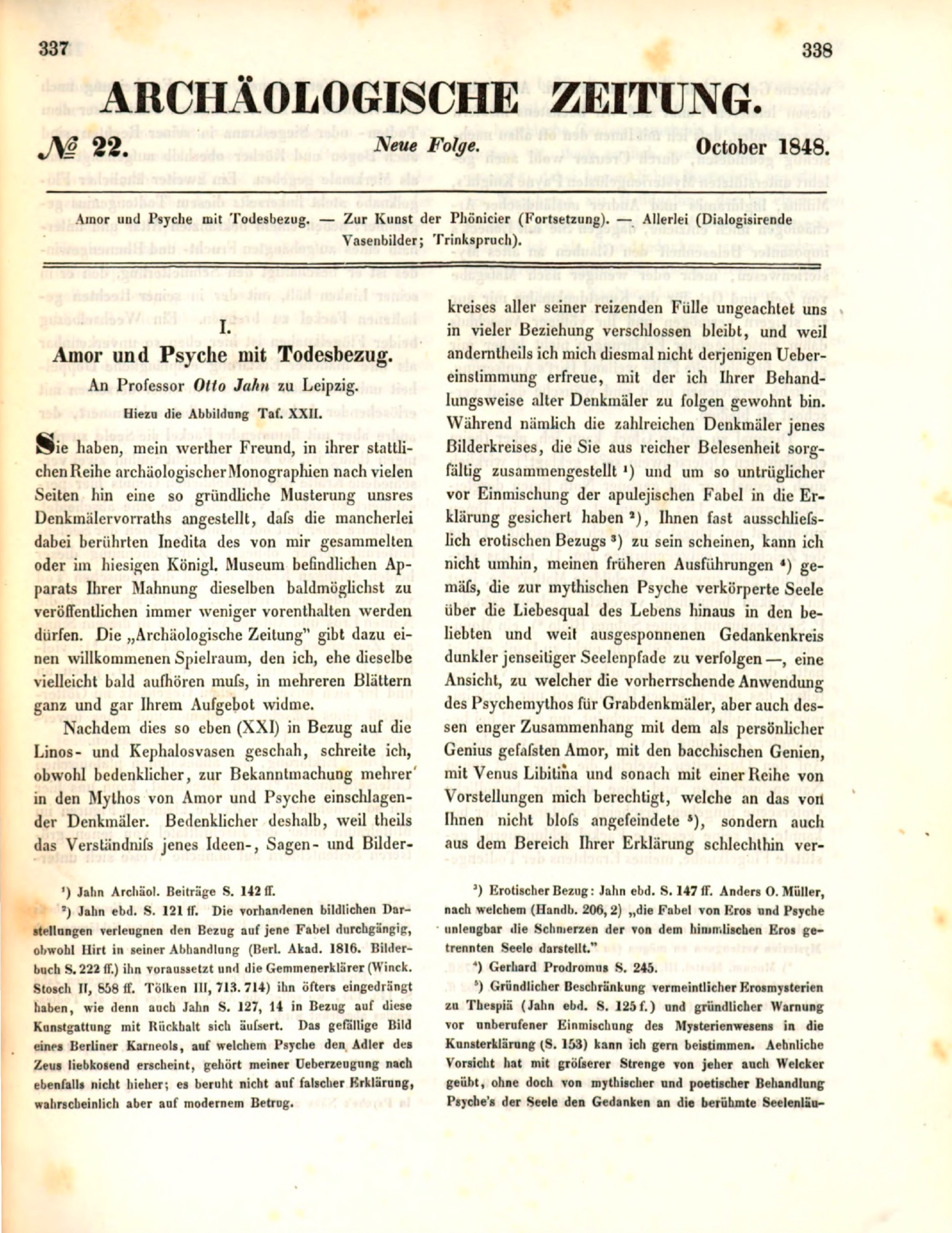
Amor und Psyche mit Todesbezug
Cupid and Psyche in Relation to Death
Journal Article
Jahn, O. (1848) Amor und Psyche mit Todesbezug. [Cupid and Psyche in Relation to Death] Archäologische Zeitung, Vol. 6, No. 22, October, pp. 337–345.
Sinkankas/Born No.: NIS/NIB | Language: in German | RWHL
gems, glyptic, engraved gems, agate, cameo, intaglio, shell, ancient gems, Rome, Greece, ancient jewelry, rings
You, my esteemed friend, have in your imposing series of archaeological monographs carried out so thorough a survey of our store of monuments in so many directions that the various unpublished pieces thereby touched upon, whether from the material collected by myself or preserved in the Royal Museum here, can less and less be withheld from publication despite your urging that they appear as soon as possible. The Archäologische Zeitung offers a welcome opportunity for this, and before it perhaps soon ceases publication, I shall devote several papers entirely and wholly to your request. Having thus just done so (XI) with regard to the Unos and Kephalos vases, I proceed, though with greater hesitation, to the publication of several monuments relating to the mythos of Amor and Psyche. More hesitation is warranted because, on the one hand, the understanding of that circle of ideas, legends, and images, despite all its enchanting richness, remains closed to us in many respects; and because, on the other hand, I do not this time enjoy that agreement with your mode of treating ancient monuments which I have long been accustomed to follow. For while the numerous monuments of that cycle of imagery, which you have carefully assembled from wide reading and which you have all the more securely protected against the intrusion of the Apuleian fable into their interpretation, seem to you to be almost exclusively erotic in reference, I cannot refrain, in accordance with my earlier discussions, from following the soul embodied as the mythical Psyche beyond the torments of earthly love into the popular and widely extended realm of dark pathways of the soul in the afterlife. I am justified in this view by the predominant use of the Psyche myth on funerary monuments, but also by its close connection with Amor conceived as a personal genius, with the Bacchic genii, with Venus Libitina, and consequently with a whole series of conceptions which touch upon the domain of all mysteries — a domain not merely attacked by you, but wholly excluded from the sphere of your interpretation. Even on this latter point we are at most agreed insofar as, together with you, I reject the often overly indulgent “mystery cravings” of Payne Knight, Millin, Inghirami, and other foreign archaeologists, tendencies which Creuzer also supported with considerable learning. Yet, on the other hand, Lobeck’s imposing erudition only strengthens for me the belief in the existence of ancient mystery cults, to a greater or lesser extent according to time and place, in relation to works of art. Your complete exclusion of interpretations touching upon this field carries no greater weight with me than Hirt’s former remark in similar cases: that he did not like such things and wished to be spared them.